After all people don't have access to PCs or Kinkos (unless it means signing up for social welfare payments).Once again, you are referencing polling on Voter ID as a standalone policy, NOT the SAVE Act voter suppression bill.
Trump Administration Updates
- Thread starter TigerGrowls
- Start date
You are using an out of date browser. It may not display this or other websites correctly.
You should upgrade or use an alternative browser.
You should upgrade or use an alternative browser.

It doesn't matter if you have access to either or both, you still have to re-register IN PERSON after you receive your birth certificate/passport/marriage license.After all people don't have access to PCs or Kinkos (unless it means signing up for social welfare payments).
This applies to anyone whose last name doesn't match their birth certificate, new registrants and anyone who has moved. This could apply to as many as 100 million people, which guarantees that millions won't have completed this in time for the mid-terms.
There also won't be enough time to implement the Act in all election jurisdictions in the next 60 days, but that's probably the point because it will drastically cut down on the numbers of voters and will create chaos at the polls, which will lead to mistakes. Based on what we know about this administration, that will be all they need to call the election invalid and possibly seize ballots and voting machines.

Trump is in New Jersey this weekend and he’s not playing.
He’s telling Republicans: Approve Todd Blanche as AG or he stays acting AG and we push the anti-weaponization bill hard.
Cornyn and Tillis wanted guarantees in writing before voting. Trump isn’t blinking.
And the SAVE America Act? A group of Republican senators are now telling John Thune: Cancel recess. Pass it. No more delays.
Proof of citizenship to register to vote. Period.
The usual suspects are already screaming. Cory Booker claims it wouldn’t have stopped the 6,600 non-citizens registered in New Jersey.
States should handle elections. When laws are broken, prosecute. But let’s stop pretending this is complicated.
Senate is days from recess. Major items still open.
Trump is applying pressure.
Stay locked in. This week matters.
I agree, what's unique is that when you do the math and right now, without higher taxes on everyone, the numbers don't work, those pushing for a Medicare for all solution are expecting their own costs to go down. Sounds just like the ACA solution..more people, more demand, more benefits and costs come down. Somehow that never seems to work.I agree 100%. The problem is there are no magical answers. It's easy to blame greedy corporations but provider profit margins aren't that high except for some drug companies. It's a lot like Social Security where the choices are a combination of higher taxes and reduced benefits. I'm sure you remember the Simpson-Bowles commission whose recommendations went nowhere.
The question typically comes down to who has to pay more and who is going to receive less. But that doesn't mean you don't try.

so if I understand your position, you're ok with SAVE act if it goes into effect the day after the upcoming election?It doesn't matter if you have access to either or both, you still have to re-register IN PERSON after you receive your birth certificate/passport/marriage license.
This applies to anyone whose last name doesn't match their birth certificate, new registrants and anyone who has moved. This could apply to as many as 100 million people, which guarantees that millions won't have completed this in time for the mid-terms.
There also won't be enough time to implement the Act in all election jurisdictions in the next 60 days, but that's probably the point because it will drastically cut down on the numbers of voters and will create chaos at the polls, which will lead to mistakes. Based on what we know about this administration, that will be all they need to call the election invalid and possibly seize ballots and voting machines.
I agree that There;s not enough time to get it implemented for the midterms. I for one, will be out of state from now past the midterm. I would not be able to re register in time for a November vote.
The law would only apply to NEW registrations or people who are reregistering after a move or name change. There is NO WAY that 100 million people fall into that category. There are roughly 200 million registered voters. You're claiming that half of them fall into this category.It doesn't matter if you have access to either or both, you still have to re-register IN PERSON after you receive your birth certificate/passport/marriage license.
This applies to anyone whose last name doesn't match their birth certificate, new registrants and anyone who has moved. This could apply to as many as 100 million people, which guarantees that millions won't have completed this in time for the mid-terms.
There also won't be enough time to implement the Act in all election jurisdictions in the next 60 days, but that's probably the point because it will drastically cut down on the numbers of voters and will create chaos at the polls, which will lead to mistakes. Based on what we know about this administration, that will be all they need to call the election invalid and possibly seize ballots and voting machines.
Incorrect, I don't approve of a few of the provisions at all but if they are serious about the need for the Act, then they should target the 2028 election for it to go into effect so that there is adequate time for everyone to re-register and get all systems updated. But since Trump isn't on the ballot then, he doesn't care about it because he wants to ram it down our throats before the mid-terms in hopes that it suppresses the vote.so if I understand your position, you're ok with SAVE act if it goes into effect the day after the upcoming election?
I agree that There;s not enough time to get it implemented for the midterms. I for one, will be out of state from now past the midterm. I would not be able to re register in time for a November vote.
Yes, that's what I'm claiming. Could be more.The law would only apply to NEW registrations or people who are reregistering after a move or name change. There is NO WAY that 100 million people fall into that category. There are roughly 200 million registered voters. You're claiming that half of them fall into this category.
73 million Americans have a legal name that differs from the name on their birth certificate. This total is largely driven by about 69 million women and 4 million men who changed their surnames after marriage, alongside others who updated their names through legal court decrees or adoptions. [1, 2, 3]
More than 12% of the U.S. population—representing roughly 32 to 34 million Americans—move to a new home each year. This frequent geographic mobility includes millions of voting-age citizens, creating ongoing challenges for maintaining accurate voter registration rolls
Naturalization Rates: According to U.S. Citizenship and Immigration Services (USCIS), between 800,000 and 1 million immigrants typically become U.S. citizens each year. https://en.wikipedia.org/wiki/Voter_registration_in_the_United_States
- Presidential Election Years: During high-stakes presidential cycles, an estimated 15 million to 20 million people register for the very first time. Civic databases show that during a full two-year federal cycle, roughly 80 million Americans either register for the first time or update their existing records. [1]
- Midterm and Off-Years: In non-presidential years, the number of brand-new registrations slows down significantly, usually hovering around 3 million to 5 million people.
Yes, that's what I'm claiming. Could be more.
73 million Americans have a legal name that differs from the name on their birth certificate. This total is largely driven by about 69 million women and 4 million men who changed their surnames after marriage, alongside others who updated their names through legal court decrees or adoptions. [1, 2, 3]
More than 12% of the U.S. population—representing roughly 32 to 34 million Americans—move to a new home each year. This frequent geographic mobility includes millions of voting-age citizens, creating ongoing challenges for maintaining accurate voter registration rolls
Naturalization Rates: According to U.S. Citizenship and Immigration Services (USCIS), between 800,000 and 1 million immigrants typically become U.S. citizens each year. https://en.wikipedia.org/wiki/Voter_registration_in_the_United_States
- Presidential Election Years: During high-stakes presidential cycles, an estimated 15 million to 20 million people register for the very first time. Civic databases show that during a full two-year federal cycle, roughly 80 million Americans either register for the first time or update their existing records. [1]
- Midterm and Off-Years: In non-presidential years, the number of brand-new registrations slows down significantly, usually hovering around 3 million to 5 million people.
- 73 million isn't 100 million
- Of those 73 million most are already registered to vote so you're probably down to 10 million or so.
But sure dpic, 100 million wouldn't be able to vote. Good grief, even liberals aren't that stupid.
Last edited:
First of all you can't read and second, you can't seem to get it through your thick head that it doesn't matter what your daughter did before - if the Act goes into effect and the name on her license doesn't match her birth certificate, she will have to re-register in person by bringing her birth certificate/passport/marriage license.My daughter got married and changed her name. She also lives in a state different from where she was born. My daughter in law also changed her name after she got married. They both said it was very easy but apparently you consider them to be two of the few who are capable of such a feat. Of course they both have access to a computer and could drive to Kinkos if necessary.
- 73 million isn't 100 million
- Of those 73 million most are already registered to vote so you're probably down to 10 million or so.
But sure dpic, 100 million wouldn't be able to vote. Good grief, even liberals aren't that stupid.
So let's do the math one more time since you skipped over most of my post:
73 million whose name doesn't match their birth certificate
29 million voting age people who move each year(34 million total).
5 million who register for the first time before mid-term elections.
1 million NEW citizens.
108 million TOTAL
I don't understand why this is directed at me when I didn't write the Act, I'm only explaining it. If you don't like it, you're free to prove me wrong but please use facts, not your feelings.

The Save Act wouldn't require existing registered voters to reregister unless they move or change their name. You should look it up instead of naively following your left wing masters.First of all you can't read and second, you can't seem to get it through your thick head that it doesn't matter what your daughter did before - if the Act goes into effect and the name on her license doesn't match her birth certificate, she will have to re-register in person by bringing her birth certificate/passport/marriage license.
Neither my wife, daughter, or daughter in law has a birth certificate that matches their birth certificate and all of them would be allowed to continue voting unless they move. In that case they would need to change their address, driver's license, bank financial account, Social Security, etc. and while they're at it their voter registration. Proof of citizenship would be easy.
Last edited:
You just sent me down a rabbit hole so I'm here to concede that you may be right, though it really is confusing. The bill has been updated several times, including the language about who must re-register and I think that's another issue that critics point out - very few people understand the details and the administration has done little to clarify the provisions of the bill other than to frame it as a Voter ID bill. But women with mis-matched names who have already registered do appear to be exempt.The Save Act wouldn't require existing registered voters to reregister unless they move or change their name. You should look it up instead of naively following your left wing masters.
Neither my wife, daughter, or daughter in law has a birth certificate that matches their birth certificate and all of them would be allowed to continue voting unless they move. In that case they would need to change their address, driver's license, bank financial account, Social Security, etc. and while they're at it their voter registration. Proof of citizenship would be easy.
After reading more about it, it also appears that Republicans may even be harmed more because red state citizens are less likely to have a passport/birth certificate and many more Republican women take their husband's name than Democratic women.
Anyway, it's a mess so hopefully it doesn't get passed because there's no way we have time to implement it before the mid-terms.
I'll take my lumps here.
Wrong.Yes, that's what I'm claiming. Could be more.
73 million Americans have a legal name that differs from the name on their birth certificate. This total is largely driven by about 69 million women and 4 million men who changed their surnames after marriage, alongside others who updated their names through legal court decrees or adoptions. [1, 2, 3]
More than 12% of the U.S. population—representing roughly 32 to 34 million Americans—move to a new home each year. This frequent geographic mobility includes millions of voting-age citizens, creating ongoing challenges for maintaining accurate voter registration rolls
Naturalization Rates: According to U.S. Citizenship and Immigration Services (USCIS), between 800,000 and 1 million immigrants typically become U.S. citizens each year. https://en.wikipedia.org/wiki/Voter_registration_in_the_United_States
- Presidential Election Years: During high-stakes presidential cycles, an estimated 15 million to 20 million people register for the very first time. Civic databases show that during a full two-year federal cycle, roughly 80 million Americans either register for the first time or update their existing records. [1]
- Midterm and Off-Years: In non-presidential years, the number of brand-new registrations slows down significantly, usually hovering around 3 million to 5 million people.
No, the proposed SAVE Act does not require all currently registered US citizens to proactively re-register to vote. However, the bill introduces a strict "documentary proof of citizenship" requirement that would affect tens of millions of Americans whenever they must register for the first time or update an existing registration. [1, 2]
How the SAVE Act Changes Voter Registration
The Safeguard American Voter Eligibility (SAVE) Act fundamentally alters how federal elections are managed by shifting from self-attestation to strict paperwork verification. [1, 2]
- New Requirements: To register or modify a registration, citizens must provide proof of citizenship, such as a U.S. passport, birth certificate, or naturalization certificate. [1, 2]
- Triggers for Updates: Already-registered voters would only be forced to comply with these rules if they move to a new jurisdiction, change their name (e.g., due to marriage), or alter their political party affiliation. [1, 2]
- Voter Purges: The act mandates that states conduct frequent voter roll audits. If a citizen is mistakenly removed during a purge, they would have to re-register under the new, stricter document rules. [1, 2]
We could do it with just Social Security cards/numbers but Biden decided to give SS numbers to non citizens. 2.1 million just in 2024.Save act would require registered voters to provide proof of citizenship,.. Not all states currently require this.
yes...manufactuing employment is BOOMING
(down 38,000 jobs since this time last year)
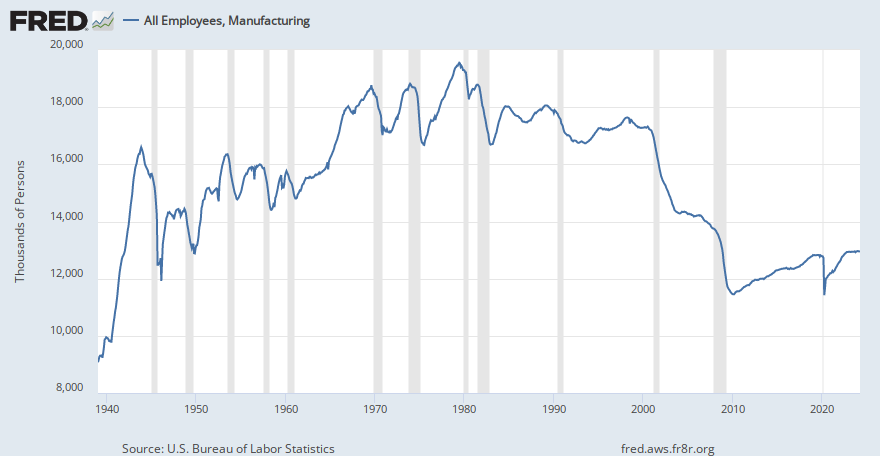
All Employees, Manufacturing
Graph and download economic data for All Employees, Manufacturing (MANEMP) from Jan 1939 to Aug 2026 about headline figure, establishment survey, manufacturing, employment, and USA.
fred.stlouisfed.org
 BREAKING: In a massive development, US oil giant Chevron is signing a deal with Iraq to *CIRCUMVENT* the Strait of Hormuz as they move into Iraqi oil fields
This is HUGE, Iran is fuming!

"Chevron will sign a Memorandum of Understanding today with Iraq to enter into 2 Iraqi oil fields, and doing study to move oil from Iraq north AROUND the Strait, possibly through the Mediterranean Sea. This is all meant to add that global oil supply AVOIDING the issues."
Trump just recently met with the Iraqi PM.
HE KNOWS WHAT HE'S DOING
The global oil order is being changed!


Thanks ********.
The HI trust fund’s balance is set to increase through 2031. But spending will outstrip income in the following year, and that imbalance will continue until the fund is eventually exhausted in 2040, according to the CBO’s new projections.
The expected loss of more than a decade in HI solvency is mostly due to Republicans’ “Big Beautiful Bill,” which President Donald Trump signed into law in July. The legislation lowered taxes and created a temporary deduction for Americans aged 65 or older, shrinking Medicare revenues from taxing Social Security benefits, the CBO said.
 www.healthcaredive.com
GOP’s ‘Big Beautiful Bill’ erases 12 years of solvency for Medicare trust fund: CBO
Congressional scorekeepers expect the Hospital Insurance trust fund to run dry more than a decade earlier than they previously expected, after the Republican megabill slashed the revenues it receives.Dive Brief:
- A key trust fund underpinning Medicare could run out of funds 12 years earlier than previously expected, after Republicans cut taxes last summer that flowed into Medicare’s coffers, according to a new analysis from congressional scorekeepers.
- The Hospital Insurance trust fund is set to be exhausted by 2040, the Congressional Budget Office said Monday. Early last year, before the GOP’s “Big Beautiful Bill” was signed into law, the CBO expected the trust fund would last until 2052.
- Projections of looming insolvency have dogged Medicare for years and are highly uncertain. Still, the earlier go-broke date is concerning in light of the 70 million elderly and disabled Americans who receive health insurance from the program and would see their benefits reduced if the fund expires.
Dive Insight:
The HI trust fund pays for benefits in Medicare Part A, including care provided in inpatient hospitals, skilled nursing facilities and hospices. It’s funded by several sources, but the lion’s share comes from the Medicare payroll tax and income taxes on Social Security benefits.The HI trust fund’s balance is set to increase through 2031. But spending will outstrip income in the following year, and that imbalance will continue until the fund is eventually exhausted in 2040, according to the CBO’s new projections.
The expected loss of more than a decade in HI solvency is mostly due to Republicans’ “Big Beautiful Bill,” which President Donald Trump signed into law in July. The legislation lowered taxes and created a temporary deduction for Americans aged 65 or older, shrinking Medicare revenues from taxing Social Security benefits, the CBO said.
GOP’s ‘Big Beautiful Bill’ erases 12 years of solvency for Medicare trust fund: CBO
Congressional scorekeepers expect the Hospital Insurance trust fund to run dry more than a decade earlier than they previously expected, after Republicans’ megabill slashed the revenues it receives from taxes.
IT’S DONE. TODD BLANCHE HAS BEEN CONFIRMED! Todd Blanche is officially Attorney General.
50-49. Single-vote margin.
Murkowski and Collins walked away from the President’s pick. The rest of the Republican conference didn’t.
The man who stood in the courtroom for Trump is now permanently running the entire Justice Department.
No more acting. No more excuses.
The American people demanded an end to the two-tier system. This is the first real step. Time to deliver.
Congrats Todd!
Thanks ********.
GOP’s ‘Big Beautiful Bill’ erases 12 years of solvency for Medicare trust fund: CBO
Congressional scorekeepers expect the Hospital Insurance trust fund to run dry more than a decade earlier than they previously expected, after the Republican megabill slashed the revenues it receives.
Dive Brief:
- A key trust fund underpinning Medicare could run out of funds 12 years earlier than previously expected, after Republicans cut taxes last summer that flowed into Medicare’s coffers, according to a new analysis from congressional scorekeepers.
- The Hospital Insurance trust fund is set to be exhausted by 2040, the Congressional Budget Office said Monday. Early last year, before the GOP’s “Big Beautiful Bill” was signed into law, the CBO expected the trust fund would last until 2052.
- Projections of looming insolvency have dogged Medicare for years and are highly uncertain. Still, the earlier go-broke date is concerning in light of the 70 million elderly and disabled Americans who receive health insurance from the program and would see their benefits reduced if the fund expires.
Dive Insight:
The HI trust fund pays for benefits in Medicare Part A, including care provided in inpatient hospitals, skilled nursing facilities and hospices. It’s funded by several sources, but the lion’s share comes from the Medicare payroll tax and income taxes on Social Security benefits.
The HI trust fund’s balance is set to increase through 2031. But spending will outstrip income in the following year, and that imbalance will continue until the fund is eventually exhausted in 2040, according to the CBO’s new projections.
The expected loss of more than a decade in HI solvency is mostly due to Republicans’ “Big Beautiful Bill,” which President Donald Trump signed into law in July. The legislation lowered taxes and created a temporary deduction for Americans aged 65 or older, shrinking Medicare revenues from taxing Social Security benefits, the CBO said.
GOP’s ‘Big Beautiful Bill’ erases 12 years of solvency for Medicare trust fund: CBO
Congressional scorekeepers expect the Hospital Insurance trust fund to run dry more than a decade earlier than they previously expected, after Republicans’ megabill slashed the revenues it receives from taxes.
so you're pretty sure Medicare will go away in 2040?
If Republicans stay in charge, it's conceivable yes. They are currently running up a 2 trillion dollar deficit in 2026 while doing everything they can to destroy healthcare for tens of millions of people and it looks like it will get even worse next year. Trump is screwing this country over while getting absurdly rich and he doesn't give a single fvkk.so you're pretty sure Medicare will go away in 2040?
If Republicans stay in charge, it's conceivable yes. They are currently running up a 2 trillion dollar deficit in 2026 while doing everything they can to destroy healthcare for tens of millions of people and it looks like it will get even worse next year. Trump is screwing this country over while getting absurdly rich and he doesn't give a single fvkk.
this is where you and I don't see eye to eye....you only see debts and deficits through your "Republican" viewpoint. And while I know you know that there have been both Democrat and Republican administrations running deficits, you only see one. And like a lot of folks you forget the the last Biden 10 year budget had $10 trillion of additional debt...so this is not simply a Democrat problem.
The other thing about the millions whose healthcare is being destroyed..I assume that you're talking about the end of expanded subsidies for the ACA. These expanded subsidies were incorporated in the American Rescue Plan in March 2021 and expanded in August 2022 to expire at the end of 2025. These were passed to get more people on the ACA due to COVID. You might recall that at those times The president was Joe Biden and both the House and Senate were controlled by democrats. The Republican controlled Congress did not end the subsidies, they ended as per the laws created and passed by democrats. They could have made them permanent but they set a sunset provision, and at the end of that period, the subsidies expired.
Now you could argue that the Republicans could have passed a new bill to expand or make permanent the subsidies, but Joe Biden declared the COVID emergency over. So the purpose for the subsidies was also over.
This is an instance where republicans actually went along with a Democrat passed bill. The democrats set the expiration date and the bill expired.
Doing a "but Biden" here doesn't work because we're talking about the ways Trump is actively destroying healthcare and not doing a damn thing to help anyone - this would not have happened under a democratic president. He's a lame duck who has raided our coffers for he and his family, while ignoring the families in the rest of the country.this is where you and I don't see eye to eye....you only see debts and deficits through your "Republican" viewpoint. And while I know you know that there have been both Democrat and Republican administrations running deficits, you only see one. And like a lot of folks you forget the the last Biden 10 year budget had $10 trillion of additional debt...so this is not simply a Democrat problem.
The other thing about the millions whose healthcare is being destroyed..I assume that you're talking about the end of expanded subsidies for the ACA. These expanded subsidies were incorporated in the American Rescue Plan in March 2021 and expanded in August 2022 to expire at the end of 2025. These were passed to get more people on the ACA due to COVID. You might recall that at those times The president was Joe Biden and both the House and Senate were controlled by democrats. The Republican controlled Congress did not end the subsidies, they ended as per the laws created and passed by democrats. They could have made them permanent but they set a sunset provision, and at the end of that period, the subsidies expired.
Now you could argue that the Republicans could have passed a new bill to expand or make permanent the subsidies, but Joe Biden declared the COVID emergency over. So the purpose for the subsidies was also over.
This is an instance where republicans actually went along with a Democrat passed bill. The democrats set the expiration date and the bill expired.
"Critics, nonpartisan analysts, and congressional reports state that Donald Trump’s legislative and administrative actions—most notably the passage of the One Big Beautiful Bill Act (OBBBA) in July 2025—have severely harmed American healthcare by stripping millions of coverage, increasing out-of-pocket costs, and forcing the closure of hundreds of medical facilities. [1, 2, 3]
The primary ways these policies have negatively impacted Americans include:
Massive Reductions in Health Insurance Coverage
- Loss of Insurance: The Congressional Budget Office (CBO) estimates that the OBBBA's health program cuts will cause approximately 10 to 15 million Americans to lose health insurance. [1, 2]
- Surging Deductibles: Average deductibles for Affordable Care Act (ACA) marketplace plans increased by $1,027 in 2026.
- Hospital & Clinic Closures: Due to funding shortages driven by federal cuts, 216 hospitals and clinics closed across 39 states between mid-2025 and mid-2026, disproportionately harming rural communities. [1]
- Maternal Care Shutterings: Numerous hospitals closed their labor, delivery, and neonatal ICU wards, forcing pregnant women to travel long distances for emergency care. [1]
- Defunding Family Planning: Provisions blocking federal Medicaid payments to organizations like Planned Parenthood restricted access to cancer screenings and reproductive services. [1, 2, 3]
- Throttled Patient Safety Research: Staffing and grant cuts effectively shut down the federal Agency for Healthcare Research and Quality (AHRQ), halting over 100 grants dedicated to preventing hospital infections and improving medical practice safety. [1]
we could go back and forth on this forever...you're going to tell me all the things that republicans did and I won't disagree with anything you post. But we're not getting to the most fundamental questions: is it the government's responsibility to provide medical coverage for it's citizens? if yes, then at what level and for whom? Is health care a right? if yes, then why are you and I paying for health insurance and others are not? If, as you seemingly propose, we have a single payer or Medicare for all government program, who is eligible all residents or only citizens, what does this government program cover, who pays for it and by how much?Doing a "but Biden" here doesn't work because we're talking about the ways Trump is actively destroying healthcare and not doing a damn thing to help anyone - this would not have happened under a democratic president. He's a lame duck who has raided our coffers for he and his family, while ignoring the families in the rest of the country.
"Critics, nonpartisan analysts, and congressional reports state that Donald Trump’s legislative and administrative actions—most notably the passage of the One Big Beautiful Bill Act (OBBBA) in July 2025—have severely harmed American healthcare by stripping millions of coverage, increasing out-of-pocket costs, and forcing the closure of hundreds of medical facilities. [1, 2, 3]
The primary ways these policies have negatively impacted Americans include:
Massive Reductions in Health Insurance Coverage
Skyrocketing Healthcare and Out-of-Pocket Costs
- Loss of Insurance: The Congressional Budget Office (CBO) estimates that the OBBBA's health program cuts will cause approximately 10 to 15 million Americans to lose health insurance. [1, 2]
- Medicaid Rollbacks: The legislation slashed over $1 trillion from Medicaid, introducing administrative red tape that pushes low-income individuals off their plans. [1, 2]
- Expired ACA Subsidies: The administration allowed pandemic-era enhanced premium tax credits to expire, driving down individual enrollment. [1, 2]
Medical Facility Closures and Staff Layoffs
- Surging Deductibles: Average deductibles for Affordable Care Act (ACA) marketplace plans increased by $1,027 in 2026.
- Premium Hikes: The expiration of federal premium subsidies has caused insurance premiums to spike, with some enrollees facing a 75% premium increase to keep their coverage. [1, 2, 3]
Restrictions on Reproductive and Patient Safety Services
- Hospital & Clinic Closures: Due to funding shortages driven by federal cuts, 216 hospitals and clinics closed across 39 states between mid-2025 and mid-2026, disproportionately harming rural communities. [1]
- Healthcare Staff Layoffs: Over 8,450 medical professional positions were eliminated nationwide as hospitals scaled back operations to survive financial constraints. [1, 2]
- Maternal Care Shutterings: Numerous hospitals closed their labor, delivery, and neonatal ICU wards, forcing pregnant women to travel long distances for emergency care. [1]
- Defunding Family Planning: Provisions blocking federal Medicaid payments to organizations like Planned Parenthood restricted access to cancer screenings and reproductive services. [1, 2, 3]
- Throttled Patient Safety Research: Staffing and grant cuts effectively shut down the federal Agency for Healthcare Research and Quality (AHRQ), halting over 100 grants dedicated to preventing hospital infections and improving medical practice safety. [1]
Until we answer these questions, all the things about the BBB cutting this or that or the ACA being a success or failure, we're just debating around the edges. Because if the government is reposnsible for providing healthcare we're not doing a very good job, and conversely, if it's not a government responsibility we're paying money we simply don't have.
If you perceive I'm doing a "but Biden", really didn't mean to limit my 'but" to only him. I don't think any of our leaders in the WH or Congress are doing what need to be done to solve the problem
I would have to spend an hour writing a treatise to respond to all these questions and I'm not interested in investing that much time right now but if tens of millions of Americans are unable to pay for or obtain health insurance, then we have a problem that only the government can fix. A government of the people would try to find a solution to that problem, a selfish, incompetent government would not. Only one side is interested in making things better for those that can't afford healthcare coverage, the other side is only interested in hoarding wealth for themselves. I'll let you figure out who's who.we could go back and forth on this forever...you're going to tell me all the things that republicans did and I won't disagree with anything you post. But we're not getting to the most fundamental questions: is it the government's responsibility to provide medical coverage for it's citizens? if yes, then at what level and for whom? Is health care a right? if yes, then why are you and I paying for health insurance and others are not? If, as you seemingly propose, we have a single payer or Medicare for all government program, who is eligible all residents or only citizens, what does this government program cover, who pays for it and by how much?
Until we answer these questions, all the things about the BBB cutting this or that or the ACA being a success or failure, we're just debating around the edges. Because if the government is reposnsible for providing healthcare we're not doing a very good job, and conversely, if it's not a government responsibility we're paying money we simply don't have.
If you perceive I'm doing a "but Biden", really didn't mean to limit my 'but" to only him. I don't think any of our leaders in the WH or Congress are doing what need to be done to solve the problem
Latest
-
01
 Tiger Illustrated Football Recruiting
Xander Edwards on Clemson visit: 'They treated me like a priority'
Tiger Illustrated Football Recruiting
Xander Edwards on Clemson visit: 'They treated me like a priority'
-
02
 Tiger Illustrated Football Recruiting
Clemson Football Roster & Recruiting Big Board: Offensive Line
Tiger Illustrated Football Recruiting
Clemson Football Roster & Recruiting Big Board: Offensive Line
-
03
 Tiger Illustrated Football
Dabo Swinney: Corian Gipson lost for the season, additional injury info, open date week prep for Clemson
Tiger Illustrated Football
Dabo Swinney: Corian Gipson lost for the season, additional injury info, open date week prep for Clemson
-
04
 Tiger Illustrated Football
Here's what we know about Clemson's football team entering the open date
Tiger Illustrated Football
Here's what we know about Clemson's football team entering the open date
-
05
 Tiger Illustrated Football Recruiting
MONDAY INSIDER
Tiger Illustrated Football Recruiting
MONDAY INSIDER