The economy
- Thread starter Rastafarian
- Start date
You are using an out of date browser. It may not display this or other websites correctly.
You should upgrade or use an alternative browser.
You should upgrade or use an alternative browser.


in fairness, 33% of the voters don't know the 3 branches of government, who their senator or representative is, or whether or not we have a debt.5-6 posters here but ~33% of the voters still won't

Are those Walmart figures juiced at all by the $3b tariff payout they just received?
Big push by Texas O&G companies to use their production waters as the water for data centers. Couple of AI companies just signed 8+ figure contracts with these O&G companies to have access to their production water, pretreat it, and then use that as their water source. It’s a really savvy idea and as long as the pretreatment works then it’ll solve a lot of the water issues for data centers in TexasTexas seems to be the hot draw for data centers. Climate, water, .....?
The environmental impact and needs seems large
"Texas has seen huge growth in power demand. Along with data centers and the crypto industry, consumption is also increasing from oil and gas producers and as the population expands. That leaves little room for error in a state that also sees regular extreme weather, which can add more strain to the aging grid."
dpic do you not see any self irony when in one post you complain about reduced spending on Medicaid and in another you complain about government spending too much???

They said they will be returning all the tariffs to consumers via lower prices and raised their guidance for next quarter.Are those Walmart figures juiced at all by the $3b tariff payout they just received?
Issued new debt and up $5 overnight. Must have been expected
I'm not sure sharing a viral tweet qualifies as complaining but if the choice is between tax cuts for the rich and healthcare for those in need, Ill choose the latter.dpic do you not see any self irony when in one post you complain about reduced spending on Medicaid and in another you complain about government spending too much???
Did Massie hurt your feelings by telling the truth?

I know. Trump voters.in fairness, 33% of the voters don't know the 3 branches of government, who their senator or representative is, or whether or not we have a debt.
Here's how that will work...They said they will be returning all the tariffs to consumers via lower prices and raised their guidance for next quarter.
That 20 oz box of cereal that sold for $6/box will become a 14 oz box selling for $5/box.
Price dropped 16%!!!!!!!!
Size of box dropped 30%!!!!!!
Trump and Bessent..."WE GOT WALMART TO LOWER PRICES"
MAGA will eat that shiit up with a sponge and a spoon.


not at all I like massie....I just think it ironic to "complain" about deficits and then call for more spending...don't you see the irony there??I'm not sure sharing a viral tweet qualifies as complaining but if the choice is between tax cuts for the rich and healthcare for those in need, Ill choose the latter.
Did Massie hurt your feelings by telling the truth?
Our deficit would have been smaller without the 4 trillion we added with the tax cuts and no one would have had to lose their healthcare. Comprende?not at all I like massie....I just think it ironic to "complain" about deficits and then call for more spending...don't you see the irony there??
entendo! but no one had to lose healthcare. Nobody was kicked off, the government just complied with the Biden admin expanded subsidies sunset provision. The people who had healthcare before COVID could have just reverted to their old plans. People who didn't have COVID could have purchased. it.Our deficit would have been smaller without the 4 trillion we added with the tax cuts and no one would have had to lose their healthcare. Comprende?
I'd be Ok with doing away with the tax cuts. Didn't help me in any way.
By the way, where did you get the $4trillion number??
When you add this in with the debt and geopolitical changes you must be a flat earther to believe this market is going up without massive liquidity input from our fiat treasury printing press.
The current U.S. Buffett Indicator sits at approximately 240%, which indicates that the stock market is strongly overvalued relative to gross domestic product (GDP)
But have no fear, as long as we have payroll 401K contributions for passive index investing, the mechanical bid will always show up on schedule
The current U.S. Buffett Indicator sits at approximately 240%, which indicates that the stock market is strongly overvalued relative to gross domestic product (GDP)
But have no fear, as long as we have payroll 401K contributions for passive index investing, the mechanical bid will always show up on schedule
Last edited:

So to summarize - inflation up, GDP down, worker share of GDP down
Winning.
Winning.
So to summarize - inflation up, GDP down, worker share of GDP down
Winning.
I believe we are operating on Trump math
Reference Canadian miners, metals and the TACO trade war rhetoric. Canada does not want to be a US state.
Precious metals are priced on global markets, not by bilateral U.S.-Canada trade agreements. Because trade wars create global economic uncertainty, investors are flocking to "safe-haven" assets like gold. Seems like the risk is in swap rates and the USD interest rates and perto dollar boost from Iran mess is running out of fuel.
Marsh may put on a hawkish face, but who believes a rate increase Is in the cards going into mid terms?
Precious metals are priced on global markets, not by bilateral U.S.-Canada trade agreements. Because trade wars create global economic uncertainty, investors are flocking to "safe-haven" assets like gold. Seems like the risk is in swap rates and the USD interest rates and perto dollar boost from Iran mess is running out of fuel.
Marsh may put on a hawkish face, but who believes a rate increase Is in the cards going into mid terms?
Last edited:
Trump math?Issued new debt and up $5 overnight. Must have been expected

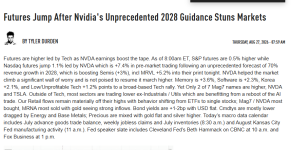
NVDA crushed earnings today. Dragging all the AI stocks up with it.
Fiat currency Treasury counterfiting
The Treasury’s auction of $8 billion in a reopened 30-year TIPS, CUSIP 912810US5, generated a real yield to maturity of 2.973%, highest for this term since October 2001. While that’s historic, the real yield fell just shy of the 3% milestone, thanks to bond-market intervention by Treasury Secretary Scott Bessent.
The Treasury’s auction of $8 billion in a reopened 30-year TIPS, CUSIP 912810US5, generated a real yield to maturity of 2.973%, highest for this term since October 2001. While that’s historic, the real yield fell just shy of the 3% milestone, thanks to bond-market intervention by Treasury Secretary Scott Bessent.
This checks a lot of boxes for where we stand with spiraling debt. I must have misplaced a copy of Swiss banker Ferdinand Lipps presentation paper from many years back.
The Consequence of Monetary Inflation: The Inevitable Failure of Fiat Money" is a highly regarded economic essay written by the late Swiss private banker, author, and sound-money advocate Ferdinand Lipps (1932–2005).
Lipps was an outspoken critic of modern central banking. He wrote extensively on how unbacked paper currencies historically collapse. Below is a scannable overview of the core arguments, historical context, and foundational concepts detailed in his work. [1, 2]
 Core Concepts of the Paper
Ferdinand Lipps approached monetary policy from the perspective of the Austrian School of Economics. This economic philosophy strongly favors free markets and money backed by physical commodities like gold. [1, 2, 3]
 The Destructive Consequences Detailed by Lipps
Lipps outlines specific phases of damage that a society undergoes as its paper money depreciates: [1]
 The Solution: Return to Gold
Lipps’s ultimate conclusion is that society must return to a gold standard or a system of commodity-backed "sound money". He highlights several reasons why gold protects economic freedom: [1, 2]
The Consequence of Monetary Inflation: The Inevitable Failure of Fiat Money" is a highly regarded economic essay written by the late Swiss private banker, author, and sound-money advocate Ferdinand Lipps (1932–2005).
Lipps was an outspoken critic of modern central banking. He wrote extensively on how unbacked paper currencies historically collapse. Below is a scannable overview of the core arguments, historical context, and foundational concepts detailed in his work. [1, 2]
Core Concepts of the PaperFerdinand Lipps approached monetary policy from the perspective of the Austrian School of Economics. This economic philosophy strongly favors free markets and money backed by physical commodities like gold. [1, 2, 3]
- Monetary Inflation vs. Price Inflation: Lipps emphasizes that true inflation is the artificial expansion of the money supply by central banks. Rising prices for groceries or fuel are merely the consequence of having too many paper dollars or euros chasing a limited supply of goods. [1, 2, 3]
- The Illusion of Fiat Money: He defines fiat money as government-issued currency that is not backed by a physical commodity. Because it has no intrinsic worth and relies purely on public trust, it is highly susceptible to political over-printing. [1, 2]
- The Inevitable Failure: Lipps argues that every fiat currency system in human history has ultimately ended in a complete loss of purchasing power. He notes that without a strict physical anchor, governments are always tempted to print money to fund debts or social spending, which gradually destroys the citizens' savings. [1, 2, 3]
The Destructive Consequences Detailed by LippsLipps outlines specific phases of damage that a society undergoes as its paper money depreciates: [1]
- The Destruction of Savings: When money can be created out of thin air, its value falls. This penalizes responsible people who save money while rewarding those who take on massive debts. [1, 2]
- Economic Distortions: Artificially low interest rates and printed money create "booms" that feel like prosperity but are actually bubbles. These malinvestments eventually pop, leading to harsh recessions or depressions. [1, 2]
- Moral and Social Decay: Lipps strongly argues that debasing the currency erodes a nation's moral fabric. It leads to a shorter-term mindset where people favor quick speculation over hard, long-term productive work. [1, 2]
The Solution: Return to GoldLipps’s ultimate conclusion is that society must return to a gold standard or a system of commodity-backed "sound money". He highlights several reasons why gold protects economic freedom: [1, 2]
- Natural Scarcity: Governments cannot print gold, meaning the money supply grows slowly and predictably. [1, 2]
- Long-Term Price Stability: Historically, commodity-backed systems maintain highly stable prices over centuries, allowing families and businesses to safely plan for the future. [1, 2]
- A Check on Government Power: If governments have to pay for policies with real gold rather than paper, they are forced to balance their budgets and limit dangerous expansions. [1, 2]
- "booms" that feel like prosperity but are actually bubbles. These malinvestments eventually pop, leading to harsh recessions or depressions.
- Moral and Social Decay: Lipps strongly argues that debasing the currency erodes a nation's moral fabric. It leads to a shorter-term mindset where people favor quick speculation over hard, long-term productive work.
Last edited:
Consider the past 10 days: A free model called Ox Alpha appeared online, performing near the frontier of what AI can do, and nobody will even say who built it. OpenAI cut prices on its flagship model for the third time in about a month. Meanwhile, the token-price gauge this column flagged as a warning signal back in July has kept sliding since. Intelligence, as a product, is deflating in real time

Dick’s Sporting Goods poor earnings report due to consumer distress. Stock dropped 30%
It’s Happening. Walmart cratered too
It’s Happening. Walmart cratered too
I don’t know if this deserves a laughing or mad emoji. Either way, Bessent has proven himself to be another lying, POS Trump protector.Treasury Secretary Scott Bessent said Ukrainian drone strikes on Russian energy facilities were one reason for rising global energy prices, citing those attacks before mentioning the war against Iran when asked about the elevated cost of living in the US.
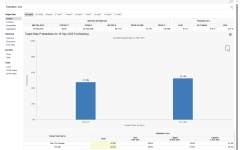
Market right at 50-50 odds of a rate hike at the September meeting. Up from about 30-70 two or three days ago. That move in expectations undoubtedly spurred yesterday's rally. All eyes on the 10y and crude oil for the time being.
I still am in the camp that there will not be a rate hike, because counter intuitively i think it will be counterproductive. Most inflation is in housing and energy and raising rates won't help those things.
There has been one metric that has never been wrong predicting a rate decision and it is (barely) showing a hike. The one thing that is different this time is that Warsh is the Fed Govenor. Warsh wasn't hired to raise rates. I think he bucls the trend and holds rates steady.
I still am in the camp that there will not be a rate hike, because counter intuitively i think it will be counterproductive. Most inflation is in housing and energy and raising rates won't help those things.
There has been one metric that has never been wrong predicting a rate decision and it is (barely) showing a hike. The one thing that is different this time is that Warsh is the Fed Govenor. Warsh wasn't hired to raise rates. I think he bucls the trend and holds rates steady.
Jobs everywhere. And what is this, revisions higher? A stark contrast from the Biden admin that had 1,00,000 ghost jobs that were revised away. Market sells off a little i think because it thinks a rate hike is more likely with strong jobs. Im sticking with my call, no hike. Warsh wasn't hired to hike. Market is going higer. Be long
 JUST IN: Americans without college degrees are having "one of the best job markets" in DECADES under Donald J. Trump — WSJ
This is incredible.
Trump courted the non-college worker vote and HE'S DELIVERING FOR THEM.
Just watch as deportations continue and visas face extended restrictions and heightened fees...it's all coming together

AMERICANS FIRST!
Democrats trying to sabotage Trump. To hell with citizens.
WOW! Trump Energy Sec. Chris Wright mic drops CNN's Dana Bash to her face after she attacks President Trump for gas prices
"The Biden admin CLOSED over a *DOZEN* refineries in the US."
"Gavin Newsom in California closed two SIGNIFICANT refineries just in the past 12 months!"
"We are rowing in the OPPOSITE direction. We are expanding refiner capacity. Venezuela will bring in a rise in refinery capacity."

Trump is the energy president, the fake news won't admit it
WOW! Trump Energy Sec. Chris Wright mic drops CNN's Dana Bash to her face after she attacks President Trump for gas prices"The Biden admin CLOSED over a *DOZEN* refineries in the US."
"Gavin Newsom in California closed two SIGNIFICANT refineries just in the past 12 months!"
"We are rowing in the OPPOSITE direction. We are expanding refiner capacity. Venezuela will bring in a rise in refinery capacity."
Trump is the energy president, the fake news won't admit it

Reading all of this horsesh*t makes me chuckle. DOGE was a good idea??? Sure, you let some random dick who know nothing come in and zero out YOUR spending and give him unfettered access to YOUR financials and tell us how well that works out.
FTR, we had budget SUPLUS less than 30 years ago. Multiple years even. How? A Democratic Congress passed a massive tax hike and a Democratic president worked across the aisle to control spending. What happened? Well, the GOP put a slimy Newt in charge who weaponized govt and made compromise a dirty word. Then we elected a Republican who slashed taxes and got us into a nonsensical war. Sound familiar? And that Republican was elected by the very same people who bitched incessantly about deficits.
It isn’t Congress. It isn’t the President. It’s US. We the People.
FTR, we had budget SUPLUS less than 30 years ago. Multiple years even. How? A Democratic Congress passed a massive tax hike and a Democratic president worked across the aisle to control spending. What happened? Well, the GOP put a slimy Newt in charge who weaponized govt and made compromise a dirty word. Then we elected a Republican who slashed taxes and got us into a nonsensical war. Sound familiar? And that Republican was elected by the very same people who bitched incessantly about deficits.
It isn’t Congress. It isn’t the President. It’s US. We the People.

Latest
-
01
 Tiger Illustrated Football
Sunday Clemson Football Nuggets
Tiger Illustrated Football
Sunday Clemson Football Nuggets
-
02
 Tiger Illustrated Football
The internal vibe of Clemson's football team heading into Miami matchup
Tiger Illustrated Football
The internal vibe of Clemson's football team heading into Miami matchup
-
03
 Tiger Illustrated Football
Where we think this Clemson football team stands entering October
Tiger Illustrated Football
Where we think this Clemson football team stands entering October
-
04
 Tiger Illustrated Football
CLEMSON FOOTBALL: The Day After
Tiger Illustrated Football
CLEMSON FOOTBALL: The Day After
-
05
 Tiger Illustrated Football
Clemson grinds up Cal en route to win No. 3
Tiger Illustrated Football
Clemson grinds up Cal en route to win No. 3