J.T. Ginn
- Thread starter Dawgs'n'Grizz
- Start date
You are using an out of date browser. It may not display this or other websites correctly.
You should upgrade or use an alternative browser.
You should upgrade or use an alternative browser.

Any update on this kid? Got to think this Omaha run is making him more likely to come to State.
Yeah. Who wouldn’t turn down $2.3 million for the chance to spend a week in Omaha?***

Kumar Rocker just turned down 1st round money to play at Vandy? Why can't it eventually happen to us?
Yeah. Who wouldn’t turn down $2.3 million for the chance to spend a week in Omaha?***
I could probably think of the Florida players that did.
Kumar Rocker just turned down 1st round money to play at Vandy? Why can't it eventually happen to us?
Because guys that do that are few and far between. This isn’t fantasy baseball.
I think JT would've already announced he is going to college if he had that intent.
By not announcing yet, he is basically stating that there is a dollar amount in which he would sign to play pro baseball, & I can't imagine that amount is greater that 2 mil
By not announcing yet, he is basically stating that there is a dollar amount in which he would sign to play pro baseball, & I can't imagine that amount is greater that 2 mil

Not saying he comes or not but I do feel there is more of trend to go to college instead of the minors than there use to be.
Not saying he comes or not but I do feel there is more of trend to go to college instead of the minors than there use to be.
I can understand why for sure, but 2 mil is hard to turn down.
Almost every P5 college baseball game is on TV these days. College teams take private buses and chartered planes to games and come back home to sorority girls and cheerleaders. You spend all your hours with other guys like you, many of whom you played travel ball with your whole life. You train in state-of-the-art facilities, eat in fully stocked dining halls, and play in front of thousands of adoring fans every weekend, with one game a week in between. Your family and friends can attend most, if not all, of your games. Once you are drafted you'll mostly go straight to High-A ball, with a potential fast-track to the big leagues in 2-3 years if you perform well. If it doesn't work out you've got a college degree and connections to successful alumni who love to hire college athletes.
High schoolers who go straight to the minors usually sign a contact giving a club rights to you for your first five seasons in the minors, and your first six years in the majors, after which you'll be eligible for free agency, at about age 30. You'll likely start in rookie ball, or Low A ball, and get to travel overnight from Danville to Pulaski. You'll spend most of your time with people you don't know from all over the globe, many of whom speak little or no English. You'll share hotel rooms with two or three teammates and eat PB&J's. You'll play six games a week and there are often more people in the dugouts than in the stands. Since MLB successfully lobbied to be exempt from Federal labor laws, you'll be paid $1,160 per month during the season— $7.25 per hour, for a 40-hour work week, five months out of the year, for a total salary of about $6,000 per season. You will not be paid for spring training or offseason workouts, though you will be required to stay in shape all year. You will count on your signing bonus, or what's left after taxes and agent's fees, to support you until you reach the big leagues or don't get re-signed by your club, a process that could take a year or two, or five, or ten, or possibly never. Either way, when your playing career is over you'll likely be entering the work force without a college degree, and no work experience other than playing baseball.
Unless the money is absolutely life changing I know which one I'd pick.
https://www.forbes.com/sites/mauryb...-and-the-minimum-wage-exemption/#24cd31c53c21
High schoolers who go straight to the minors usually sign a contact giving a club rights to you for your first five seasons in the minors, and your first six years in the majors, after which you'll be eligible for free agency, at about age 30. You'll likely start in rookie ball, or Low A ball, and get to travel overnight from Danville to Pulaski. You'll spend most of your time with people you don't know from all over the globe, many of whom speak little or no English. You'll share hotel rooms with two or three teammates and eat PB&J's. You'll play six games a week and there are often more people in the dugouts than in the stands. Since MLB successfully lobbied to be exempt from Federal labor laws, you'll be paid $1,160 per month during the season— $7.25 per hour, for a 40-hour work week, five months out of the year, for a total salary of about $6,000 per season. You will not be paid for spring training or offseason workouts, though you will be required to stay in shape all year. You will count on your signing bonus, or what's left after taxes and agent's fees, to support you until you reach the big leagues or don't get re-signed by your club, a process that could take a year or two, or five, or ten, or possibly never. Either way, when your playing career is over you'll likely be entering the work force without a college degree, and no work experience other than playing baseball.
Unless the money is absolutely life changing I know which one I'd pick.
https://www.forbes.com/sites/mauryb...-and-the-minimum-wage-exemption/#24cd31c53c21
But for Ginn none of that matters. He’s going to get north of 2.5 mil just to sign the dotted line.
Elite college players go straight to A+.
Devil's advocate, Austin riley is in AAA now. He would've just been drafted last week had he went to college.
Yep, which is why I'd take the three years of college life, coaching, training, competition, etc, vs starting in rookie ball or even short season A ball, and getting to High A or even AA at about the same time.
College ball is also a great option for guys who are a little undersized but can really play. MLB teams who shy away from an undersized HS player may try to pick him up if he's got a good body of work in college, especially in SEC, ACC, Pac12, etc.
True, also, none of this probably matters for Ginn. Like another poster said, unlikely a club spent a R1 pick on him if he wasn't 100% going to sign, but who knows?
Last edited:
Because guys that do that are few and far between. This isn’t fantasy baseball.
Disagree. It happens at Vandy because EVERY player is 'guaranteed' up to $260K to sign. It's allowed them to sign the top class in 2 of the 3 previous years. LINK
"Five Vanderbilt signees were selected in the first three rounds of the MLB Draft, but other coveted prospects like Rocker were bypassed. That means the Commodores, who have touted college baseball’s No. 1 recruiting class in two of the past three years, could retain the bulk of their signees in the 2018 class."
Apparently, JT Ginn would.Yeah. Who wouldn’t turn down $2.3 million for the chance to spend a week in Omaha?***
Elite college players go straight to A+.
Devil's advocate, Austin riley is in AAA now. He would've just been drafted last week had he went to college.
They can move up rather fast in one year as well.
Apparently, JT Ginn would.
I doubt the unlikely trip to Omaha had much to do with this deal.
His turning down the Dodgers is more likely tied to him not being ready to pay taxes.***
Last edited:
Latest
-
01
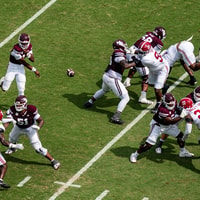 Maroon and White Football
Mississippi State PFF Grades from 56-23 loss to Alabama
Maroon and White Football
Mississippi State PFF Grades from 56-23 loss to Alabama
-
02
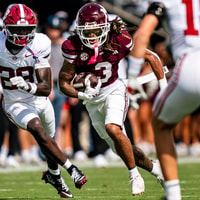 Maroon and White Football
Anthony Evans III posts highest PFN WR grade of Week 5
Maroon and White Football
Anthony Evans III posts highest PFN WR grade of Week 5
-
03
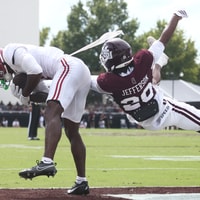 Maroon and White Football
Standout Stats: No. 7 Alabama 56-23 No. 16 Mississippi State
Maroon and White Football
Standout Stats: No. 7 Alabama 56-23 No. 16 Mississippi State
-
04
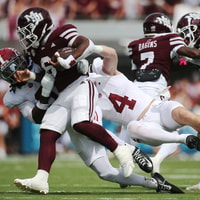 Maroon and White Football
Unpacking Mississippi State's offensive unraveling against Alabama
Maroon and White Football
Unpacking Mississippi State's offensive unraveling against Alabama
-
05
 Maroon and White Football
"Learning Moments": Mississippi State HC Jeff Lebby speaks on rough outing for QB Kamario Taylor
Maroon and White Football
"Learning Moments": Mississippi State HC Jeff Lebby speaks on rough outing for QB Kamario Taylor