
How did it reportedly jump from $3.5 million last year to around $10 million this year? Who were the donors? They allowed us to compete for some very good players. Kudos to them.

SWARM?How did it reportedly jump from $3.5 million last year to around $10 million this year? Who were the donors? They allowed us to compete for some very good players. Kudos to them.
Yeah I’m sure that’s right. Somebody stepped up big time.SWARM?
Are they allowed to use some of the $20.5 revenue sharing yet that schools get? Breakdown most men’s b-ball programs add estimated 4-5 million.How did it reportedly jump from $3.5 million last year to around $10 million this year? Who were the donors? They allowed us to compete for some very good players. Kudos to them.
Good question.Are they allowed to use some of the $20.5 revenue sharing yet that schools get? Breakdown most men’s b-ball programs add estimated 4-5 million.

Are they allowed to use some of the $20.5 revenue sharing yet that schools get? Breakdown most men’s b-ball programs add estimated 4-5 million.
Sounds like some donors really stepped up. We don’t have Mark Cubans, but seems like a few donors really helped out.That would be part of the overall budget. Multiple revenue/donor streams is going to be the complete budget
I knew Iowalaw would come through with a big donation. God bless you Iowalaw!Iowalaw made a huge donation so Ben could compete with Darian DeVries.

There was Much more than $3.5M last year!!! That would have only covered Alvaro & Stirtz....How did it reportedly jump from $3.5 million last year to around $10 million this year? Who were the donors? They allowed us to compete for some very good players. Kudos to them.

From everything I've read, Bennett got $1.7M and Alvaro $1.3M. Hausen $700K. Could be Profit Sharing $2M to $2.5, additional NIL of $3.5M. Maybe $6M total. I still think they had less than $10M this year. Coleman wouldn't have been that high. McKeever is the big ticket guy.There was Much more than $3.5M last year!!! That would have only covered Alvaro & Stirtz....
We supposedly have $10M this year. But if Tavion Banks can come back and re-join the team, Ben will get what he needs for Tavion... Guarantee it!!!

If the NCCA doesn’t come up with some type of CAP like professional sports, I think we’re in trouble. How the hell are we going to continue to compete with the blue bloods or ones who got $$$ if these schools keep pushing the market price UP? The price of these rosters will continue to go UP… as well as each individual player. It should’ve been a crime when Fran was working with 2.5 mil lol my god the average mid-major has that.By all accounts, we have $12-$13 mil in the bank for this year for NIL roster payments.

I believe the approximately $3.5 million number being thrown around was what the University used for the NIL allocation. Now the broadcasting entities(Learfield) are negotiating payments to players. Instead of paying X amount to the University there is some work arounds that some can be funneled to the players. (something along those lines according to Heinrichs). Swarm is 3rd on the totem pole but still important. It has also been stated that the March Madness run brought in more money for Swarm earmarked for bball in that short few week window of our elite 8 run than the entire previous year. While we are not flush with cash Brad said we are probably in the top quarter of B1G NIL hoops money. (don't quote me on this). Football is top half. Which could sound disappointing but as Brad said. Look at the B1G. Ohio St, Penn St, Oregon, Michigan, USC, etc. Being in the top half is just fine.Yeah I’m sure that’s right. Somebody stepped up big time.

That concerns me also. I keep saying - this whole thing is just getting started. 5-10 years from now, who knows what this whole thing is going to look like if some guardrails aren't put on it. There's only so much a lot of people are going to want to contribute on an annual basis.If the NCCA doesn’t come up with some type of CAP like professional sports, I think we’re in trouble. How the hell are we going to continue to compete with the blue bloods or ones who got $$$ if these schools keep pushing the market price UP? The price of these rosters will continue to go UP… as well as each individual player. It should’ve been a crime when Fran was working with 2.5 mil lol my god the average mid-major has that.
A cap won't work. Then it will be back to the way it used to be. Under the table payments and such. They need to allow one free transfer and then you have to sit out a year or soemthing. If a big money program takes another schools player there needs to be some sort of financial contribution from the big money program to the smaller money programs NIL fund. Something similar to what Major League Baseball does. (Who most certainly needs a salary cap and a salary minimum)If the NCCA doesn’t come up with some type of CAP like professional sports, I think we’re in trouble. How the hell are we going to continue to compete with the blue bloods or ones who got $$$ if these schools keep pushing the market price UP? The price of these rosters will continue to go UP… as well as each individual player. It should’ve been a crime when Fran was working with 2.5 mil lol my god the average mid-major has that.
That concerns me also. I keep saying - this whole thing is just getting started. 5-10 years from now, who knows what this whole thing is going to look like if some guardrails aren't put on it. There's only so much a lot of people are going to want to contribute on an annual basis.
I like that idea. I think eventually signing players to long term contracts with buyouts and maybe in some cases a player sitting out a year if he transfers more than 1 time.A cap won't work. Then it will be back to the way it used to be. Under the table payments and such. They need to allow one free transfer and then you have to sit out a year or soemthing. If a big money program takes another schools player there needs to be some sort of financial contribution from the big money program to the smaller money programs NIL fund. Something similar to what Major League Baseball does. (Who most certainly needs a salary cap and a salary minimum)
.... and maybe in some cases a player sitting out a year if he transfers more than 1 time.

And if the players you ink are no good your program goes dormant until they graduate.I like that idea. I think eventually signing players to long term contracts with buyouts and maybe in some cases a player sitting out a year if he transfers more than 1 time.

I completely agree that the key to some degree of stability is to reform the transfer eligibility rules.A cap won't work. Then it will be back to the way it used to be. Under the table payments and such. They need to allow one free transfer and then you have to sit out a year or soemthing. If a big money program takes another schools player there needs to be some sort of financial contribution from the big money program to the smaller money programs NIL fund. Something similar to what Major League Baseball does. (Who most certainly needs a salary cap and a salary minimum)

Hausen getting $700k to mainly ride the bench really boggles my mind! Either they thought he would be a major contributor or they were willing to get an expensive insurance policy type player in case of injury.From everything I've read, Bennett got $1.7M and Alvaro $1.3M. Hausen $700K. Could be Profit Sharing $2M to $2.5, additional NIL of $3.5M. Maybe $6M total. I still think they had less than $10M this year. Coleman wouldn't have been that high. McKeever is the big ticket guy.
I completely agree that the key to some degree of stability is to reform the transfer eligibility rules.
The obstacle to reform is the US Supreme Court. A global framework which passes constitutional scrutiny is needed. It seems inevitable that Congress will get involved.
I’m in favor of reinstating the one year rule with an exception allowed for transfer to a lower division. No “hardship” exemptions.
What monopoly are you referring to?It has been a good learning experience to discover how many people are in favor of a monopolistic business model.
So get good Coaches who can evaluate recruits and develop them. Same as it's always been.And if the players you ink are no good your program goes dormant until they graduate.

Or perhaps Iowa is ahead. Why in the world should these college athletes — who are now very wealthy individuals, I might add — be given such a lucrative tax break?I searched to see if there were any NIL state tax laws is use. The below shocked me. Iowa is behind.
Key NIL Tax Exemption Developments (As of April 2026):
- Arkansas: Became the first state in May 2025 to exempt NIL earnings paid by universities from its 3.9% income tax.
- Mississippi: The House passed a bill in March 2026, HB 4014, to exempt NIL income to help schools compete with neighboring states.
- Active Legislation: Other states, including Alabama, Georgia, Louisiana, and South Carolina, have introduced similar proposals to eliminate taxes on NIL income.
- Proposed Income Tax Elimination: Missouri voters will decide later in 2026 on a constitutional amendment to allow lawmakers to eliminate the state income tax entirely by replacing it with expanded sales tax.
What monopoly are you referring to?

The NCAA is a membership association made up of the schools themselves, and a lot of power now sits with conferences, media networks, state NIL laws, courts, and athlete markets. The NCAA is losing control not because it is an all-powerful monopoly, but because its old amateurism model is being challenged by the schools, athletes, courts, and the market. So the better claim is not “the NCAA is a monopoly,” but “the NCAA has used centralized rules to restrict athlete compensation,” which is a narrower and more accurate argument.The NCAA. That's why they are losing all these cases in court.
Right. Monopoly implies exclusive control and that does not describe the current NCAA.The NCAA is a membership association made up of the schools themselves, and a lot of power now sits with conferences, media networks, state NIL laws, courts, and athlete markets. The NCAA is losing control not because it is an all-powerful monopoly, but because its old amateurism model is being challenged by the schools, athletes, courts, and the market. So the better claim is not “the NCAA is a monopoly,” but “the NCAA has used centralized rules to restrict athlete compensation,” which is a narrower and more accurate argument.
The NCAA is a membership association made up of the schools themselves, and a lot of power now sits with conferences, media networks, state NIL laws, courts, and athlete markets. The NCAA is losing control not because it is an all-powerful monopoly, but because its old amateurism model is being challenged by the schools, athletes, courts, and the market. So the better claim is not “the NCAA is a monopoly,” but “the NCAA has used centralized rules to restrict athlete compensation,” which is a narrower and more accurate argument.
Right. Monopoly implies exclusive control and that does not describe the current NCAA.
I don’t think you’re understanding…Is it ok for people to disagree with you, right? Good grief. Why is everything a personal attack with you?It is always refreshing that we have posters here that know the law better than the 9 Supreme Court justices that voted 9-0.
From the decision:
"Even assuming the NCAA is a joint venture, though, it is a joint venture with monopoly power in the relevant market."
Its like everyone posts what they think it should be and have never bothered to read the court decisions.
Appreciate all the good legal analysis on how the courts are wrecking college basketball. But the original question was how Hawks got from $3.5 million to $10 million in one year. I think JedHawk77 answered that question.I don’t think you’re understanding…Is it ok for people to disagree with you, right? Good grief. Why is everything a personal attack with you?
You’re leaning too hard on that quote and overstating what the Court actually said. In NCAA v. Alston, the Court didn’t rule that the NCAA is a literal monopoly in the broad sense people are using here. That line is part of a narrower antitrust analysis, where the Court assumes or describes “market power” in a defined market so it can evaluate specific restrictions on athlete compensation. That’s very different from declaring the NCAA an illegal monopoly overall. Courts often use that kind of language as a legal framework, not a blanket label. So citing that sentence as proof the NCAA is a monopoly skips the context and stretches the holding beyond what the decision actually says.
I don’t think you’re understanding…Is it ok for people to disagree with you, right? Good grief. Why is everything a personal attack with you?
You’re leaning too hard on that quote and overstating what the Court actually said. In NCAA v. Alston, the Court didn’t rule that the NCAA is a literal monopoly in the broad sense people are using here. That line is part of a narrower antitrust analysis, where the Court assumes or describes “market power” in a defined market so it can evaluate specific restrictions on athlete compensation. That’s very different from declaring the NCAA an illegal monopoly overall. Courts often use that kind of language as a legal framework, not a blanket label. So citing that sentence as proof the NCAA is a monopoly skips the context and stretches the holding beyond what the decision actually says.
Scott Dochterman said Al made at least $2M... Who knows for certain. There can be multiple deals for just one player, from rev sharing to the UI funds, Swarm, corporate deals, etc.From everything I've read, Bennett got $1.7M and Alvaro $1.3M. Hausen $700K. Could be Profit Sharing $2M to $2.5, additional NIL of $3.5M. Maybe $6M total. I still think they had less than $10M this year. Coleman wouldn't have been that high. McKeever is the big ticket guy.
I believe it was Dochterman that also did a show that B10 teams call each other to find out offers they have made when completing for a player so they know when to move on. I guess their war on agents they fight together.Scott Dochterman said Al made at least $2M... Who knows for certain. There can be multiple deals for just one player, from rev sharing to the UI funds, Swarm, corporate deals, etc.
There needs to be some type of transparency or this will just bankrupt a lot of school. Plus, I want a level playing field and lot of teams being competitive... Not just Coke & Diet Coke...
The level playing field concept sounds great but isn’t reality. More transparency is more realistic.Scott Dochterman said Al made at least $2M... Who knows for certain. There can be multiple deals for just one player, from rev sharing to the UI funds, Swarm, corporate deals, etc.
There needs to be some type of transparency or this will just bankrupt a lot of school. Plus, I want a level playing field and lot of teams being competitive... Not just Coke & Diet Coke...
Scott Dochterman said Al made at least $2M... Who knows for certain. There can be multiple deals for just one player, from rev sharing to the UI funds, Swarm, corporate deals, etc.
There needs to be some type of transparency or this will just bankrupt a lot of school. Plus, I want a level playing field and lot of teams being competitive... Not just Coke & Diet Coke...
My salary is public. Of course, I’m paid by the taxpayers. I suppose if that wasn’t the case, I might have a problem with the concept, unless, of course, there was a compelling public interest in what I was being paid, such as, say, customers being asked to crowd-source a portion of my salary. That might make a difference.Do you make your private transactions public?
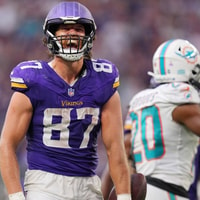 Hawkeye Report Football
Hawkeyes in the NFL: Week Four Top Performers
Hawkeye Report Football
Hawkeyes in the NFL: Week Four Top Performers
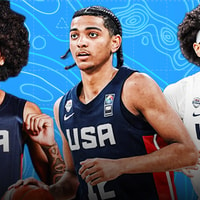 Rivals Basketball Recruiting
Intel: The latest on 5-stars Beckham Black, DeMarcus Henry, and Cayden Daughtry
Rivals Basketball Recruiting
Intel: The latest on 5-stars Beckham Black, DeMarcus Henry, and Cayden Daughtry
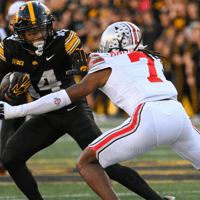 Hawkeye Report Football
Tuesdays with Torbee
Hawkeye Report Football
Tuesdays with Torbee
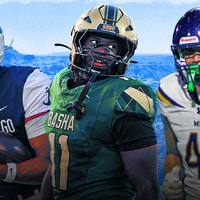 Rivals Football Recruiting
Whispers from out West: ACC, Big Ten, Big 12 and SEC visits resonate with several from the region
Rivals Football Recruiting
Whispers from out West: ACC, Big Ten, Big 12 and SEC visits resonate with several from the region
 Hawkeye Report Football
Hank Brown listed as starter in Iowa's two deeps
Hawkeye Report Football
Hank Brown listed as starter in Iowa's two deeps
