
Could we call a truce ?
- Thread starter ManitouDan_anon
- Start date
You are using an out of date browser. It may not display this or other websites correctly.
You should upgrade or use an alternative browser.
You should upgrade or use an alternative browser.

Probably the bestThere are very few posters who fit that description year in year out. There are posters who can legitimately wonder if this years version of our team can get it together as ones in the past have. Almost every year there are glaring weaknesses that warrant discussion and Cal does have some bad coaching moments that likewise warrant discussion. 90-95% on the board are here to discuss our cats and yes there will be times of venting from frustration.
The pot stirring and calling people out generally is meant for anyone who says anything remotely negative and didn’t show 100% belief at all times. Hell I still don’t have belief in this team that they will make the final four or win the natty but that doesn’t mean I don’t want it to happen. It serves no purpose and just further divides the fanbase. If that’s their goal then more power to them, they are miserable SOB’s I’d want nothing to do with anyway.
I have participated in my last calling anyone out thread. Just going to ignore moving forward.
I will continue to call out both sides.
Well, that's probably true. And sometimes you can explain a loss as a result of a "pitiful effort". But not very often - for some folks, any loss necessarily means either the coach or the team gave a pitiful effort. Which, of course, isn't true. What he's saying in the post you're replying to is "law of averages" and you don't have to be a stat head or someone who will argue offensive efficiency until blue in the face to know the basic sentiment of the phrase is true. You play enough games - and Cal by now coached over 400 here - and you're going to lose some you shouldn't for a variety of reasons. We all know this, so when it happens, it shouldn't cause a freak out (or at least shouldn't make folks say the coach is a moron). But that's what happens.Stats, averages, bell curves, population sample, probability is just another way of trying explain something away. Anytime you have a human equation involved you can throw all that crap out the window. Now if using those makes you feel better, that’s great. But don’t expect average, normal basketball fans to juggle a bunch of numbers to try and figure out why they saw a pitiful effort.
The law of averages is what makes Cal's tournament record at UK so extraordinary. Many fans want to focus on the losses, and not the wins - but what amazes me is we have no Lehigh or Mercer or Northern Iowa, none of that. He's lost as a 5 to a 9, and that's as bad as it's been. None of this losing as a 2 to a 14. No law of averages applies there, and he doesn't get a lot of credit for it, because "he's supposed to win those games." Well, Izzo and Self and Wright and K etc are supposed to win those games, too.......
Last edited:

Being educated in statistics and/ or mathematics is a great thing. This world would long ago went back to the four legged critters without it. Common sense is also a great thing, and mathematics would never have been necessary without it. Combine the two and you have a great thing. Problem is, no one wants to do that because almost everyone is lacking in one of the two, so they put down the one they are lacking in. Take common sense and apply it to whatever scholastic endeavors you are trying to sell, and you have a winner. Or maybe simpler stated, measure your chickens before you build a nesting box. Think about it.

This reminds me of that part in Billy Madison where they are playing fake jeopardy and the host tells Billy (you're Billy in this example) that his answer was totally incorrect, nothing he said was remotely close to the answer and we are now all dumber for listening to it.Okay, this is a long one, but please, sit down with a box of thin mints and enjoy. If I help even one person understand why their emotional rollercoastering doesn't make sense from a logical standpoint, I will be overcome with gladness.
Look, I don't have any beef with you as a poster. I have no idea what you know or don't know about probability, but this is a great setup for me to discuss something that really needs to be said on here about a few of our panic artists on this board:
If you want to talk about who should be allowed to debate, if we draw the line anywhere, it should really be between people who understand stats and those who don't.
With many of us the gap in understanding on this topic is literally the same as between a 5 year old child and their elementary school teacher, and as a result some of the loudest arguments about what "should've happened" are so misinformed that they're frankly embarassing and would force me to put a student into remediation.
I'm not interested in belittling anyone based on their education level (or if you got a pointless expensive piece of paper studying underwater feminist lesbian dance theory). It's not worth everybody's time to spend decades on any one topic, including mathematics. I get that.
Lacking understanding is not the issue. There are tons of things I know nothing about - auto body work, raising giraffes in captivity, building solar arrays, you name it. And I'm willing to admit it and listen.
In contrast, some believe that they innately understand from experience what is statistically likely and what is not, even though many have emotional, tear-smudged perspectives on what is likely to occur, and those percentages change from hour to hour based on their hormones and how much Maker's is left in the bottle.
Again, you don't need to waste decades in school - just a fundamental grasp of a few concepts would propel some on here to vast new heights logically.
At the end of the day, the debate is just going to be between people who understand the following: if you have, say, a 97% chance to win a certain game, and you play 35-40 games a season, then you will, with near certainty, end up on the wrong side of that game multiple times over a decade-long career. Let's call this horrible event "the bad loss".
"The bad loss" will occur regularly, at some interval or another, and it will occur regardless of effort, desire, focus, talent, or coaching ability. The nature of probability is such that once in a while the cumulative effect of bounces, refs, issues in the players' lives, illness/injury status, etc will simply combine in some bizarre fashion to not go your way, so a loss is not a truly unrealistic outcome versus any D1 team.
Yes, every single close loss can be explained away by a bad play here or a coaching decision there, but those mistakes occur in every game for every single team, win or lose - they are as certain as the sun rising in the morning. You probably fixate on these little flaws most strongly during close losses, but they always happen - they are a virtual guarantee unless we roll out 5 robots.
And even without these little flaws, "the bad loss" would still come with certainty due to factors I mentioned earlier (bounces/refs/etc), but it will come even more frequently given the fact that you can write into every game a few instances of human error. For every team in every sport, from now until the end of time. Guaranteed.
The people who don't understand this concept will act - not just sad - but genuinely, freshly horrified and experience anxiety that extends into their regular life whenever "the bad loss" comes (as rare as it may be) and they will scramble to find someone on whom to pour out their frustration because without any understanding, their only outlet for their emotions is to lash out.
And before I hear it, the point is not that the rational view is to accept every loss as fine. Sometimes a bad loss is obviously the fault of a coach or a player for a very specific reason/action that could be readily pinpointed and corrected.
But that's only the case for some losses. Often, the attitude and effort is all there, and things just fell apart in tiny little moments that add up. There is no level of perfection that you could ever reach that would eliminate losses or even just upsets.
In other words, the horrible losses that make some of you guys want to kick your dog are going to come from time to time regardless, just like a person with perfect health habits can still be diagnosed with many terrible diseases.
Many diseases are rarer in the health-conscious individual, just like losses (especially upsets) are rarer under Cal than any other coach. But they still happen, no matter how good you are.
So the rational view is to set some reasonable threshold of winning in advance (taking into account what other high level coaches in the modern era are able to achieve), and then look at progress over the years and decades. You stick with it and let that keep you measured instead of throwing post-loss tantrums that you would never accept from your 5 year old.
It's like with weight loss: often people with a tenuous grasp of biology will sit there and panic day-to-day with every pound up and down, and that is a massive waste of energy for them and is selfishly draining towards everyone around them.
You will gain and shed pounds over silly things like sodium retention and that small-scale data is just useless noise in regards to your actual goals.
The only rational way to approach weight loss is to set a realistic goal in advance (taking into account what other motivated people are able to achieve), and then look at progress over months and years.
This is also the PC way to describe different humans' responses to realizing that they've run out of ice cream in the freezer. From age 3 to adulthood, that response varies wildly.
In fact, some of those humans would describe the ice-creamless event as an example of "adversity" with a straight face. Although the ones who react the most acutely probably don't have that word in their vocab quite yet.
Watch "Everyone Is Now Dumber - Billy Madison" on YouTube
You said… correction, you accused me of saying: """You aren't allowed to debate me. I'm correct. But also, come debate me like a man and don't make fun of me.""
You know, if you put quotation marks around it, it means that person said it, umm, I never said that.
What I DID say however, was debate me like a damn man, instead of "you're a hater." "Quit whining." "Tell me who you want to replace Cal." "Here comes the CLOD".
When all I said was, "we turn the ball over too much" and "the culture needs to change, we need to retain guys that aren't first rounders" .
That's debating like an *******. Disagree, but don't hide behind mommy's computer like a little *****.
After you finish patting yourself on the back, remember this basic premise. There are statistics, damned statistics, and lies. To put it simply, statistics can be used to prove or disprove (and I use those terms lightly) anything. I had a college stats professor that made that statement all the time.
you actually read that ?
Unfortunately yes. In my opinion, it was condescending crap. He must either be or fancy himself a teacher.you actually read that ?
The only other thing I'll say is the point I've made about politics that applies here: there are extremists on both sides, and each side thinks the extremists on its own side are a small fringe, while the extremists on the other side is representative of that side. There is a spectrum of opinion here. 0 to 100, with 0 being the guy who really does seem miserable, thinks Cal is a moron or a failure, who thinks no loss is ever acceptable. 100 is the guy who never finds fault in anything, everything is always sunshine and seashells, the coach is never at fault and the players never at fault and no one should ever utter a critical word. but there aren't many 0s or 100s, there are a lot of 25s and 40s and 70s and 88s. But everyone who is on the 50-100 side thinks everyone on the other side is a zero, and everyone on the 0-50 side thinks all the others are 100s.
Did that make sense? I think I made myself dizzy.
Did that make sense? I think I made myself dizzy.
Well if there was an intended truce, it looks like someone didn't get the order and fired a dozen hellfire missile collectively.
My favorite quote is this “figures don’t lie, but liars can figure”. In other words numbers can be manipulated to fit any type of narrative.After you finish patting yourself on the back, remember this basic premise. There are statistics, damned statistics, and lies. To put it simply, statistics can be used to prove or disprove (and I use those terms lightly) anything. I had a college stats professor that made that statement all the time.
Not every December. That's the problem. We need another team with some top 5 players so that we can enjoy the entire basketball season for a change.This.
Every December we struggle. I sometimes wonder if some of those people have paid attention the last 10 years.
Its been good watching the team grow , sure isn't the 80's Lakers , more like the Pistons , a grind it out beat you into submission sort of team . I do wish Cal opens up the offense a LITTLE more and doesnt get so entirely conservative late in game . Its kinda like we have have read the book . We fight , scrap and play good enough for 36 minutes to usually have a lead at the end or a 6-10 point cushion somewhere along the flow of the game. Then its 2-3 or more slow possessions where the shot clock gets us , the other team gets some momentum from that and its a dog fight til the end . Wish he would keep up the pace until the last 2 min , not 4 min.
How can you not love the progression of Nick and IQ ? Brooks bust his butt , Ashton plays as hard as humanly possible . The others all give it their all. Make not always be easy to watch but winning trumps everything.
How can you not love the progression of Nick and IQ ? Brooks bust his butt , Ashton plays as hard as humanly possible . The others all give it their all. Make not always be easy to watch but winning trumps everything.

Not every December. That's the problem. We need another team with some top 5 players so that we can enjoy the entire basketball season for a change.
Outside of 2010 (no early losses but had a hard time beating Miami of Ohio, Sam Houston St, and Stanford), 2012 (struggled with ODU, lost to IU) 2015 (perfection in regular season), and 2017 (December home loss to UCLA; loss to UL), most of our other teams have struggled.
I don’t expect to go undefeated every year and enjoy the process of improving as the season progresses. Yet, if the Cats aren’t playing March-level ball at Thanksgiving some fans quit on the season and only show up to ***** or jump back on the bandwagon in February.
Latest
-
01
 KSR
Kentucky inexplicably dropped out of the AP Poll. This is why voters should feel bad about themselves.
KSR
Kentucky inexplicably dropped out of the AP Poll. This is why voters should feel bad about themselves.
-
02
 KSR Football
'Cold-Blooded' Kenny Minchey leads Kentucky to another massive SEC road win
KSR Football
'Cold-Blooded' Kenny Minchey leads Kentucky to another massive SEC road win
-
03
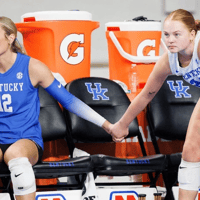 KSR Volleyball
No. 3 Kentucky VB drowns in The Swamp, loses 3-2 to No. 7 Florida
KSR Volleyball
No. 3 Kentucky VB drowns in The Swamp, loses 3-2 to No. 7 Florida
-
04
 KSR Football
Henry Boyer has been a clutch touchdown machine for Kentucky
KSR Football
Henry Boyer has been a clutch touchdown machine for Kentucky
-
05
 KSR Football
Kentucky may become nationally relevant because of Will Stein, but he says Wildcats win the games
KSR Football
Kentucky may become nationally relevant because of Will Stein, but he says Wildcats win the games