Lmao, she was asked a question and she politely answered it. You seem to have a real problem with other peoples opinion when it doesn't go along with what you thinkNot pumped Cunningham decided to rise her star with the maga grift. It will be interesting to see how the Fever navigate it because she could turn into a bit of a locker room cancer.
***CC22 and the Fever mega thread***
- Thread starter LetsGoHawks83
- Start date
You are using an out of date browser. It may not display this or other websites correctly.
You should upgrade or use an alternative browser.
You should upgrade or use an alternative browser.


There's another "Support Sophie Cunningham Rally" tomorrow before the game at Portland. Better be careful of those crazies there.
I agree with you. I am sure the counter protesters will be loud and interesting.
There's a lot of people (including the parents) who think that biological girls and biological women ONLY should compete in girls and women's sports.
They also had fans swearing at them and asking security to "remove the trash", this is on video, for doing nothing but having a sign supporting Sophies statement. Supposedly not only were fans (and ownership) swearing at the 16 year old girls, but several "fans" tried to trip them when they were coming down the stairs, and someone spit on them. Evidently this is what the "woke" crowd , (and the Storm organization) believes is creating a "welcoming place for all fans". You can't make up just how much BS these people throw out there...
I am glad that Caitlin brought MILLIONS of eyeballs onto the WNBA because now the entire nation is seeing what an ugly, ugly product it is.
Not pumped Cunningham decided to rise her star with the maga grift. It will be interesting to see how the Fever navigate it because she could turn into a bit of a locker room cancer.
There's a lot of people (including the parents) who think that biological girls and biological women ONLY should compete in girls and women's sports. Martina Navratilova, a lesbian and one of the greatest tennis players of all time, is one of them and she definitely is not what you call "MAGA grift."

Lmao, she was asked a question and she politely answered it. You seem to have a real problem with other peoples opinion when it doesn't go along with what you think
She said what she said. She looked pretty friendly with the guy that ran the gladiator games on the White House grounds. Her social media posts are pretty maga, and she is for sure going to be cashing in.

The only thing Sophie has done that disappointed me was being part of the UFC desecration of the White House lawn. These dumb MAGAs on here actually think libs like me are advocating for boys playing girls sports. They always believe the fear porn from Republican liars. I think trans people have a right to exist. Not boys playing girls sports. Most democrats believe the same.She said what she said. She looked pretty friendly with the guy that ran the gladiator games on the White House grounds. Her social media posts are pretty maga, and she is for sure going to be cashing in.
Agree with this 1000%. While the % is incredibly small of trans playing women’s sports it just shouldn’t be. You want to transition over, I’m all for it. Whatever makes a person happy. And Sophie can say whatever she wants. But unfortunately this just makes it harder for CC who is in a no win situation here. She’s trying to not take sides on anything. And she shouldn’t have to.The only thing Sophie has done that disappointed me was being part of the UFC desecration of the White House lawn. These dumb MAGAs on here actually think libs like me are advocating for boys playing girls sports. They always believe the fear porn from Republican liars. I think trans people have a right to exist. Not boys playing girls sports. Most democrats believe the same.
Good ESPN article.
Some excerpts:
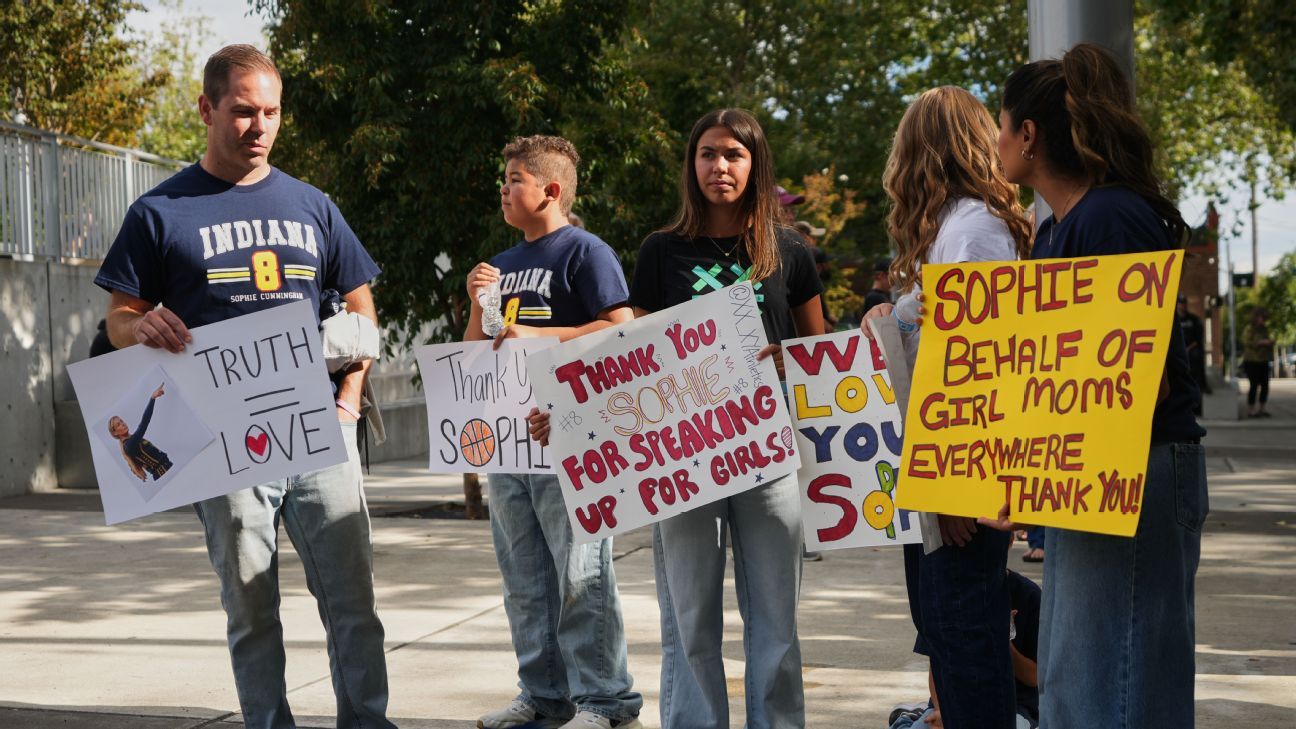
A few dozen people gathered outside of Tuesday's Indiana at Seattle WNBA game to express support for a ballot initiative that would bar transgender students from participating in girls' athletics at schools in Washington.
Two of them, who identified themselves in an online interview as 16-year-olds, later attended the game wearing T-shirts from the brand XX-XY Athletics. They also held a sign thanking Fever guard Sophie Cunningham, who has been vocal about the issue for "speaking up for girls."
The way any person, organization or league should manage such a thing (no matter what side of the ballot initiative the girls were on) is to ignore it and accept that (gasp) people can have honestly held opinions.
Instead, Seattle co-owner Celeste Keaton confronted the young fans.
"She told us we were f---ing insane," one of the girls told political commentator and podcast host Brandi Kruse.
The Storm later issued an apology for Keaton's actions: "We remain committed to creating a welcoming and respectful environment for anyone who attends a Storm game." The WNBA jumped in and issued a fine and five-home game suspension for the owner.
Good for the league, which desperately needed to signal a measure of common sense.
It will, however, do little to calm the, ah, storm.
After all, according to a 2025 New York Times poll, 79% of Americans believe transgender female athletes "should not be allowed to compete in women's sports." The issue isn't close.
All of this came just days after an All-Star Weekend, when the discussion centered on how the WNBA needs to focus on actual basketball rather than wedge issues. So much for that.
One problem is that Keaton represents a part of the league -- players, coaches, executives, media, etc. -- that seems to believe that not only should every player, and apparently every fan, agree with them on every issue, but that everyone has an obligation to express that opinion publicly.
The league has grown quickly in recent years, from an often overlooked entity to what will, by 2030, be a 18-team operation (up from 12) playing a 50-game schedule (up from 30 to 34). Perhaps the only thing that can stunt growth is continuing to insult customers.
While there was a sizable contingent among longtime supporters who enjoyed the like-minded community the league could provide, it was never homogenous -- television ratings were consistently bolstered by fans of men's basketball eager for games to watch each summer.
Now everything is new, bigger and more diverse. These are incredible athletes competing at the highest level. Support what they do on the court instead of trying to police what they (and their fans) think off the court.
 www.espn.com
Some excerpts:
A few dozen people gathered outside of Tuesday's Indiana at Seattle WNBA game to express support for a ballot initiative that would bar transgender students from participating in girls' athletics at schools in Washington.
Two of them, who identified themselves in an online interview as 16-year-olds, later attended the game wearing T-shirts from the brand XX-XY Athletics. They also held a sign thanking Fever guard Sophie Cunningham, who has been vocal about the issue for "speaking up for girls."
The way any person, organization or league should manage such a thing (no matter what side of the ballot initiative the girls were on) is to ignore it and accept that (gasp) people can have honestly held opinions.
Instead, Seattle co-owner Celeste Keaton confronted the young fans.
"She told us we were f---ing insane," one of the girls told political commentator and podcast host Brandi Kruse.
The Storm later issued an apology for Keaton's actions: "We remain committed to creating a welcoming and respectful environment for anyone who attends a Storm game." The WNBA jumped in and issued a fine and five-home game suspension for the owner.
Good for the league, which desperately needed to signal a measure of common sense.
It will, however, do little to calm the, ah, storm.
After all, according to a 2025 New York Times poll, 79% of Americans believe transgender female athletes "should not be allowed to compete in women's sports." The issue isn't close.
All of this came just days after an All-Star Weekend, when the discussion centered on how the WNBA needs to focus on actual basketball rather than wedge issues. So much for that.
One problem is that Keaton represents a part of the league -- players, coaches, executives, media, etc. -- that seems to believe that not only should every player, and apparently every fan, agree with them on every issue, but that everyone has an obligation to express that opinion publicly.
The league has grown quickly in recent years, from an often overlooked entity to what will, by 2030, be a 18-team operation (up from 12) playing a 50-game schedule (up from 30 to 34). Perhaps the only thing that can stunt growth is continuing to insult customers.
While there was a sizable contingent among longtime supporters who enjoyed the like-minded community the league could provide, it was never homogenous -- television ratings were consistently bolstered by fans of men's basketball eager for games to watch each summer.
Now everything is new, bigger and more diverse. These are incredible athletes competing at the highest level. Support what they do on the court instead of trying to police what they (and their fans) think off the court.
Wetzel: WNBA apology unlikely to calm the gathering political storm
Columnist Dan Wetzel says the WNBA should stop trying to police what players and fans think.
www.espn.com
Last edited:
Spread the hate sounds like a good plan. Maybe just laugh at their hypocracy.One of these days the other side is finally going to get fed up with this ******** and it's not going to be a good deal
Id be more wary of priests than Trans in a bathroom but you do you.
B4 you jump my ****. I think if you are born w a dick but identify as female God played a ****** trick on you but that doesnt mean you get to compete against females.
I also think J.K. Rowling has a good take on this.. just one old man's take.
How dare you post about actual basketball news! I demand we talk about how ****** other teams terrible fan bases are. DO BETTER FRAN! (SARCASM)
You put it better than i did. Kudos.The only thing Sophie has done that disappointed me was being part of the UFC desecration of the White House lawn. These dumb MAGAs on here actually think libs like me are advocating for boys playing girls sports. They always believe the fear porn from Republican liars. I think trans people have a right to exist. Not boys playing girls sports. Most democrats believe the same.
My bad. LolHow dare you post about actual basketball news! I demand we talk about how ****** other teams terrible fan bases are. DO BETTER FRAN! (SARCASM)

If she "Runs her mouth" trying to keep dudes out of girls and women's sports, then keep running your mouth, Sophie.Great job Sophie, she runs her mouth in an interview and now the Fever will have to deal with this.
I'm going to agree with you on this because I strongly feel that sports and politics don't mix. LeBron was a huge advocate for political opinion for years until Adam Silver put a stop to it. You don't hear a peep around politics in the league now. And that's the way it should be. Sophie, going forward, can get her message out without getting into the political spectrum.She said what she said. She looked pretty friendly with the guy that ran the gladiator games on the White House grounds. Her social media posts are pretty maga, and she is for sure going to be cashing in.
Much of the "Ugliness" is brought to you by a "Do nothing queen" Commissioner. The inmates are running the asylum.I am glad that Caitlin brought MILLIONS of eyeballs onto the WNBA because now the entire nation is seeing what an ugly, ugly product it is.
The only thing Sophie has done that disappointed me was being part of the UFC desecration of the White House lawn. These dumb MAGAs on here actually think libs like me are advocating for boys playing girls sports. They always believe the fear porn from Republican liars. I think trans people have a right to exist. Not boys playing girls sports. Most democrats believe the same.
There are more anti-trans in sports bills and laws than there are boys in girls sports. I view that as less of the issue than how the issue gets politically leveraged. So what I'm actually doing is speaking against how this issue will be used to sow derision and be used as a mantra politically for certain types.
I'm going to agree with you on this because I strongly feel that sports and politics don't mix. LeBron was a huge advocate for political opinion for years until Adam Silver put a stop to it. You don't hear a peep around politics in the league now. And that's the way it should be. Sophie, going forward, can get her message out without getting into the political spectrum.
I feels like a lot of this stuff has been bubbling up in the W for the last few years and I definitely place the lion's share on the commissioner.
This is Engelbert's final season. The ball is in Silver's court now. I'm sure he'll do the right thing. The W could be so much more enjoyable with good leadership. In the more natural sense, as the older players fade into retirement, the younger talent will shine, and with good management, the league should finally prosper and garner much less scrutiny as well.There are more anti-trans in sports bills and laws than there are boys in girls sports. I view that as less of the issue than how the issue gets politically leveraged. So what I'm actually doing is speaking against how this issue will be used to sow derision and be used as a mantra politically for certain types.
I feels like a lot of this stuff has been bubbling up in the W for the last few years and I definitely place the lion's share on the commissioner.
Yep. The commissioner instead of staying ahead of this from the get go actually hoped it would just go away. She also (though she should have) way underestimated the impact Clark would have on the league. Look, I get that 60-70% of the league is lesbian. And the fan base before CC I’m sure also leaned heavily that way. The All Star game and everything that surrounded it was an absolute PR nightmare for that league. It’s also crazy disappointing that the league owners didn’t realize what was going to happen as well. The owners are culpable as well in this. Just ridiculous. It’s not going to just go away.There are more anti-trans in sports bills and laws than there are boys in girls sports. I view that as less of the issue than how the issue gets politically leveraged. So what I'm actually doing is speaking against how this issue will be used to sow derision and be used as a mantra politically for certain types.
I feels like a lot of this stuff has been bubbling up in the W for the last few years and I definitely place the lion's share on the commissioner.


yes, sophie and most normal people are on the correct side of this, and the other side is the cancer. most normal people do not want grown men in little girls' locker rooms and bathroomsLmao, she was asked a question and she politely answered it. You seem to have a real problem with other peoples opinion when it doesn't go along with what you think
How often are grown men in little girls locker rooms? Key words being grown men and little girls. Your posts are just consistently absurd. You're a crazy conspiracy theorist.yes, sophie and most normal people are on the correct side of this, and the other side is the cancer. most normal people do not want grown men in little girls' locker rooms and bathrooms
from the moment I was born in ottumwa, by the way , ottumwans don't ask to be born there. it's just fate.I bet you’ve validated a few stereotypes in your day haven’t you OTex
this is what sophie was saying. if an 18 yr old man beats a 16 yr old in track, and then goes into the locker room afterwards to have a shower... yes it does happen in woke states in high school. this is what sophie is against. guys are in the shower with girls. not right.How often are grown men in little girls locker rooms? Key words being grown men and little girls. Your posts are just consistently absurd. You're a crazy conspiracy theorist.
I guess governor abbott is a crazy conspiracy loon , he signed into law the " Save Women’s Sports Act (Senate Bill 15) in June 2023, signed into law by Governor Greg Abbott, which prohibits biological men from competing in women’s collegiate sports"... this according to google search
whitlock thinks both sides are staging this. funding people to get there on the front row. maybe so. it distracts away from the crappy league.I agree with you. I am sure the counter protesters will be loud and interesting.
There's a lot of people (including the parents) who think that biological girls and biological women ONLY should compete in girls and women's sports.

Yeah, so, let's get back to discussing basketball. Hoping for another fun night of Caitlin hitting her stride.

How often are grown men in little girls locker rooms? Key words being grown men and little girls. Your posts are just consistently absurd. You're a crazy conspiracy theorist.
He can't afford the $10 per month to post on the OT board so he brings his stupidity to the sports threads.

I’ve been to Ottumwa….from the moment I was born in ottumwa, by the way , ottumwans don't ask to be born there. it's just fate.
Yeah, so, let's get back to discussing basketball. Hoping for another fun night of Caitlin hitting her stride.

were you sober?I’ve been to Ottumwa….
I am betting angel reese 400 bucks that you are going to see CC get a tech tonite and she gets sent packing for a suspension
I guess some basketball news is ok but still we all want to know - who is Paige's new girlfriend?How dare you post about actual basketball news! I demand we talk about how ****** other teams terrible fan bases are. DO BETTER FRAN! (SARCASM)
I am 100% for her taking her shirt off whilst partying in clubs. they could turn that back onto the crowd that is against it by saying, "oh yeah, you sure liked it last night at the strip club!!"I guess some basketball news is ok but still we all want to know - who is Paige's new girlfriend?
Griner has filed for a divorce with his/her wife. Griner is pursuing joint custody of their two year old son. Who's your daddy?
Latest
-
01
 Hawkeye Report Football
Game Preview: Northern Iowa at Iowa
Hawkeye Report Football
Game Preview: Northern Iowa at Iowa
-
02
 Hawkeye Report Football
The Friday Five talking Iowa football
Hawkeye Report Football
The Friday Five talking Iowa football
-
03
 Hawkeye Report Basketball
Ranking every Iowa men's basketball conference game
Hawkeye Report Basketball
Ranking every Iowa men's basketball conference game
-
04
 Hawkeye Report Olympics
Realin granted medical redshirt, rejoins Iowa roster for 2026-27
Hawkeye Report Olympics
Realin granted medical redshirt, rejoins Iowa roster for 2026-27
-
05
 Hawkeye Report Basketball
Ranking every single Iowa Women's Basketball conference matchup
Hawkeye Report Basketball
Ranking every single Iowa Women's Basketball conference matchup