Bombshell Claim: Scientists Find "Man-made Climate Change Doesn't Exist In Practice"

Pospecteer

All-Conference
Dec 8, 2006
36,507
3,172
113
Interesting research. The Finnish and Japanese must have stock in Exxon and WV coal because their research needs to be expanded to prove to disprove. Maybe we can take the green energy subsidies and get to the bottom of this...

Bombshell Claim: Scientists Find "Man-made Climate Change Doesn't Exist In Practice"

by Tyler Durden
Fri, 07/12/2019 - 05:55
194
SHARES
TwitterFacebookRedditEmailPrint

one among a series of papers.

This has been collaborated by a team at Kobe University in Japan, which has furthered the Finnish researchers' theory: "New evidence suggests that high-energy particles from space known as galactic cosmic rays affect the Earth's climate by increasing cloud cover, causing an 'umbrella effect'," the just published study has found, a summary of which has been released in the journal Science Daily. The findings are hugely significant given this 'umbrella effect' — an entirely natural occurrence — could be the prime driver of climate warming, and not man-made factors.
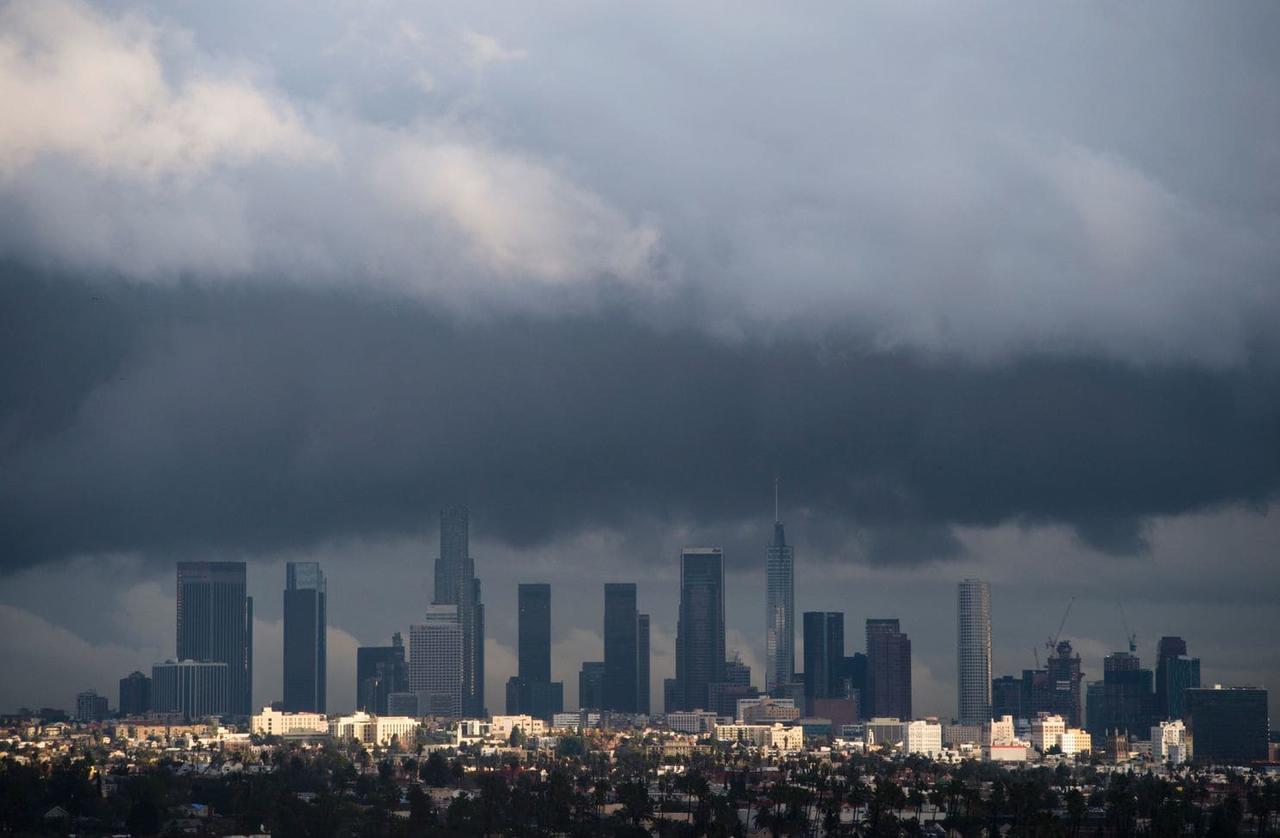

Clouds over Los Angeles, via AFP/Getty
Science Daily. "This study provides an opportunity to rethink the impact of clouds on climate. When galactic cosmic rays increase, so do low clouds, and when cosmic rays decrease clouds do as well, so climate warming may be caused by an opposite-umbrella effect."

In their related paper, aptly titled, “No experimental evidence for the significant anthropogenic [man-made] climate change”, the Finnish scientists find that low cloud cover "practically" controls global temperatures but that “only a small part” of the increased carbon dioxide concentration is anthropogenic, or caused by human activity.

The following is a key bombshell section in one of the studies conducted by Finland's Turku University team:
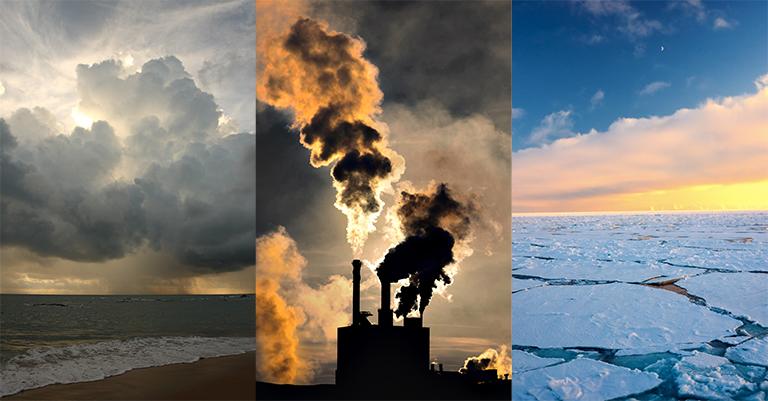

Image source: NASA
Conclusions from both the Japanese and Finnish studies strongly suggest, for example, that Rep. Alexandria Ocasio-Cortez's "drastic measures to cut carbon emissions" which would ultimately require radical legislation changes to "remake the U.S. economy" would not only potentially bankrupt everyone but simply wouldn't even work, at least according to the new Finnish research team findings.

To put AOC's "drastic measures" in perspective — based entirely on the fundamental assumption of the monumental and disastrous impact of human activity on the climate — consider the following conclusions from the Finnish studies:

“During the last hundred years the temperature increased about 0.1°C because of carbon dioxide. The human contribution was about 0.01°C.

Which leads the scientists to state further:

“Because the anthropogenic portion in the increased carbon dioxide is less than 10 percent, we have practically no anthropogenic climate change,” the researchers concluded.

And the team in Japan has called for a total reevaluation of current climate models, which remain dangerously flawed for dismissing a crucial variable:

This study provides an opportunity to rethink the impact of clouds on climate. When galactic cosmic rays increase, so do low clouds, and when cosmic rays decrease clouds do as well, so climate warming may be caused by an opposite-umbrella effect. The umbrella effect caused by galactic cosmic rays is important when thinking about current global warming as well as the warm period of the medieval era.

Failure to account for this results in the following, according to the one in the series of studies: "The IPCC climate sensitivity is about one order of magnitude too high, because a strong negative feedback of the clouds is missing in climate models."


Image source: AFP/Getty
"If we pay attention to the fact that only a small part of the increased CO2 concentration is anthropogenic, we have to recognize that the anthropogenic climate change does not exist in practice," the researchers conclude.

Though we doubt the ideologues currently pushing to radically remake the American economy through what ends up being a $93 trillion proposal (according to one study) — including AOC's call for a whopping 70% top tax rate — will carefully inquire of this new bombshell scientific confirmation presented in the new research, we at least hope the US scientific community takes heed before it's too late in the cause of accurate and authentic science that would stave off irreparable economic disaster that would no doubt ripple across the globe, adding to both human and environmental misery.

And "too late" that is, not for some mythical imminent or near-future "global warming Armageddon" as the currently in vogue highly politicized "science" of activists and congress members alike claims.
 

79eer

Junior
Oct 4, 2008
8,544
394
83
Bombshell Claim: Scientists Find "Man-made Climate Change Doesn't Exist In Practice"


Image source: NASA
Conclusions from both the Japanese and Finnish studies strongly suggest, for example, that Rep. Alexandria Ocasio-Cortez's "drastic measures to cut carbon emissions" which would ultimately require radical legislation changes to "remake the U.S. economy" would not only potentially bankrupt everyone but simply wouldn't even work
Guessing you accidentally omitted “NEWS FLASH” at the beginning of the article.
 

moe

Junior
May 29, 2001
32,863
284
83
Interesting research. The Finnish and Japanese must have stock in Exxon and WV coal because their research needs to be expanded to prove to disprove. Maybe we can take the green energy subsidies and get to the bottom of this...

Bombshell Claim: Scientists Find "Man-made Climate Change Doesn't Exist In Practice"

by Tyler Durden
Fri, 07/12/2019 - 05:55
194
SHARES
TwitterFacebookRedditEmailPrint

one among a series of papers.

This has been collaborated by a team at Kobe University in Japan, which has furthered the Finnish researchers' theory: "New evidence suggests that high-energy particles from space known as galactic cosmic rays affect the Earth's climate by increasing cloud cover, causing an 'umbrella effect'," the just published study has found, a summary of which has been released in the journal Science Daily. The findings are hugely significant given this 'umbrella effect' — an entirely natural occurrence — could be the prime driver of climate warming, and not man-made factors.


Clouds over Los Angeles, via AFP/Getty
Science Daily. "This study provides an opportunity to rethink the impact of clouds on climate. When galactic cosmic rays increase, so do low clouds, and when cosmic rays decrease clouds do as well, so climate warming may be caused by an opposite-umbrella effect."

In their related paper, aptly titled, “No experimental evidence for the significant anthropogenic [man-made] climate change”, the Finnish scientists find that low cloud cover "practically" controls global temperatures but that “only a small part” of the increased carbon dioxide concentration is anthropogenic, or caused by human activity.

The following is a key bombshell section in one of the studies conducted by Finland's Turku University team:


Image source: NASA
Conclusions from both the Japanese and Finnish studies strongly suggest, for example, that Rep. Alexandria Ocasio-Cortez's "drastic measures to cut carbon emissions" which would ultimately require radical legislation changes to "remake the U.S. economy" would not only potentially bankrupt everyone but simply wouldn't even work, at least according to the new Finnish research team findings.

To put AOC's "drastic measures" in perspective — based entirely on the fundamental assumption of the monumental and disastrous impact of human activity on the climate — consider the following conclusions from the Finnish studies:

“During the last hundred years the temperature increased about 0.1°C because of carbon dioxide. The human contribution was about 0.01°C.

Which leads the scientists to state further:

“Because the anthropogenic portion in the increased carbon dioxide is less than 10 percent, we have practically no anthropogenic climate change,” the researchers concluded.

And the team in Japan has called for a total reevaluation of current climate models, which remain dangerously flawed for dismissing a crucial variable:

This study provides an opportunity to rethink the impact of clouds on climate. When galactic cosmic rays increase, so do low clouds, and when cosmic rays decrease clouds do as well, so climate warming may be caused by an opposite-umbrella effect. The umbrella effect caused by galactic cosmic rays is important when thinking about current global warming as well as the warm period of the medieval era.

Failure to account for this results in the following, according to the one in the series of studies: "The IPCC climate sensitivity is about one order of magnitude too high, because a strong negative feedback of the clouds is missing in climate models."


Image source: AFP/Getty
"If we pay attention to the fact that only a small part of the increased CO2 concentration is anthropogenic, we have to recognize that the anthropogenic climate change does not exist in practice," the researchers conclude.

Though we doubt the ideologues currently pushing to radically remake the American economy through what ends up being a $93 trillion proposal (according to one study) — including AOC's call for a whopping 70% top tax rate — will carefully inquire of this new bombshell scientific confirmation presented in the new research, we at least hope the US scientific community takes heed before it's too late in the cause of accurate and authentic science that would stave off irreparable economic disaster that would no doubt ripple across the globe, adding to both human and environmental misery.

And "too late" that is, not for some mythical imminent or near-future "global warming Armageddon" as the currently in vogue highly politicized "science" of activists and congress members alike claims.
Galactic cosmic rays! Duh..


Boomboom521

Redshirt
Mar 14, 2014
20,115
6
0
Henrik Svensmark has proposed that galactic cosmic rays (GCRs) could exert significant influence over global temperatures (Svensmark 1998). The theory goes that the solar magnetic field deflects GCRs, which are capable of seeding cloud formation on Earth. So if the solar magnetic field were to increase, fewer GCRs would reach Earth, seeding fewer low-level clouds, which are strongly reflective. Thus an increased solar magnetic field can indirectly decrease the Earth's albedo (reflectivity), causing the planet to warm. Therefore, in order for this theory to be plausible, all four of the following requirements must be true.

  1. Solar magnetic field must have a long-term positive trend.
  2. Galactic cosmic ray flux on Earth must have a long-term negative trend.
  3. Cosmic rays must successfully seed low-level clouds.
  4. Low-level cloud cover must have a long-term negative trend.
Fortunately we have empirical observations against which we can test these requirements.

Solar magnetic field
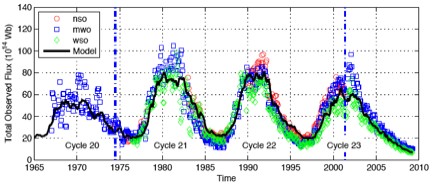
Solar magnetic field strength correlates strongly with other solar activity, such as solar irradiance and sunspot number. As is the case with these other solar attributes, solar magnetic field has not changed appreciably over the past three decades (Lockwood 2001).


Figure 1: Solar Magnetic Flux from 1967 to 2009 (Vieira and Solanki 2010)

Galactic Cosmic Ray Flux
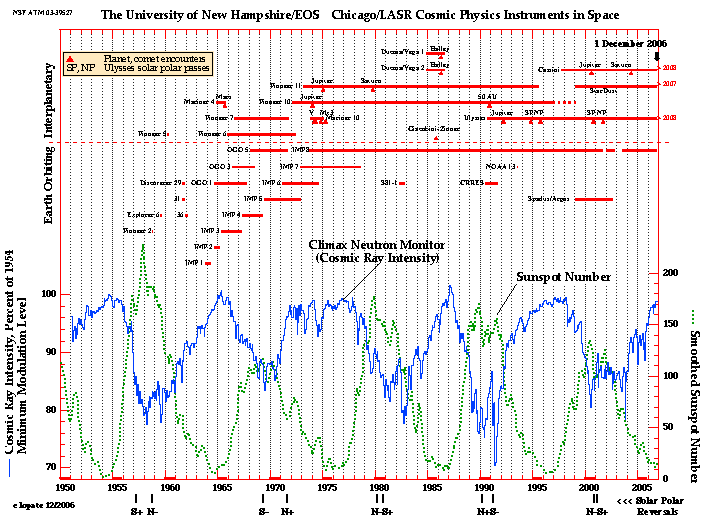
Cosmic ray flux on Earth has been monitored since the mid-20th century, and has shown no significant trend over that period.


Figure 2: Cosmic Ray Intensity (blue) and Sunspot Number (green) from 1951 to 2006 (University of New Hampshire)

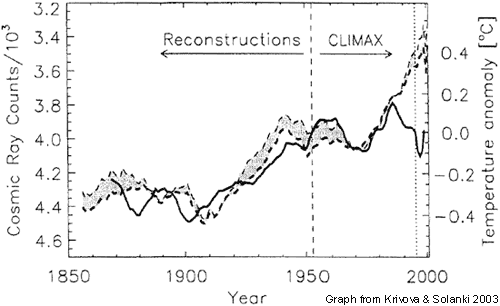
In fact cosmic ray flux has lagged behind the global temperature change since approximately 1970 (Krivova 2003).

"between 1970 and 1985 the cosmic ray flux, although still behaving similarly to the temperature, in fact lags it and cannot be the cause of its rise. Thus changes in the cosmic ray flux cannot be responsible for more than 15% of the temperature increase"


Figure 3: Reconstructed cosmic radiation (solid line before 1952) and directly observed cosmic radiation (solid line after 1952) compared to global temperature (dotted line). All curves have been smoothed by an 11 year running mean (Krivova 2003).

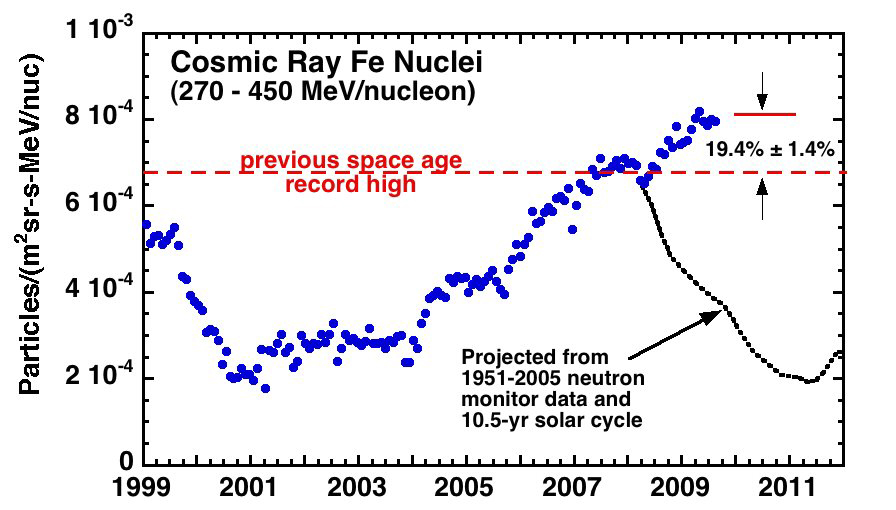
Benestad (2013) compared cosmic ray flux to global surface temperature changes and found "there is little empirical evidence that links GCR to the recent global warming." In fact, since 1990, galactic cosmic ray flux on Earth has increased - "the opposite direction to that required to explain the observed rise in global mean temperatures" (Lockwood 2007). In fact, cosmic ray on flux recently reached record levels. According to Richard Mewaldt of Caltech, "In 2009, cosmic ray intensities have increased 19% beyond anything we've seen in the past 50 years." Erlykin et al. (2013) noted (emphasis added),

"Recent measurements of the cosmic ray intensity show that a former decrease with time has been reversed. Thus, even if cosmic rays enhanced cloud production, there would be a small global cooling, not warming."


Figure 4: Record cosmic ray flux observed in 2009 by the Advanced Composition Explorer (NASA)

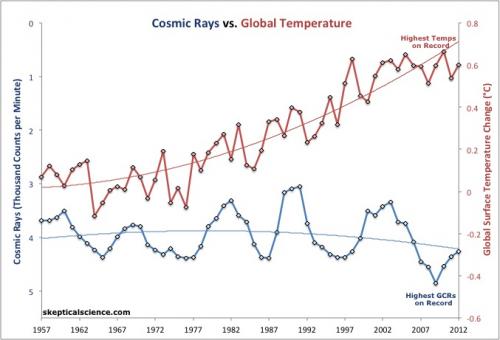
Despite this record high GCR flux which we would expect to increase cloud cover and cause cooling, 2009 was tied for the second-hottest year on record, and the 12-month running mean global surface temperature record was broken 3 times in 2010 (NASA GISS).


Figure 5: Annual average GCR counts per minute (blue - note that numbers decrease going up the left vertical axis, because lower GCRs should mean higher temperatures) from the Neutron Monitor Database vs. annual average global surface temperature (red, right vertical axis) from NOAA NCDC, both with second order polynomial fits.

GCR Cloud Seeding
In order for GCRs to successfully seed clouds, they must achieve the following three steps.

  1. GCRs must induce aerosol formation
  2. These newly-formed aerosols must grow sufficiently (through the condensation of gases in the atmosphere) to form cloud-condensation nuclei (CCN)
  3. The CCN must lead to increased cloud formation.
The first step is not controversial, and is being investigated by the CERN CLOUD experiment. A recent study by Enghoff et al. (2011) also demonstrated some success in inducing aerosol formation under laboratory conditions, although they have yet to test the process under atmospheric conditions.

However, the second step is often glossed over by those espousing the GCR warming theory. Freshly nucleated particles must grow by approximately a factor of 100,000 in mass before they can effectively scatter solar radiation or be activated into a cloud droplet (Verheggen 2009). Pierce and Adams (2009) investigated this second step by using a a general circulation model with online aerosol microphysics in order to evaluate the growth rate of aerosols from changes in cosmic ray flux, and found that they are far too small to play a significant role in cloud formation or climate change.

"In our simulations, changes in CCN from changes in cosmic rays during a solar cycle are two orders of magnitude too small to account for the observed changes in cloud properties; consequently, we conclude that the hypothesized effect is too small to play a significant role in current climate change."

Numerous studies have also investigated the effectiveness of GCRs in cloud formation (the third step). Kazil et al. (2006) found:

"the variation of ionization by galactic cosmic rays over the decadal solar cycle does not entail a response...that would explain observed variations in global cloud cover."

Sloan and Wolfendale (2008) found:

"we estimate that less than 23%, at the 95% confidence level, of the 11-year cycle changes in the globally averaged cloud cover observed in solar cycle 22 is due to the change in the rate of ionization from the solar modulation of cosmic rays."

Kristjansson et al. (2008) found:

"no statistically significant correlations were found between any of the four cloud parameters and GCR"

Calogovic et al. (2010) found:

"no response of global cloud cover to Forbush decreases at any altitude and latitude."

Kulmala et al. (2010) found

"galactic cosmic rays appear to play a minor role for atmospheric aerosol formation events, and so for the connected aerosol-climate effects as well."

Laken et al. (2013) found

"there is no robust evidence of a widespread link between the cosmic ray flux and clouds."

Krissansen-Totton & Davies (2013) found

"no statistically significant correlations between cosmic rays and global albedo or globally averaged cloud height, and no evidence for any regional or lagged correlations"

In the CERN CLOUD experiments, Almeida et al. (2013)found

"ionising radiation such as the cosmic radiation that bombards the atmosphere from space has negligible influence on the formation rates of these particular aerosols [that form clouds]"

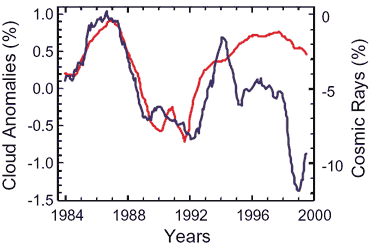
Although there was a correlation between GCRs and low-level cloud cover until about 1991, after that point the correlation broke down (Laut 2003) and cloud cover began to lag GCR trends by over 6 months, while cloud formation should occur within several days (Yu 2000).


Figure 6: Low cloud cover (blue line) versus cosmic ray intensity (red line) (Laut 2003).

Low-Level Cloud Cover
Unfortunately observational low-level cloud cover data is somewhat lacking and even yields contradictory results. Norris et al. (2007) found

"Global mean time series of surface- and satellite-observed low-level and total cloud cover exhibit very large discrepancies, however, implying that artifacts exist in one or both data sets....The surface-observed low-level cloud cover time series averaged over the global ocean appears suspicious because it reports a very large 5%-sky-cover increase between 1952 and 1997. Unless low-level cloud albedosubstantially decreased during this time period, the reduced solar absorption caused by the reported enhancement of cloud cover would have resulted in cooling of the climate system that is inconsistent with the observed temperature record."

So the jury is still out regarding whether or not there's a long-term trend in low-level cloud cover.

Lack of evidence for significant historical climateimpacts
Sloan & Wolfendale (2013) examined the influence of cosmic rays on the climate over the past billion years. They found that changes in the galactic cosmic ray intensity are too small to account for significant climate changes on Earth. This was also the conclusion of Feng & Bailer-Jones (2013).

Inability to explain other observations
In addition to these multiple lines of empirical evidence which contradict the GCR warming theory, the galactic cosmic ray theory cannot easily explain a number of observed fingerprints of the increased greenhouse effect, such as the cooling of the upper atmosphere and greater warming at night than day.

Additionally, because cosmic radiation shows greater variation in high latitudes, we expect larger changes in cloud cover in polar regions if GCRs are succesfully influencing cloud cover. This is not observed. Furthermore, examining the nuclear reactor accident at Chernobyl, ionization from the radioactivity would be expected to have produced an increase in cloud cover. There is no evident increase in cloud cover following the accident (Sloan 2007).

Galactic cosmic rays can't explain global warming
In summary, studies have shown that GCRs exert a minor influence over low-level cloud cover, solar magnetic field has not increased in recent decades, nor has GCR flux on Earth decreased. In fact, if GCRs did have a significant impact on global temperatures, they would have had a net cooling effect over the past 50 years, especially over the past 50 years when global warming was strongest. Sloan & Wolfendale (2013) found that the contribution of solar activityand galactic cosmic rays (combined) to global warming is "less than 10% of the warming seen in the twentieth century."
 

Boomboom521

Redshirt
Mar 14, 2014
20,115
6
0
Interesting research. The Finnish and Japanese must have stock in Exxon and WV coal because their research needs to be expanded to prove to disprove. Maybe we can take the green energy subsidies and get to the bottom of this...

Bombshell Claim: Scientists Find "Man-made Climate Change Doesn't Exist In Practice"

by Tyler Durden
Fri, 07/12/2019 - 05:55
194
SHARES
TwitterFacebookRedditEmailPrint

one among a series of papers.

This has been collaborated by a team at Kobe University in Japan, which has furthered the Finnish researchers' theory: "New evidence suggests that high-energy particles from space known as galactic cosmic rays affect the Earth's climate by increasing cloud cover, causing an 'umbrella effect'," the just published study has found, a summary of which has been released in the journal Science Daily. The findings are hugely significant given this 'umbrella effect' — an entirely natural occurrence — could be the prime driver of climate warming, and not man-made factors.


Clouds over Los Angeles, via AFP/Getty
Science Daily. "This study provides an opportunity to rethink the impact of clouds on climate. When galactic cosmic rays increase, so do low clouds, and when cosmic rays decrease clouds do as well, so climate warming may be caused by an opposite-umbrella effect."

In their related paper, aptly titled, “No experimental evidence for the significant anthropogenic [man-made] climate change”, the Finnish scientists find that low cloud cover "practically" controls global temperatures but that “only a small part” of the increased carbon dioxide concentration is anthropogenic, or caused by human activity.

The following is a key bombshell section in one of the studies conducted by Finland's Turku University team:


Image source: NASA
Conclusions from both the Japanese and Finnish studies strongly suggest, for example, that Rep. Alexandria Ocasio-Cortez's "drastic measures to cut carbon emissions" which would ultimately require radical legislation changes to "remake the U.S. economy" would not only potentially bankrupt everyone but simply wouldn't even work, at least according to the new Finnish research team findings.

To put AOC's "drastic measures" in perspective — based entirely on the fundamental assumption of the monumental and disastrous impact of human activity on the climate — consider the following conclusions from the Finnish studies:

“During the last hundred years the temperature increased about 0.1°C because of carbon dioxide. The human contribution was about 0.01°C.

Which leads the scientists to state further:

“Because the anthropogenic portion in the increased carbon dioxide is less than 10 percent, we have practically no anthropogenic climate change,” the researchers concluded.

And the team in Japan has called for a total reevaluation of current climate models, which remain dangerously flawed for dismissing a crucial variable:

This study provides an opportunity to rethink the impact of clouds on climate. When galactic cosmic rays increase, so do low clouds, and when cosmic rays decrease clouds do as well, so climate warming may be caused by an opposite-umbrella effect. The umbrella effect caused by galactic cosmic rays is important when thinking about current global warming as well as the warm period of the medieval era.

Failure to account for this results in the following, according to the one in the series of studies: "The IPCC climate sensitivity is about one order of magnitude too high, because a strong negative feedback of the clouds is missing in climate models."


Image source: AFP/Getty
"If we pay attention to the fact that only a small part of the increased CO2 concentration is anthropogenic, we have to recognize that the anthropogenic climate change does not exist in practice," the researchers conclude.

Though we doubt the ideologues currently pushing to radically remake the American economy through what ends up being a $93 trillion proposal (according to one study) — including AOC's call for a whopping 70% top tax rate — will carefully inquire of this new bombshell scientific confirmation presented in the new research, we at least hope the US scientific community takes heed before it's too late in the cause of accurate and authentic science that would stave off irreparable economic disaster that would no doubt ripple across the globe, adding to both human and environmental misery.

And "too late" that is, not for some mythical imminent or near-future "global warming Armageddon" as the currently in vogue highly politicized "science" of activists and congress members alike claims.

Guessing you accidentally omitted “NEWS FLASH” at the beginning of the article.
I know it goes against what you want to be fact.....but scientists have tested every theory out there. Observations, models, and scientific testing and evaluations have been a MAJOR focus of the scientific community since the 1960’s. A lot of intelligent people at prestigious universities have looked at every aspect of the climate over that period of time.

Debate policy -sure. You can’t debate the facts. Man-made climate change is a fact.
 

Pospecteer

All-Conference
Dec 8, 2006
36,507
3,172
113
Tyler Durden!!!! :joy::joy::joy:


WWTDD

I thought the same thing but the research is real. this is from phys.org

Solar activity has a direct impact on Earth's cloud cover
by Morten Garly Andersen, Technical University of Denmark


A team of scientists from the National Space Institute at the Technical University of Denmark (DTU Space) and the Racah Institute of Physics at the Hebrew University of Jerusalem has linked large solar eruptions to changes in Earth's cloud cover in a study based on over 25 years of satellite observations.

The solar eruptions are known to shield Earth's atmosphere from cosmic rays. However the new study, published in Journal of Geophysical Research: Space Physics, shows that the global cloud cover is simultaneously reduced, supporting the idea that cosmic rays are important for cloud formation. The eruptions cause a reduction in cloud fraction of about 2 percent corresponding to roughly a billion tonnes of liquid water disappearing from the atmosphere.

Since clouds are known to affect global temperatures on longer timescales, the present investigation represents an important step in the understanding of clouds and climate variability.

"Earth is under constant bombardment by particles from space called galactic cosmic rays. Violent eruptions at the Sun's surface can blow these cosmic rays away from Earth for about a week. Our study has shown that when the cosmic rays are reduced in this way there is a corresponding reduction in Earth's cloud cover. Since clouds are an important factor in controlling the temperature on Earth our results may have implications for climate change", explains lead author on the study Jacob Svensmark of DTU.

Very energetic particles

These particles generate electrically charged molecules—ions—in Earth's atmosphere. Ions have been shown in the laboratory to enhance the formation of aerosols, which can serve as seeds for the formation of the cloud drops that make up a cloud. Whether this actually happens in the atmosphere, or only in the laboratory is a topic that has been investigated and debated for years.

When the large solar eruptions blow away the galactic cosmic rays before they reach Earth they cause a reduction in atmospheric ions of up to about 20 to -30 percent over the course of a week. So if ions affect cloud formation it should be possible to observe a decrease in cloud cover during events when the Sun blows away cosmic rays, and this is precisely what is done in this study.


The so-called 'Forbush decreases' of the cosmic rays have previously been linked to week-long changes in Earth's cloud cover but the effect has been debated at length in the scientific literature. The new study concludes that "there is a real impact of Forbush decreases on cloud microphysics" and that the results support the suggestion that "ions play a significant role in the life-cycle of clouds".


Arriving at that conclusion was, however, a hard endeavor; Very few strong Forbush decreases occur and their effect on cloud formation is expected to be close to the limit of detection using global atmospheric observations measured by satellites and land based stations. Therefore it was of the greatest importance to select the strongest events for study since they had to have the most easily detected effect. Determining this strength required combining data from about 130 stations in combination with atmospheric modeling.

This new method resulted in a list of 26 events in the period of 1987-2007 ranked according to ionization. This ranked list was important for the detection of a signal, and may also shed some light on why previous studies have arrived at varied conclusions, since they have relied on events that were not necessarily ranked high on the list.

Possible long term effect

The effect from Forbush decreases on clouds is too brief to have any impact on long-term temperature changes.

However since clouds are affected by short term changes in galactic cosmic radiation, they may well also be affected by the slower change in Solar activity that happens on scales from tens to hundreds of years, and thus play a role in the radiation budget that determines the global temperature.

The Suns contribution to past and future climate change may thus be larger than merely the direct changes in radiation, concludes the scientists behind the new study.
 

Boomboom521

Redshirt
Mar 14, 2014
20,115
6
0
But they are real and they do impact clouds. Worth researching more before we spend trillions in climate change

https://phys.org/news/2016-08-solar-impact-earth-cloud.html
It’s been researched.

I know many of you have no respect for what they do in academia, but they take their roles in our society VERY seriously. Scientists do not just simply follow the King and the Church’s decrees any longer, they actively and passionately seek real answers and solutions by applying the scientific method to questions.
 

Pospecteer

All-Conference
Dec 8, 2006
36,507
3,172
113
Winter monsoons became stronger during geomagnetic reversal
Revealing the impact of cosmic rays on the Earth's climate
Date:
July 3, 2019
Source:
Kobe University
Summary:
New evidence suggests that high-energy particles from space known as galactic cosmic rays affect the Earth's climate by increasing cloud cover, causing an 'umbrella effect'.
Share:
Materials provided by Kobe University. Note: Content may be edited for style and length.

Journal Reference:

  1. Yusuke Ueno, Masayuki Hyodo, Tianshui Yang, Shigehiro Katoh. Intensified East Asian winter monsoon during the last geomagnetic reversal transition. Scientific Reports, 2019; 9 (1) DOI: 10.1038/s41598-019-45466-8
Cite This Page:

Kobe University. "Winter monsoons became stronger during geomagnetic reversal: Revealing the impact of cosmic rays on the Earth's climate." ScienceDaily. ScienceDaily, 3 July 2019. <www.sciencedaily.com/releases/2019/07/190703121407.htm>.


advertisement


WVUCOOPER

Redshirt
Dec 10, 2002
55,556
40
31
I thought the same thing but the research is real. this is from phys.org

Solar activity has a direct impact on Earth's cloud cover
by Morten Garly Andersen, Technical University of Denmark


A team of scientists from the National Space Institute at the Technical University of Denmark (DTU Space) and the Racah Institute of Physics at the Hebrew University of Jerusalem has linked large solar eruptions to changes in Earth's cloud cover in a study based on over 25 years of satellite observations.

The solar eruptions are known to shield Earth's atmosphere from cosmic rays. However the new study, published in Journal of Geophysical Research: Space Physics, shows that the global cloud cover is simultaneously reduced, supporting the idea that cosmic rays are important for cloud formation. The eruptions cause a reduction in cloud fraction of about 2 percent corresponding to roughly a billion tonnes of liquid water disappearing from the atmosphere.

Since clouds are known to affect global temperatures on longer timescales, the present investigation represents an important step in the understanding of clouds and climate variability.

"Earth is under constant bombardment by particles from space called galactic cosmic rays. Violent eruptions at the Sun's surface can blow these cosmic rays away from Earth for about a week. Our study has shown that when the cosmic rays are reduced in this way there is a corresponding reduction in Earth's cloud cover. Since clouds are an important factor in controlling the temperature on Earth our results may have implications for climate change", explains lead author on the study Jacob Svensmark of DTU.

Very energetic particles

These particles generate electrically charged molecules—ions—in Earth's atmosphere. Ions have been shown in the laboratory to enhance the formation of aerosols, which can serve as seeds for the formation of the cloud drops that make up a cloud. Whether this actually happens in the atmosphere, or only in the laboratory is a topic that has been investigated and debated for years.

When the large solar eruptions blow away the galactic cosmic rays before they reach Earth they cause a reduction in atmospheric ions of up to about 20 to -30 percent over the course of a week. So if ions affect cloud formation it should be possible to observe a decrease in cloud cover during events when the Sun blows away cosmic rays, and this is precisely what is done in this study.


The so-called 'Forbush decreases' of the cosmic rays have previously been linked to week-long changes in Earth's cloud cover but the effect has been debated at length in the scientific literature. The new study concludes that "there is a real impact of Forbush decreases on cloud microphysics" and that the results support the suggestion that "ions play a significant role in the life-cycle of clouds".


Arriving at that conclusion was, however, a hard endeavor; Very few strong Forbush decreases occur and their effect on cloud formation is expected to be close to the limit of detection using global atmospheric observations measured by satellites and land based stations. Therefore it was of the greatest importance to select the strongest events for study since they had to have the most easily detected effect. Determining this strength required combining data from about 130 stations in combination with atmospheric modeling.

This new method resulted in a list of 26 events in the period of 1987-2007 ranked according to ionization. This ranked list was important for the detection of a signal, and may also shed some light on why previous studies have arrived at varied conclusions, since they have relied on events that were not necessarily ranked high on the list.

Possible long term effect

The effect from Forbush decreases on clouds is too brief to have any impact on long-term temperature changes.

However since clouds are affected by short term changes in galactic cosmic radiation, they may well also be affected by the slower change in Solar activity that happens on scales from tens to hundreds of years, and thus play a role in the radiation budget that determines the global temperature.

The Suns contribution to past and future climate change may thus be larger than merely the direct changes in radiation, concludes the scientists behind the new study.
Just find it so on brand for you to read and post from a movie character. Total lib move.
 

Pospecteer

All-Conference
Dec 8, 2006
36,507
3,172
113
From NASA


Galactic Cosmic Rays
Galactic Cosmic Rays in the News


Galactic cosmic rays (GCRs) come from outside the solar system but generally from within our Milky Way galaxy. GCRs are atomic nuclei from which all of the surrounding electronshave been stripped away during their high-speed passage through the galaxy. They have probably been accelerated within the last few million years, and have traveled many times across the galaxy, trapped by the galactic magnetic field. GCRs have been accelerated to nearly the speed of light, probably by supernova remnants. As they travel through the very thin gas of interstellar space, some of the GCRs interact and emit gamma rays, which is how we know that they pass through the Milky Way and other galaxies.

The elemental makeup of GCRs has been studied in detail , and is very similar to the composition of the Earth and solar system. but studies of the composition of the isotopes in GCRs may indicate the that the seed population for GCRs is neither the interstellar gas nor the shards of giant stars that went supernova. This is an area of current study.


The image on the right is the EGRET gamma ray all-sky survey, courtesy of Dr. Carl Fichtel and the EGRET Instrument Science Team. Some GCRs interact with the interstellar medium and produce gamma rays. More about the interstellar medium...

Included in the cosmic rays are a number of radioactive nuclei whose numbers decrease over time. As in the carbon-14 dating technique, measurements of these nuclei can be used to determine how long it has been since cosmic ray material was synthesized in the galactic magnetic field before leaking out into the vast void between the galaxies. These nuclei are called "cosmic ray clocks".

Read about an experiment helping us to study GCRs: TIGER, the Trans-Iron Galactic Element Recorder
 

Pospecteer

All-Conference
Dec 8, 2006
36,507
3,172
113
I know it goes against what you want to be fact.....but scientists have tested every theory out there. Observations, models, and scientific testing and evaluations have been a MAJOR focus of the scientific community since the 1960’s. A lot of intelligent people at prestigious universities have looked at every aspect of the climate over that period of time.

Debate policy -sure. You can’t debate the facts. Man-made climate change is a fact.

I am not a scientist but we all know that they have not tested every theory out there and we are still looking for solid data to prove or disprove man made climate change.

We use modeling to try and link past climate to our current capabilities.
 

Boomboom521

Redshirt
Mar 14, 2014
20,115
6
0
I am not a scientist but we all know that they have not tested every theory out there and we are still looking for solid data to prove or disprove man made climate change.

We use modeling to try and link past climate to our current capabilities.

My god, the amount of “solid data” that proves it is staggering. You simply don’t want to see it
 

Boomboom521

Redshirt
Mar 14, 2014
20,115
6
0
I am not a scientist but we all know that they have not tested every theory out there and we are still looking for solid data to prove or disprove man made climate change.

We use modeling to try and link past climate to our current capabilities.
Solid data: CO2 that is produced from either burning fossil fuels or burning forests has a unique isotopic form than other CO2, so it can literally be measured how much carbon we are putting into the air.
 

Pospecteer

All-Conference
Dec 8, 2006
36,507
3,172
113
Solid data: CO2 that is produced from either burning fossil fuels or burning forests has a unique isotopic form than other CO2, so it can literally be measured how much carbon we are putting into the air.

I posted an article about new research that points to a different cause of climate change. I said we need to look into it further. Are you saying that it's a closed case and now research is not needed, just action?

Look no further than medicine to show how continued research is needed to help us evolve our knowledge of the world. It was not that long ago that smoking was supposed to help with asthma. There are many things in medicine that has done a 180 from conventional wisdom once believed to be closed science and how we treat the disease now.

Some professor from Princeton does not believe that CO2 is bad, in fact, CO2 is needed to grow plants. It is as important as O2 in keeping us alive. His is 100% right in his statement but he is getting discredited on a daily basis.
 

Boomboom521

Redshirt
Mar 14, 2014
20,115
6
0
I posted an article about new research that points to a different cause of climate change. I said we need to look into it further. Are you saying that it's a closed case and now research is not needed, just action?

Look no further than medicine to show how continued research is needed to help us evolve our knowledge of the world. It was not that long ago that smoking was supposed to help with asthma. There are many things in medicine that has done a 180 from conventional wisdom once believed to be closed science and how we treat the disease now.

Some professor from Princeton does not believe that CO2 is bad, in fact, CO2 is needed to grow plants. It is as important as O2 in keeping us alive. His is 100% right in his statement but he is getting discredited on a daily basis.
I don’t know if it’s just your lack of basic understanding of the subject, or your overwealming desire to discredit science consensus— but

1) it’s not a new concept that cosmic rays contribute to warming, and that warming in turn contributes to climate change. That has been looked into extensively, actually. It’s contribution has been considered in evaluation in many research projects (if not all). I posted an article explaining why this source cannot be seen as the leading contributor to rapid climate change we are witnessing today.

2) Action absolutely is needed immediately. What action that would be is open for debate. Costs are already having an impact in most coastal cities in the US, so we need to reverse the effects as best we can as soon as we can. You stubbornly disagree that man is the cause? Fine, but you can’t deny what the problem is CO2, and that it needs to be dealt with (unless you deny facts). So, let’s figure out ways to do that. Changing how we farm, for example, figuring out the complexities and problems with nuclear power, growing coral, recycling, solar panels on homes, electric cars, etc.... The market can’t adjust naturally fast enough, government is needed.

3) Research and observation will ALWAYS be needed. It should never stop. Misinformation and pseudo-science needs to stop in this area, so we can stop the denial.

4) CO2 is a good thing, when in balance. We are absolutely throwing that balance out of fvcking whack, and that’s the problem.
 

boomerwv

Freshman
Jan 16, 2008
9,988
79
48
The research you are citing hasn't been published in any scientific journal or been peer reviewed.
 

Pospecteer

All-Conference
Dec 8, 2006
36,507
3,172
113
I don’t know if it’s just your lack of basic understanding of the subject, or your overwealming desire to discredit science consensus— but

1) it’s not a new concept that cosmic rays contribute to warming, and that warming in turn contributes to climate change. That has been looked into extensively, actually. It’s contribution has been considered in evaluation in many research projects (if not all). I posted an article explaining why this source cannot be seen as the leading contributor to rapid climate change we are witnessing today.

2) Action absolutely is needed immediately. What action that would be is open for debate. Costs are already having an impact in most coastal cities in the US, so we need to reverse the effects as best we can as soon as we can. You stubbornly disagree that man is the cause? Fine, but you can’t deny what the problem is CO2, and that it needs to be dealt with (unless you deny facts). So, let’s figure out ways to do that. Changing how we farm, for example, figuring out the complexities and problems with nuclear power, growing coral, recycling, solar panels on homes, electric cars, etc.... The market can’t adjust naturally fast enough, government is needed.

3) Research and observation will ALWAYS be needed. It should never stop. Misinformation and pseudo-science needs to stop in this area, so we can stop the denial.

4) CO2 is a good thing, when in balance. We are absolutely throwing that balance out of fvcking whack, and that’s the problem.

1) New research is indicating otherwise. It is currently being published. Might be BS but it needs addressed.

2) I live on the East Coast, less than 60 miles from the shore. I have at least 25 friends who own summer homes or actually live on the shore, never once have they complained about global warming and its impact on owning property literally on the shore. This includes homes in NH, MA, NY, NJ, DE, MD, NC, SC, FL, and CA. My son lives less than 5 miles from the Ocean and works in NYC, never once has he complained about climate change and his ability to make a living, let alone impact his quality of life. Tell me specifically what you are talking about.

3) Climate Change research is less than 100 years old (being generous). In 20 years what we currently know will be vastly different than what we think today. I remember in college being told that costal cities would be underwater by 2020 unless we did something. Guess what, we have not done anything correct?

4) Say what you what, but it is not out of whack, just not what someone thinks it should be. Who has decided what the baseline should be when the world is millions of years old? There is a documentary on Prime researching why the dino's died. I was told growing up it was CO2. Now they are saying that it was cloud cover caused my a meteor that hit Mexico. Stated that if it was CO2 the small mammals would not have survived which lead to us being here. Pretty interesting stuff.
 

Boomboom521

Redshirt
Mar 14, 2014
20,115
6
0
1) New research is indicating otherwise. It is currently being published. Might be BS but it needs addressed.

2) I live on the East Coast, less than 60 miles from the shore. I have at least 25 friends who own summer homes or actually live on the shore, never once have they complained about global warming and its impact on owning property literally on the shore. This includes homes in NH, MA, NY, NJ, DE, MD, NC, SC, FL, and CA. My son lives less than 5 miles from the Ocean and works in NYC, never once has he complained about climate change and his ability to make a living, let alone impact his quality of life. Tell me specifically what you are talking about.

3) Climate Change research is less than 100 years old (being generous). In 20 years what we currently know will be vastly different than what we think today. I remember in college being told that costal cities would be underwater by 2020 unless we did something. Guess what, we have not done anything correct?

4) Say what you what, but it is not out of whack, just not what someone thinks it should be. Who has decided what the baseline should be when the world is millions of years old? There is a documentary on Prime researching why the dino's died. I was told growing up it was CO2. Now they are saying that it was cloud cover caused my a meteor that hit Mexico. Stated that if it was CO2 the small mammals would not have survived which lead to us being here. Pretty interesting stuff.
Economic Impact
Since 1980, extreme weather has cost $1.6 trillion. Munich Re, the world's largest reinsurance firm, blamed climate change for $24 billion of losses in the California wildfires. It warned that insurance firms will have to raise premiums to cover rising costs from extreme weather. That could make insurance too expensive for most people.


Scientists estimated that, if temperatures only rose 2 C, global gross domestic productwould fall 15%. If temperatures rose to 3 C, global GDP would fall 25%. If nothing is done, temperatures will rise by 4 C by 2100. Global GDP would decline by more than 30% from 2010 levels. That's worse than the Great Depression, where global trade fell 25%. The only difference is that it would be permanent.


The World Employment and Social Outlook 2018 estimated that climate change threatens 1.2 billion jobs.

The industries most at risk are agriculture, fisheries, and forestry. Maine is already seeing a decline in its lobster catches. Natural disasters have already cost 23 million working life years since 2000. On the other hand, efforts to stop climate change would create 24 million new jobs by 2030.
Climate change creates mass migrationaround the world. Immigrants are leaving flooded coastlines, drought-stricken farmlands, and areas of extreme natural disasters. Since 2008, extreme weather has displaced 22.5 million people according to the United Nations High Commissioner for Refugees. By 2050, climate change will force 700 million people to emigrate.


Climate change is causing mass migration around the world.

Immigrants are leaving flooded coastlines, drought-stricken farmlands, and areas of extreme natural disasters. Since 2008, extreme weather has displaced 22.5 million peopleaccording to the United Nations High Commissioner for Refugees. By 2050, climate change will force 700 million people to emigrate.


Immigration at the U.S. border will only increase as climate change worsens conditions in Latin America. The World Bank estimates that climate change could send 1.4 million people north by 2050. Drought, shifting rain patterns, and extreme weather destroys crops and leads to food insecurity. The World Food Program foundthat almost half of Central American immigrants left because there wasn't enough food.


In 2017, the U.S. Department of Defense reported that climate change is a “direct threat” to U.S. national security.

Climate change endangers 128 military bases. A 2018 Pentagon survey revealed that U.S. Naval Academy in Annapolis, Md. has experienced storm surge flooding and hurricane damage. The Cape Lisburne Long Range Radar Station in Alaska has lost a seawall from extreme weather. In response, Congress asked DoD to identify the 10 most vulnerable sites and recommend solution strategies.
As America experiences more extremely hot days, food prices are rising. Corn and soybean yields in the United States plummet precipitously when temperatures rise above 84 degrees Fahrenheit. Those crops feed cattle and other meat sources. It's created spikes in beef, milk, and poultry prices. Worker productivity declines sharply, particularly for outdoor jobs. That further increases the cost of food.


A 2019 study found that a warming ocean has pushed global fish yields down 4% since 1920. That's 1.4 million metric tons. In the North Atlantic and Sea of Japan, that decline is 35%. That affects Atlantic cod, haddock, and herring. Many species are threatened with extinction. That affects the 3 billion people who rely on fish for their primary source of protein. It also affects the $100 billion fishing industry and the 56 million people employed. It especially affects the United States, which imports 90% of its seafood.
 

Pospecteer

All-Conference
Dec 8, 2006
36,507
3,172
113
Economic Impact
Since 1980, extreme weather has cost $1.6 trillion. Munich Re, the world's largest reinsurance firm, blamed climate change for $24 billion of losses in the California wildfires. It warned that insurance firms will have to raise premiums to cover rising costs from extreme weather. That could make insurance too expensive for most people.

Scientists estimated that, if temperatures only rose 2 C, global gross domestic productwould fall 15%. If temperatures rose to 3 C, global GDP would fall 25%. If nothing is done, temperatures will rise by 4 C by 2100. Global GDP would decline by more than 30% from 2010 levels. That's worse than the Great Depression, where global trade fell 25%. The only difference is that it would be permanent.

The World Employment and Social Outlook 2018 estimated that climate change threatens 1.2 billion jobs.

The industries most at risk are agriculture, fisheries, and forestry. Maine is already seeing a decline in its lobster catches. Natural disasters have already cost 23 million working life years since 2000. On the other hand, efforts to stop climate change would create 24 million new jobs by 2030.
Climate change creates mass migrationaround the world. Immigrants are leaving flooded coastlines, drought-stricken farmlands, and areas of extreme natural disasters. Since 2008, extreme weather has displaced 22.5 million people according to the United Nations High Commissioner for Refugees. By 2050, climate change will force 700 million people to emigrate.

Don't want to be a dick but these are estimates. We currently don't have flooded coastlines (excluded hurricane season) Extreme weather is not not climate change, its a singular event.

Climate change is causing mass migration around the world.

Immigrants are leaving flooded coastlines, drought-stricken farmlands, and areas of extreme natural disasters. Since 2008, extreme weather has displaced 22.5 million peopleaccording to the United Nations High Commissioner for Refugees. By 2050, climate change will force 700 million people to emigrate.


Immigration at the U.S. border will only increase as climate change worsens conditions in Latin America. The World Bank estimates that climate change could send 1.4 million people north by 2050. Drought, shifting rain patterns, and extreme weather destroys crops and leads to food insecurity. The World Food Program foundthat almost half of Central American immigrants left because there wasn't enough food.


In 2017, the U.S. Department of Defense reported that climate change is a “direct threat” to U.S. national security.

Climate change endangers 128 military bases. A 2018 Pentagon survey revealed that U.S. Naval Academy in Annapolis, Md. has experienced storm surge flooding and hurricane damage. The Cape Lisburne Long Range Radar Station in Alaska has lost a seawall from extreme weather. In response, Congress asked DoD to identify the 10 most vulnerable sites and recommend solution strategies.
As America experiences more extremely hot days, food prices are rising. Corn and soybean yields in the United States plummet precipitously when temperatures rise above 84 degrees Fahrenheit. Those crops feed cattle and other meat sources. It's created spikes in beef, milk, and poultry prices. Worker productivity declines sharply, particularly for outdoor jobs. That further increases the cost of food.


A 2019 study found that a warming ocean has pushed global fish yields down 4% since 1920. That's 1.4 million metric tons. In the North Atlantic and Sea of Japan, that decline is 35%. That affects Atlantic cod, haddock, and herring. Many species are threatened with extinction. That affects the 3 billion people who rely on fish for their primary source of protein. It also affects the $100 billion fishing industry and the 56 million people employed. It especially affects the United States, which imports 90% of its seafood.

I can tell you are passionate about this and I applaud you for your concern for the planet. I am 100% in agreement that we need to take care of this world and conserving all of our resources, cleaning up the oceans, picking up trash and recycling when appropriate.

I question science because of the flaws in collection (the major climate change paper that started all of this admitted that they actually changed the hard data from ocean temperature collection devices-no one ever should change the actual data- instead of accounting for it in their modeling.) They admitted that if they changed their modeling, it did not give them the results they were looking for.

I used to present pharma articles to physicians, of course we only paid for studies that showed our products in a positive light or made our competitor look bad. I learned how to look at study design to point out flaws, etc. I see similar tactics used in climate change, on both sides.

You have showed me a ton of what if's and anecdotal evidence but not a true link. Extreme weather is not proof that man made global warming is happening, it does prove that climate change is happening just like it has the last 1000 years. In fact, you have produced zero links to increased CO2 levels and climate change.

I am all-in on promoting less consumption (except beer and wine), cleaning our forest s and oceans, etc. I am 100% against forcing the USA to make dramatic changes to how we live, while other countries continue with the status quo.
 

Boomboom521

Redshirt
Mar 14, 2014
20,115
6
0
I can tell you are passionate about this and I applaud you for your concern for the planet. I am 100% in agreement that we need to take care of this world and conserving all of our resources, cleaning up the oceans, picking up trash and recycling when appropriate.

I question science because of the flaws in collection (the major climate change paper that started all of this admitted that they actually changed the hard data from ocean temperature collection devices-no one ever should change the actual data- instead of accounting for it in their modeling.) They admitted that if they changed their modeling, it did not give them the results they were looking for.

I used to present pharma articles to physicians, of course we only paid for studies that showed our products in a positive light or made our competitor look bad. I learned how to look at study design to point out flaws, etc. I see similar tactics used in climate change, on both sides.

You have showed me a ton of what if's and anecdotal evidence but not a true link. Extreme weather is not proof that man made global warming is happening, it does prove that climate change is happening just like it has the last 1000 years. In fact, you have produced zero links to increased CO2 levels and climate change.

I am all-in on promoting less consumption (except beer and wine), cleaning our forest s and oceans, etc. I am 100% against forcing the USA to make dramatic changes to how we live, while other countries continue with the status quo.
Thanks for being open minded about it at least. There’s a lot of misinformation on the topic, but I don’t mind the questioning of data at all — that’s healthy.

As for policy, I’m on the extreme end, but recognize the economic impacts of extreme policy action. If we can get to a place where all agree on the facts, we can find ways to move forward that benefits everyone.

As for international policy, NOTHING gets done on a global UNIFORM scale unless the US moves seriously. You know that, the world in many ways looks to us.
 

Pospecteer

All-Conference
Dec 8, 2006
36,507
3,172
113
Thanks for being open minded about it at least. There’s a lot of misinformation on the topic, but I don’t mind the questioning of data at all — that’s healthy.

As for policy, I’m on the extreme end, but recognize the economic impacts of extreme policy action. If we can get to a place where all agree on the facts, we can find ways to move forward that benefits everyone.

As for international policy, NOTHING gets done on a global UNIFORM scale unless the US moves seriously. You know that, the world in many ways looks to us.

I can respect that. Don't agree, but I respect it.