You had Delta.I don't know what variant I had and, according to my friend who is the head nurse at the VA hospital, no one else does either...takes them 3+ months to get variant results after sending off data.
Day 1-3 was 102 degree temps, body aches, chills, headache and searing pain in my chest as I coughed up the nastiest stuff I've ever seen in my life. Lethargy. Vitamins C, D, Zinc, Mucinex, Tylenol Advil.
Days 4-9 - fever was gone. Thought my head was going to explode. Serious pressure in nose/sinuses. Lethargy. Searing pain in chest was gone by day 6. Productive cough continued. Vitamins C, D, Mucinex, Tylenol Advil
Got smart and called Doc on Day 9 and was prescribed steroid Medrol. Within 12 minutes of first dose the pressure in my head lessened and I could breathe through my nose. Lethargy.
Days 10-14 - could take a nap anytime, anywhere. productive cough.
Days 15-16 - continue to cough up stuff. a lot of stuff. Can take a nap anytime, anywhere.
I rarely get sick so I don't have much to compare this to...but it was awful. The worst part was that every day was the same (especially days 4-9) with zero improvement. somehwere around days 3-5 was intermittent Diarrhea.
Good luck. Get the steroid if nasty cough/lower respiratory.
49 years of age. 75" 180 lbs. No underlying issues.
Almost forgot...phizered 3x
Got the omicron
- Thread starter tigerswin13
- Start date
You are using an out of date browser. It may not display this or other websites correctly.
You should upgrade or use an alternative browser.
You should upgrade or use an alternative browser.
I don’t. One study suggested it. I can’t rule it out, but no, I wouldn’t say it’s conclusive. Is that the only conclusion you could draw from that? Sheep indeed.So, just to be clear, you think early vaccination leads to diabetes?
StrokeExamples of serious side effects??
Bell’s Palsy
Heart Trouble
Thrombosis
Guillain-Barre
I’ll take my chances with the sniffles
Omicron spreading so fast everyone will catch it. No need for additional clinical trials because of natural immunity, which is many times better than a shot.Will keep you out of the hospital or ground.
Phzier's own study says you only increase your chances of not getting Covid by 0.89 of 1%. Side affects and deaths way under reported. It doesn't stop you from getting it and transmitting it. Time between boosters will grow shorter and shorter Per Doctor in our own family. Remember it's experimental. The way it's being pushed so hard is disturbing as I don't think for a minute they care about our health Especially when you add in all the other stuff going on here and abroad. Pray for America
So you think people who don't get the first two jabs are selfish, but it is perfectly ok for you not to get the booster, which has shown the most resistance to the omicron, in particular? I agree with you on many many things, but the view that it IS selfish not to get the first two shots, and is not selfish to forego the booster is ridiculous.I've been vaccilating about the booster. When the morons in DC started talking about the possible need for a second booster, I put it on hold. I know all who vaccinated took a leap of faith from Washington, DC. That's scary as hell to even consider they have the best intentions of We the People on their minds. You can:t lie like a cheap rug ever since the Reagan Presidency and expect us to really believe them. JMO
Good luck. Praying for you brother.Stroke
Bell’s Palsy
Heart Trouble
Thrombosis
Guillain-Barre
I’ll take my chances with the sniffles
Maybe you can tell me why they(vaccines) are still not all FDA approved and why the vax companies are exempt from liability if they are all so UNQUESTIONABLY safe?Tell me about the “long term side effects” of vaccines that don’t show up within a couple of months. Maybe you could also tell us how live or attenuated virus vaccines are somehow safer than vaccines that don’t have the actual virus in them.
So much this. Pretty much every true vaccine is to prevent contraction(and spread) of a disease. This is simply not the case with covid. Does the vax help with reducing the spread for some variants? Yes. Does it prevent contraction like other actual vaccines? No.The semantics part is less important. The more significant point is that many vaccines actually eradicate a disease. Think polio or small pox. By contrast, things like the flu shot just seasonally affect viral transmissions and severity. The covid vaxx is like the flu shot, not like the polio vaccine. The flu shot is recommended, not mandated. That should be the case here as well.
Also, other diseases such as polio would have had severe health consequences for a massive percentage of the population. As it stands now, deaths are about one quarter of one percent of the population total and the total deaths for two years is only about a quarter of the typical number of deaths per year - not to mention there are a significant number of people categorized as covid deaths that likely would have have died within the last two years with or without covid due to comorbidity issues.
Getting over covid now. A few bad days with fever, massive headache, pretty much constant cough and congestion for 7-8 days with little sleep due to cough. No body aches other than being sore from constant coughing. Got it early morning New years eve. Most symptoms gone, but still have cough and pretty tired, but feel much better.
edit to say had two moderna shots in 2021.
edit to say had two moderna shots in 2021.
I don’t need luck or prayers to survive the sniffles, but I appreciate it nonetheless. Do you disagree that all of these side effects have occurred in people who have taken the vaccine?Good luck. Praying for you brother.

Gosh man, you mean to tell me you're not going to test yourself for covid every time you get sick for the rest of your life??Remember three years ago when you use to get sick? You really didn't know why you were sick because you didn't know the name of the virus. You just called it "the flu." Well guess what? We're back to that folks. Hate to break it to you, but every time you get the sniffles now its not a big deal. Man up. Drive through it. You are not typhoid Mary and need to go into lock down. We're back to normal living as human being. Virus have been around a million years. One of their purposes, is to control the population of man. Deal with it.

Uh, that was what you posted. I guess you’re “just asking questions,” right? Never mind the huge amount of evidence that vaccines don’t cause diabetes.I don’t. One study suggested it. I can’t rule it out, but no, I wouldn’t say it’s conclusive. Is that the only conclusion you could draw from that? Sheep indeed.
Do Vaccines Cause Autoimmune Diseases?
Associations between vaccines and autoimmunity are another frequently cited safety concern and have been heavily studied in relation to a number of different autoimmune (AI) disorders including diabetes mellitus type 1 (DM type 1), Guillain Barré Syndrome (GBS), multiple sclerosis (MS) and other demyelinating disorders. Existing epidemiologic studies have found no associations between the number of different vaccines and an increased risk of autoimmune disorders. Two recent systematic reviews looking at the association between different individual vaccines and central demyelinating disorders (hepatitis B, human papilloma virus (HPV), influenza, MMR, varicella, tetanus, Bacillus Calmette Guérin (BCG), polio or diphtheria) concluded that there was no relationship between receipt of a vaccine and development of MS (Mailand and Frederiksen, 2017; Mouchet et al., 2018). Links with DM type 1 have also been extensively studied. A German study which included more than 1900 children from a prospective cohort data set found no association between vaccination and development of DM type 1 in children with a high familial risk of AI disorders (Beyerlein et al., 2017). A metanalysis of 23 different case control studies including 11 different vaccines and 13,000 patients found no association between vaccination and risk of DM type 1 (Morgan et al., 2016).The relationship between vaccines and diabetes has been the subject of several excellent studies.
The hypothesis that the timing of vaccines either causes or prevents diabetes was tested in 21,421 children who received the Haemophilus influenzaetype b (Hib) conjugate vaccine between 1988 and 1990 in the United States. These children were followed for 10 years after receiving the Hib vaccine. The risk of diabetes was indistinguishable from a group of 22,557 children who did not receive the Hib vaccine.
Another excellent study evaluating the relationship between vaccines and diabetes was performed using data from the Vaccine Safety DataLink. Four large health management organizations (HMOs) were used to identify children with diabetes born between 1988 and 1997. All four HMOs maintained registries of children with diabetes and cases were confirmed by means of medical records. Investigators compared 252 cases of diabetes with 768 matched controls. Children who received whole-cell pertussis, MMR, Hib, hepatitis B or varicella vaccines were not at greater risk for diabetes than children who did not receive those vaccines. In accord with the Vaccine Safety DataLink study, several other well-controlled retrospective studies found that immunizations were not associated with an increased risk of developing diabetes.
In 2011 the Institute of Medicine reviewed studies of adverse events related to vaccines. One of the associations studied was whether the tetanus component of the DTaP vaccine caused type 1 diabetes. The committee concluded that development of type 1 diabetes was not caused by receipt of this vaccine. In another study, investigators followed individuals born in 1974 for 20 years who had or had not received the BCG vaccine and found that receipt of vaccine did not increase the risk of diabetes.
Other studies listed below show that children who received the rotavirus, polio, or HPV vaccines were not at greater risk of developing diabetes. In addition, women inoculated with the influenza vaccine during pregnancy were not at increased risk of gestational diabetes.
Therefore, the best available evidence does not support the hypothesis that vaccines cause diabetes.
A multi-institution epidemiological study found no evidence that the routine childhood immunization schedule is associated with the development of type 1 diabetes.
Researchers at eight integrated health care organizations in California, Colorado, Minnesota, Oregon, Washington and Wisconsin examined associations between three measures of the childhood immunization schedule and the incidence of type 1 diabetes in children aged 2 to 14 years.
“One of the concerns that some parents have is the safety of the overall schedule, meaning there is some sort of risk to their child [getting] all of the vaccines as recommended, according to the schedule,” Glanz told Healio. “One of the specific concerns that parents might have is [a fear of] receiving too many vaccines at once might overwhelm their immune system.”
A previous report concluded that available data suggested the schedule was safe but that more research was needed, Glanz said.
“That was sort of the impetus behind this study, to look at the safety of the overall schedule, rather than individual vaccines,” Glanz said. “We chose diabetes because it's an autoimmune disease, and some parents have concerns about vaccines causing autoimmune diseases.”
Using a cohort of 584,171 children from the eight health systems, the researchers examined cumulative antigen exposure in the “first few years of life,” Glanz said, cumulative aluminum exposure through the first 14 months of life and whether either factor increased the risk for diabetes.
The study found that the average number of days unvaccinated and cumulative antigen exposure were not associated with type 1 diabetes. Cumulative vaccine aluminum exposure was associated with a reduced incidence of type 1 diabetes (adjusted HR = 0.89; 95% CI, 0.81-0.97).
“In this study, we didn't see any evidence that getting your vaccines on time increases the risk for an autoimmune disease like diabetes,” Glanz said. “That is something that pediatricians could theoretically use in conversation” with patients about the safety of vaccines.
There is no question vaccines cause GBS in rare cases. The CDC will even admit that much. Any study that starts with the premise that it cannot be caused by vaccines, as this one apparently does, is flawed and invalid, and frankly makes my point below.Uh, that was what you posted. I guess you’re “just asking questions,” right? Never mind the huge amount of evidence that vaccines don’t cause diabetes.
Do Vaccines Cause Autoimmune Diseases?
Associations between vaccines and autoimmunity are another frequently cited safety concern and have been heavily studied in relation to a number of different autoimmune (AI) disorders including diabetes mellitus type 1 (DM type 1), Guillain Barré Syndrome (GBS), multiple sclerosis (MS) and other demyelinating disorders. Existing epidemiologic studies have found no associations between the number of different vaccines and an increased risk of autoimmune disorders. Two recent systematic reviews looking at the association between different individual vaccines and central demyelinating disorders (hepatitis B, human papilloma virus (HPV), influenza, MMR, varicella, tetanus, Bacillus Calmette Guérin (BCG), polio or diphtheria) concluded that there was no relationship between receipt of a vaccine and development of MS (Mailand and Frederiksen, 2017; Mouchet et al., 2018). Links with DM type 1 have also been extensively studied. A German study which included more than 1900 children from a prospective cohort data set found no association between vaccination and development of DM type 1 in children with a high familial risk of AI disorders (Beyerlein et al., 2017). A metanalysis of 23 different case control studies including 11 different vaccines and 13,000 patients found no association between vaccination and risk of DM type 1 (Morgan et al., 2016).
The relationship between vaccines and diabetes has been the subject of several excellent studies.
The hypothesis that the timing of vaccines either causes or prevents diabetes was tested in 21,421 children who received the Haemophilus influenzaetype b (Hib) conjugate vaccine between 1988 and 1990 in the United States. These children were followed for 10 years after receiving the Hib vaccine. The risk of diabetes was indistinguishable from a group of 22,557 children who did not receive the Hib vaccine.
Another excellent study evaluating the relationship between vaccines and diabetes was performed using data from the Vaccine Safety DataLink. Four large health management organizations (HMOs) were used to identify children with diabetes born between 1988 and 1997. All four HMOs maintained registries of children with diabetes and cases were confirmed by means of medical records. Investigators compared 252 cases of diabetes with 768 matched controls. Children who received whole-cell pertussis, MMR, Hib, hepatitis B or varicella vaccines were not at greater risk for diabetes than children who did not receive those vaccines. In accord with the Vaccine Safety DataLink study, several other well-controlled retrospective studies found that immunizations were not associated with an increased risk of developing diabetes.
In 2011 the Institute of Medicine reviewed studies of adverse events related to vaccines. One of the associations studied was whether the tetanus component of the DTaP vaccine caused type 1 diabetes. The committee concluded that development of type 1 diabetes was not caused by receipt of this vaccine. In another study, investigators followed individuals born in 1974 for 20 years who had or had not received the BCG vaccine and found that receipt of vaccine did not increase the risk of diabetes.
Other studies listed below show that children who received the rotavirus, polio, or HPV vaccines were not at greater risk of developing diabetes. In addition, women inoculated with the influenza vaccine during pregnancy were not at increased risk of gestational diabetes.
Therefore, the best available evidence does not support the hypothesis that vaccines cause diabetes.
A multi-institution epidemiological study found no evidence that the routine childhood immunization schedule is associated with the development of type 1 diabetes.
Researchers at eight integrated health care organizations in California, Colorado, Minnesota, Oregon, Washington and Wisconsin examined associations between three measures of the childhood immunization schedule and the incidence of type 1 diabetes in children aged 2 to 14 years.
“One of the concerns that some parents have is the safety of the overall schedule, meaning there is some sort of risk to their child [getting] all of the vaccines as recommended, according to the schedule,” Glanz told Healio. “One of the specific concerns that parents might have is [a fear of] receiving too many vaccines at once might overwhelm their immune system.”
A previous report concluded that available data suggested the schedule was safe but that more research was needed, Glanz said.
“That was sort of the impetus behind this study, to look at the safety of the overall schedule, rather than individual vaccines,” Glanz said. “We chose diabetes because it's an autoimmune disease, and some parents have concerns about vaccines causing autoimmune diseases.”
Using a cohort of 584,171 children from the eight health systems, the researchers examined cumulative antigen exposure in the “first few years of life,” Glanz said, cumulative aluminum exposure through the first 14 months of life and whether either factor increased the risk for diabetes.
The study found that the average number of days unvaccinated and cumulative antigen exposure were not associated with type 1 diabetes. Cumulative vaccine aluminum exposure was associated with a reduced incidence of type 1 diabetes (adjusted HR = 0.89; 95% CI, 0.81-0.97).
“In this study, we didn't see any evidence that getting your vaccines on time increases the risk for an autoimmune disease like diabetes,” Glanz said. “That is something that pediatricians could theoretically use in conversation” with patients about the safety of vaccines.
I am not too interested in the “mainstream consensus” argument. It’s bought and paid for. The people who have a vested interest in vaccines being deemed safe pay for these studies. We have seen that with “science” over and over again. Where’s that ice age they were calling for much of the 20th century?
Of course the serious adverse effects are rare, but they exist. No question about it. And we simply cannot know the long-term effects. If this was a disease likely to be deadly to me, I might take the vaccine, but it isn’t now and never will be, so there is no chance I am taking it.
I had it. Fifteen days in the hospital and a ventilator. It wasn’t the sniffles for me, so I take the vaccine. I believe side effects occur, but I believe the dangers of the sickness are far worse. At least they were for me. But I’m sincere in wishing you the best.I don’t need luck or prayers to survive the sniffles, but I appreciate it nonetheless. Do you disagree that all of these side effects have occurred in people who have taken the vaccine?
Glad you made it ol boy!I had it. Fifteen days in the hospital and a ventilator. It wasn’t the sniffles for me, so I take the vaccine. I believe side effects occur, but I believe the dangers of the sickness are far worse. At least they were for me. But I’m sincere in wishing you the best.
The Pfizer vaccine is already approved. Others have EUAs, and Moderna completed its application for full approval about 3 months ago.Maybe you can tell me why they(vaccines) are still not all FDA approved and why the vax companies are exempt from liability if they are all so UNQUESTIONABLY safe?
This amicus brief, written for a number of doctors groups, from a 2011 Supreme Court case that affirmed that vaccine manufacturers are immune from liability lawsuits filed in state courts explains pretty well the mechanisms through which people claiming to be harmed by vaccines can be compensated, and why it’s important for vaccine manufacturers to have liability protection. It should be noted that a small number of claims, representing a tiny proportion of people receiving vaccines, can lead to a crippling amount of liability for a vaccine manufacturer. That’s why, unless there’s been willful misconduct, alleged damages due to vaccination are treated as side effecrs
The public health benefits of childhood vaccines cannot be overstated. Because of vaccines, a number of debilitating and life-threatening infectious dis- eases have been eliminated or virtually eliminated in this country, thereby not only enhancing the length and quality of life of countless children, but also providing significant savings in direct and indirect costs. It is no wonder that Congress has declared that “[t]he availability and use of vaccines to prevent childhood diseases is among the Nation’s top public health priorities.” H.R. Rep. No. 99-908, at 5 (1986).
In the mid-1980s, the number of vaccine-related lawsuits filed against vaccine manufacturers rose sharply. Although the tort system failed to provide adequate compensation for many children injured by vaccines, the flood of vaccine-related litigation over- whelmed vaccine manufacturers. A genuine threat to the public health emerged as manufacturers abandoned or considered abandoning the vaccine market. As the then-President of the AAP testified: “The threat to our vaccine supply in this country is a real one * * *. We could lose the remainder of our suppliers unless some positive legislative action is taken.” National Childhood Vaccine Injury Compen- sation Act of 1985: Hearing Before the S. Comm. on
Labor and Human Resources, 99th Cong. 8 (Dec. 9, 1985) (hereinafter “Dec. 9, 1985 Hearing”) (statement of Martin Smith, M.D., President of the AAP).
Congress responded by passing the Vaccine Act. The Act established a no-fault alternative compensa- tion program intended to provide adequate compen- sation to children injured by vaccines and to ensure the stability of the vaccine market and thus safe- guard the Nation’s vaccine supply. As the Third Circuit below correctly recognized, the Act furthers that latter objective in part by expressly preempting “all design defect claims, including those based in negligence.” Bruesewitz, 561 F.3d at 248 (emphasis added).
Petitioners contend that the Act preempts design defect claims “only upon a threshold showing that the vaccine’s side effects could not have been pre- vented.” Pet. Br. 25 (emphasis added). As the Third Circuit explained, however, if the Vaccine Act is interpreted “to allow case-by-case analysis of whether particular vaccine side effects are avoidable,” then “every design defect claim is subject to evaluation by a court.” Bruesewitz, 561 F.3d at 246 (emphasis added). Thus, adoption of petitioners’ interpretation of the Act could precipitate the same crisis that Congress sought to avert in passing the Vaccine Act: “the very real possibility of vaccine shortages, and, in turn increasing numbers of unimmunized children, and, perhaps, a resurgence of preventable diseases.” H.R. Rep. No. 99-908, at 7.
This shows that serious side effects due to vaccination are very, very rare:

Vaccine Side Effects
Most people don’t have any serious side effects from vaccines, but common side effects are usually mild and go away quickly on their own.
Yes, we know serious side effects sometimes happen. But we know what those serious side effects are, and they always occur within a couple of months of vaccination. Side effects that only show up years after vaccination just aren’t a thing.There is no question vaccines cause GBS in rare cases. The CDC will even admit that much. Any study that starts with the premise that it cannot be caused by vaccines, as this one apparently does, is flawed and invalid, and frankly makes my point below.
I am not too interested in the “mainstream consensus” argument. It’s bought and paid for. The people who have a vested interest in vaccines being deemed safe pay for these studies. We have seen that with “science” over and over again. Where’s that ice age they were calling for much of the 20th century?
Of course the serious adverse effects are rare, but they exist. No question about it. And we simply cannot know the long-term effects. If this was a disease likely to be deadly to me, I might take the vaccine, but it isn’t now and never will be, so there is no chance I am taking it.
Like I said, it’s really convenient to be able to just dismiss fully vetted science you don’t like by claiming it’s “bought and paid for.” Of course, that doesn’t make the cherry picked stuff that’s unvetted somehow more reliable. But it seems like some people have taken the irrationally reactionary point of view that disagreeing with consensus makes something more reliable, and that consensus is evidence of corruption. Once again, that’s very convenient.

But it seems like some people have taken the irrationally reactionary point of view that disagreeing with consensus makes something more reliable, and that consensus is evidence of corruption.
You're right. Kind of like when the consensus was the world was flat.
 Or that women couldn't perform the duties a man could. With respect to science, there's a truly insane view that somehow there can be consensus in science when by definition, scientific studies have always been about seeking the unknown, not following a group think mentality. Michael Crichton said it well:
"Let’s be clear: the work of science has nothing whatever to do with consensus. Consensus is the business of politics. Science, on the contrary, requires only one investigator who happens to be right, which means that he or she has results that are verifiable by reference to the real world. In science consensus is irrelevant. What is relevant is reproducible results. The greatest scientists in history are great precisely because they broke with the consensus. There is no such thing as consensus science. If it’s consensus, it isn’t science. If it’s science, it isn’t consensus. Period."
Last edited by a moderator:
What was the percentage of the population that died from polio during the outbreak in the 50s? In fact, during the largest epidemic of polio in the US, 52k were infected and around 3k died while 21k were left with at least mild paralysis. That’s a scary number for paralysis, and a high CFR of 5.7%, as well. By contrast, there have been around 60 million confirmed cases of COVID in the US since 2020, with 836k deaths for a CFR of 1.4%. So the problem with COVID is its infectiousness as much as its deadliness (although, 1.4% isn’t anything to shake a stick at).So much this. Pretty much every true vaccine is to prevent contraction(and spread) of a disease. This is simply not the case with covid. Does the vax help with reducing the spread for some variants? Yes. Does it prevent contraction like other actual vaccines? No.
Also, other diseases such as polio would have had severe health consequences for a massive percentage of the population. As it stands now, deaths are about one quarter of one percent of the population total and the total deaths for two years is only about a quarter of the typical number of deaths per year - not to mention there are a significant number of people categorized as covid deaths that likely would have have died within the last two years with or without covid due to comorbidity issues.
So, again, the situation with polio was very different than with COVID. It was far less prevalent, far less infectious, and it wasn’t a respiratory virus. After the Salk vaccine finished trials, it had 60–70% effectiveness against poliovirus type 1, over 90% effective against type 2 and type 3, and 94% effectiveness against the development of bulbar polio. That’s not better, if at all, than the the COVID vaccines. You also have to get 4-5 doses of the polio vaccine over years for it to be fully effective. But with far, far fewer cases during much smaller epidemics, the vaccines were able to more easily control the disease.
I like Michael Crichton, and there’s an inkling of truth in what he’s saying there, but he’s simply wrong in terms of how science progresses paradigmatically. He had a MD, but wasn’t a scientist or philosopher of science.You're right. Kind of like when the consensus was the world was flat.
"Let’s be clear: the work of science has nothing whatever to do with consensus. Consensus is the business of politics. Science, on the contrary, requires only one investigator who happens to be right, which means that he or she has results that are verifiable by reference to the real world. In science consensus is irrelevant. What is relevant is reproducible results. The greatest scientists in history are great precisely because they broke with the consensus. There is no such thing as consensus science. If it’s consensus, it isn’t science. If it’s science, it isn’t consensus. Period."
Also, I’m not even sure when there was a consensus that the world was flat. Even the ancient Greeks had an idea that the Earth is round.
Probably the most important philosopher of science was Thomas Kuhn. Here’s what he had to say:
“Observation and experience can and must drastically restrict the range of admissible scientific belief, else there would be no science. But they cannot alone determine a particular body of such belief. An apparently arbitrary element, compounded of personal and historical accident, is always a formative ingredient of the beliefs espoused by a given scientific community at a given time.”
“
Why should a change of paradigm be called a revolution? In the face of the vast and essential differences between political and scientific development, what parallelism can justify the metaphor that finds revolutions in both?
One aspect of the parallelism must already be apparent. Political revolutions are inaugurated by a growing sense, often restricted to a segment of the political community, that existing institutions have ceased adequately to meet the problems posed by an environment that they have in part created. In much the same way, scientific revolutions are inaugurated by a growing sense, again often restricted to a narrow subdivision of the scientific community, that an existing paradigm has ceased to function adequately in the exploration of an aspect of nature to which that paradigm itself had previously led the way. In both political and scientific development the sense of malfunction that can lead to crisis is prerequisite to revolution.”
Interesting how serious side effects are very, very rare, but "hospitalizations skyrocket for kids"!!! (zoom in and read, it's quite humorous what that author considers "skyrocket" to be)The Pfizer vaccine is already approved. Others have EUAs, and Moderna completed its application for full approval about 3 months ago.
This amicus brief, written for a number of doctors groups, from a 2011 Supreme Court case that affirmed that vaccine manufacturers are immune from liability lawsuits filed in state courts explains pretty well the mechanisms through which people claiming to be harmed by vaccines can be compensated, and why it’s important for vaccine manufacturers to have liability protection. It should be noted that a small number of claims, representing a tiny proportion of people receiving vaccines, can lead to a crippling amount of liability for a vaccine manufacturer. That’s why, unless there’s been willful misconduct, alleged damages due to vaccination are treated as side effecrs
The public health benefits of childhood vaccines cannot be overstated. Because of vaccines, a number of debilitating and life-threatening infectious dis- eases have been eliminated or virtually eliminated in this country, thereby not only enhancing the length and quality of life of countless children, but also providing significant savings in direct and indirect costs. It is no wonder that Congress has declared that “[t]he availability and use of vaccines to prevent childhood diseases is among the Nation’s top public health priorities.” H.R. Rep. No. 99-908, at 5 (1986).
In the mid-1980s, the number of vaccine-related lawsuits filed against vaccine manufacturers rose sharply. Although the tort system failed to provide adequate compensation for many children injured by vaccines, the flood of vaccine-related litigation over- whelmed vaccine manufacturers. A genuine threat to the public health emerged as manufacturers abandoned or considered abandoning the vaccine market. As the then-President of the AAP testified: “The threat to our vaccine supply in this country is a real one * * *. We could lose the remainder of our suppliers unless some positive legislative action is taken.” National Childhood Vaccine Injury Compen- sation Act of 1985: Hearing Before the S. Comm. on
Labor and Human Resources, 99th Cong. 8 (Dec. 9, 1985) (hereinafter “Dec. 9, 1985 Hearing”) (statement of Martin Smith, M.D., President of the AAP).
Congress responded by passing the Vaccine Act. The Act established a no-fault alternative compensa- tion program intended to provide adequate compen- sation to children injured by vaccines and to ensure the stability of the vaccine market and thus safe- guard the Nation’s vaccine supply. As the Third Circuit below correctly recognized, the Act furthers that latter objective in part by expressly preempting “all design defect claims, including those based in negligence.” Bruesewitz, 561 F.3d at 248 (emphasis added).
Petitioners contend that the Act preempts design defect claims “only upon a threshold showing that the vaccine’s side effects could not have been pre- vented.” Pet. Br. 25 (emphasis added). As the Third Circuit explained, however, if the Vaccine Act is interpreted “to allow case-by-case analysis of whether particular vaccine side effects are avoidable,” then “every design defect claim is subject to evaluation by a court.” Bruesewitz, 561 F.3d at 246 (emphasis added). Thus, adoption of petitioners’ interpretation of the Act could precipitate the same crisis that Congress sought to avert in passing the Vaccine Act: “the very real possibility of vaccine shortages, and, in turn increasing numbers of unimmunized children, and, perhaps, a resurgence of preventable diseases.” H.R. Rep. No. 99-908, at 7.
This shows that serious side effects due to vaccination are very, very rare:
Vaccine Side Effects
Most people don’t have any serious side effects from vaccines, but common side effects are usually mild and go away quickly on their own.www.hhs.gov
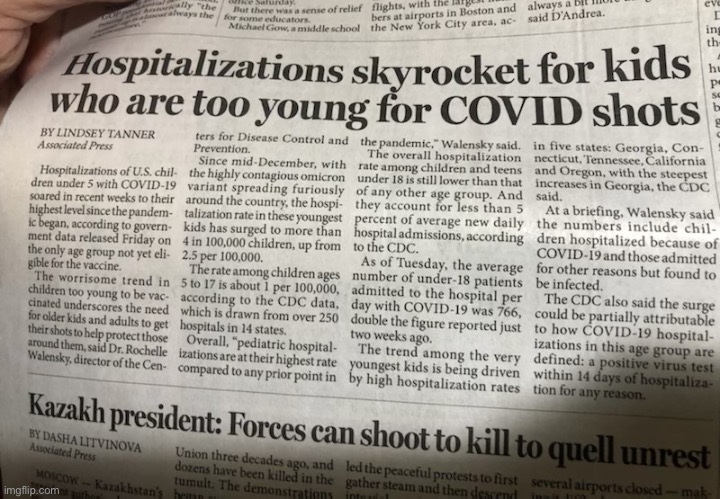
If you actually read the whole headline or piece, I’m not sure what point you’re trying to make.Interesting how serious side effects are very, very rare, but "hospitalizations skyrocket for kids"!!!
I edited my post, an increase from 2.5 hospitalizations out of 100,000 to 4 out of 100,000...yikesIf you actually read the whole headline or piece, I’m not sure what point you’re trying to make.
Yes, that is stupid. And pretty much every public health authority has pointed out that it’s stupid.I edited my post, an increase from 2.5 hospitalizations out of 100,000 to 4 out of 100,000...yikes
If you actually read the whole headline or piece, I’m not sure what point you’re trying to make.
Lindsey Tanner is a piece of work. The premise of her piece is based on false information. Not a surprise these days. It does truly make me sad that you see things as you do. But you have every right to your view even when it's clearly by all evidence and information available... completely wrong.
We've all had it twice. Life goes on and all is well. I was hoping someone with omicron would lick me at the start of this so I could get it over with. No way we escape something this infectious. My kids having it is the least of my concerns. That's the lowest bit of harm that could be done to them in the current climate. Fortunately we've had the means to buy our way out of the rest of the stupidity. But millions of children have not and we've done immeasurable harm to them and their development. It's catastrophic... and all due to our stupidity in understanding the situation we face.
Got any links for those?Yes, that is stupid. And pretty much every public health authority has pointed out that it’s stupid.

You have the flu
Impossible.
The cold and flu were cured. It's all Covid all the time.
So you don't die when you catch it
Say, tell me again the % of people who have died after contacting Omicron.
Low fever; body aches, chills, insomnia and headache days 1-3; lost taste and smell on day 3.5; lethargic the whole time; bouts of nausea and lightheaded too. Feeling progressively better, on day 6, but still not well. I work with children and am NEVER sick, so I can't wait to get off the couch and to be able to smell and taste again. Fully vaxxed and happy about that since it could be worse. Be well!

Getting a test when you were showing no symptoms is the dumbest freaking thing. That’s the problem right now. Somebody gets the sniffles, they run off to CVS and get a test.
Thank goodness parents and even schools are getting less crazy about this. My son had to come home from school the other day because he was congested, small cough and he felt like ***
I thought for sure they were going to make him quarantine or have a negative test but they didn’t. Day of rest and back at school the next day
Going to get tested for a virus with little to no symptoms when not required makes zero sense to me. But to each their own
I am not having a meltdown. Just said I have zero sympathy for you if you get it and it’s serious
Man, people are over the top about this. This dude doesn't care of unvaccinated people get covid and die. They made a personal choice. It's ok for people to do that.
Do you have zero sympathy for alcoholics? Smokers? People who drive without their seatbelts? Those who eat themselves to diabetes? All of these situations present o people with a greater chance to die.
So you're a proud vaxxer. Good for you man. Your choice, got no problem with it. But if you get covid and die should people say, "I got no sympathy for that dude. He got vaxxed and died anyway."?
I think at the crux of this for a lot of people is the fact that the government gave all these manufacturers immunity from suit if people died from their vaccine. Why would they do that if they were 100% sure it is safe - like you seem to be?
Omicron spreading so fast everyone will catch it. No need for additional clinical trials because of natural immunity, which is many times better than a shot.
well everyone may test positive for it if the test continue to be mandatory.
Still insane to me we have a virus that over 60,000,000 have tested positive for and over 98% have recovered and survived and we still let the government control our every move.
I remember in the beginning they talked death rates until the death rates were not what they thought they would be and then it became positive test numbers.
This just needs to go away…wish cancer cures were as much of a priority as this damn vaccines has been
I actively have COVId. I was vaxxed 2x and yet I’m in bed with it. Being vaccinated has not stopped the spread. You’re buying into a lie. It’s a false narrative. This vaccination didn’t prevent me from getting it nor will it stop me from spreading it. This whole battle against the unvaccinated has been debunked. It’s time to start worrying more about the virus and less about the assault on the unvaxxed.Problem bro, is you affect others. Infect is more like it. You don't give them a chance to just say no. Again, jmo.
Thankful for these numbers and prayerful for the .2 percent that did not, I know it would be hard for me to lose someone close.Your numbers are all significantly. It's 99.8% have recovered.
You literally have no idea what you're talking about. Omicron is actually from the B.1.1 lineage and is closer to Alpha than any other variant. It's strange as hell because this lineage was all but wiped out in mid to late 2020 by more transmissible variants. It likely jumped to another species, mutates and jumped back. Plenty of theories on it if you'd like to some medical journal reading. Here is a solid video from a researcher in South Africa. He's puts it in plain terms.
What? There is nothing inconsistent in that video - which I am aware of - with what I said that post. I often listen to Campbell's videos. And Omicron is not close to Alpha - you need to look at the sequenced molecular data to see how far away it is from Alpha. I do not dispute the hypotheses in the video (and in fact agree they could be possible) but jumping from humans to mice then back to humans and mutating to a form that infects the upper respiratory system as opposed to the lungs is radical mutation.
I made exactly the same arguments that he made in my post so get out of here with "you do not know what I am talking about". As already posted later in the thread, it is simply true that the VE is negative for Omicron after 2 months. Half a dozen governments in Europe/Israel have already drawn the same conclusion.
Thankful for these numbers and prayerful for the .2 percent that did not, I know it would be hard for me to lose someone close.
Actually I think my numbers were off. I just woke up a little while ago so I deleted my post. That being said if it's your family then the number is 100%. I'm not trying to be callous about it. But when it comes to these types of situations you have to just look at the numbers. There are so many other deaths and horrors that have been visited upon families because of how we reacted to this. Those numbers are in the tens of thousands and even hundreds of thousands as well. Life is filled with pitfalls. I may die today. But I certainly don't want anyone losing their freedoms because of my death.
Yes yes yes. This is why the system is failed. Our reporters and govt are more excited about the fear porn of case #’s rather than actually working to help those in need. I literally have no clue if I have it (although I obviously do) because our lovely govt now tells me it will be 5-7 days for a test result. So I wait. Signed a vaxxed man actively sick. I did my part yet it has not stopped me from getting or spreading. Hopefully it does lessen my symptoms.Getting a test when you were showing no symptoms is the dumbest freaking thing. That’s the problem right now. Somebody gets the sniffles, they run off to CVS and get a test.
I agree. I am a teacher and the effects on students of this pandemic have created a group of kids that are two years behind in their learning. I just sit in classrooms all day filled with students that I am being later informed were positive for the virus. I am 50 years old and am caring for an adopted child that is eight and my biggest fear is leaving him without someone to fight for him, as I experienced losing my mother at age 5.Actually I think my numbers were off. I just woke up a little while ago so I deleted my post. That being said if it's your family then the number is 100%. I'm not trying to be callous about it. But when it comes to these types of situations you have to just look at the numbers. There are so many other deaths and horrors that have been visited upon families because of how we reacted to this. Those numbers are in the tens of thousands and even hundreds of thousands as well. Life is filled with pitfalls. I may die today. But I certainly don't want anyone losing their freedoms because of my death.
Latest
-
01
 Tiger Illustrated Football
Where we think this Clemson football team stands entering October
Tiger Illustrated Football
Where we think this Clemson football team stands entering October
-
02
 Tiger Illustrated Football
CLEMSON FOOTBALL: The Day After
Tiger Illustrated Football
CLEMSON FOOTBALL: The Day After
-
03
 Tiger Illustrated Football
Clemson grinds up Cal en route to win No. 3
Tiger Illustrated Football
Clemson grinds up Cal en route to win No. 3
-
04
 Tiger Illustrated Football
Davidson, ground game lead Clemson past Cal 24-10
Tiger Illustrated Football
Davidson, ground game lead Clemson past Cal 24-10
-
05
 Tiger Illustrated Football
Clemson - Cal Postgame Notes + Dabo Swinney News Conference
Tiger Illustrated Football
Clemson - Cal Postgame Notes + Dabo Swinney News Conference