Interesting numbers….
Given that he clearly colors his hair (he’s old)…says quite a bit about him…definitely has some Saban vibes…confident, cocky probably an ******* but a great coach and in the end that’s what matters
Interesting numbers….
 www.espn.com

Interesting numbers….
Nah…too different. All these comparisons to Saban. How did he do ?if I was an NFL owner/GM - I would pull out all the stops to hire a Cignetti away from Indiana.
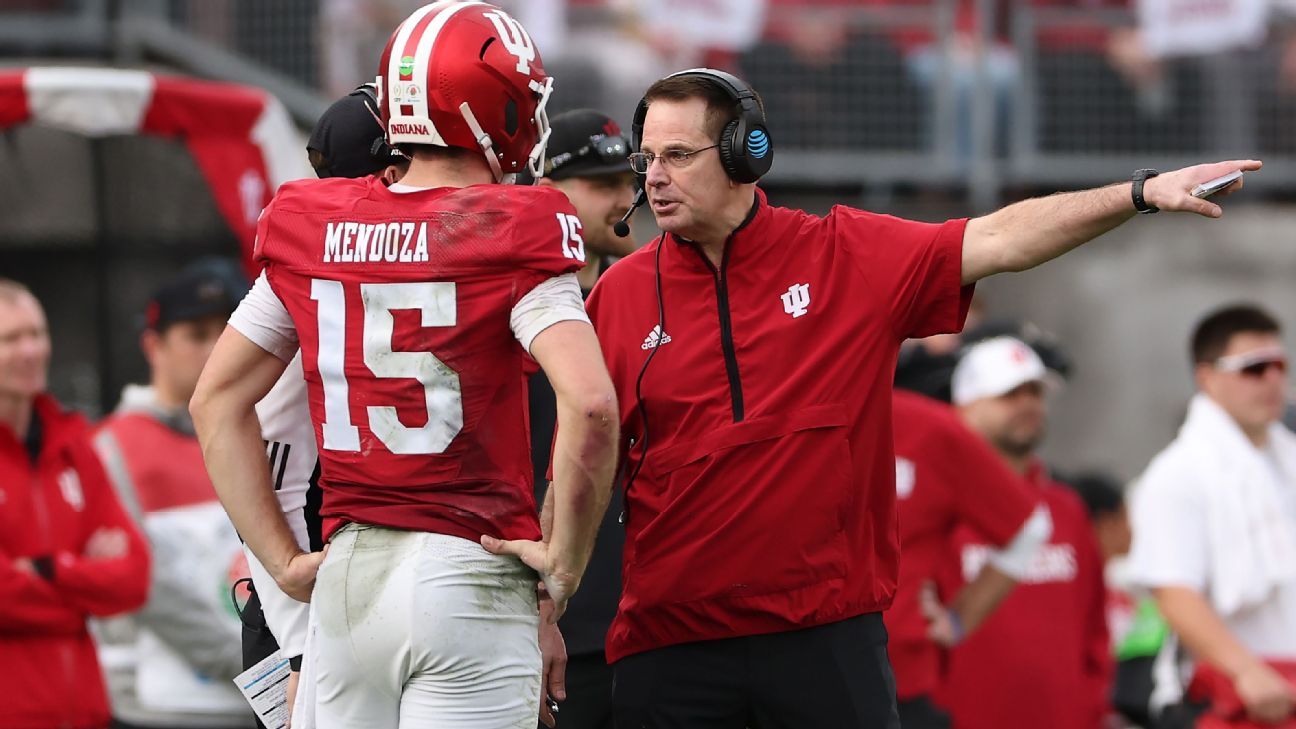
Cignetti at Indiana.

I posted elsewhere but napkin math says the increase in out of state students has brought in an additional $15M per year"Out-of-state students now account for about 50% of IU's total enrollment, with the school admitting a total of 4,697 new out-of-state students in 2025 — roughly 500 more out-of-state students than IU's previous record."
Wow! So much for educating the youth of Indiana at the state university!
I understand that. $$$s drive everything now. Isn't Rutgers capped at 10%? Maybe that's changed.I posted elsewhere but napkin math says the increase in out of state students has brought in an additional $15M per year
Not sure, but you’re correct in that this isn’t exactly how most state university systems were set up to operateI understand that. $$$s drive everything now. Isn't Rutgers capped at 10%? Maybe that's changed.
Got curious and did a Grok search on other billionaire donors for IU (not limited to Athletics), and this turned up:BINGO!!!!!!!!!!!!
Instead of complaining about regular fans are too cheap to support Rutgers Football when they don’t donate thousands of dialers, the Super Fans don’t go after the people with the money like the businesses entrenched in the state, the people who have the spendable thousands and/or millions to properly support the team.
This page always tag on Miami and the guys who played for them that they hate so much. But where’s the players from that great 2006 team, or the ones from 2012 who got screwed by Teddy Bridgewater… or the ones who were blessed by Ash… of the world to come back and support THEIR program with money, support, mentorship’s, and other ways to help out the current Rutgers unlike Ray Lewis, Michael Irvin, Edgerin James, and the other UM Alumni. There’s so many alumni featured in those highlights montages every week one or two of them surely should come back here and there like other schools…
Hell, wasn’t the complaint here was that the Alums usually get snubbed almost every year in some halftime ceremony or two.
BUT SURE… ITS THE FANS FAULT THAT RUTGERS DONT HAVE THE MONEY FOR AN INDOOR FACILITY WHILE THAT ACTUAL PLAYERS AND PEOPLE WHO CAN ACTUALLY DO SOMETHING ABOUT IT BUT DONT USUALLY HAVE THEIR PARTS GARGLED BY THE SAME PEOPLE.
 njbia.org
Yes, but otherwise in the middle of nowhere.It’s a beautiful campus. All in one place. Good town that revolves around the university. Lots to offer.
"Out-of-state students now account for about 50% of IU's total enrollment, with the school admitting a total of 4,697 new out-of-state students in 2025 — roughly 500 more out-of-state students than IU's previous record."
Wow! So much for educating the youth of Indiana at the state university!
Got curious and did a Grok search on other billionaire donors for IU (not limited to Athletics), and this turned up:
Other notable billionaire-level gifts to IU include:
- The Simon family (associated with Simon Property Group, a major real estate company founded by Melvin Simon and his brothers; the family has billionaire-level wealth): They are frequently cited as longtime major donors to IU, supporting various initiatives over the years.
- The Cook family (associated with Cook Medical/Cook Group, a medical device company; Carl Cook and family are billionaires): They are also noted as longstanding significant donors to the university.
IU has received many large donations over time (including from foundations like Lilly Endowment), but the Simons and Cooks stand out as the most consistently mentioned billionaire-affiliated donors beyond Cuban in recent discussions about the university's major backers.These contributions span academics, facilities, and athletics, reflecting IU's broad alumni and philanthropic network.
- Conrad T. Prebys (real estate billionaire and IU alumnus) made a $20 million gift in 2015 to benefit the Kelley School of Business and fund a new university amphitheater.
-----
We have multiple Fortune 500 companies in NJ (Becton Dickinson, J&J, Hertz, and these):
Meanwhile, IU harvests donations from families that moved from Brooklyn to Indianapolis (Simons) and another family that moved from Illinois to Indiana (Cooks).
- Prudential Financial, $70.40 billion
- Merck & Co., $64.16 billion
- Bristol Myers Squibb, $48.30 billion
- PBF Energy, $33.11 billion
- Becton Dickinson & Co., $20.17 billion
- Cognizant Technology Solutions, $19.73 billion
- Automatic Data Processing, $19.20 billion
- Kenvue, $15.45 billion
- Avis Budget Group, $11.78 billion
- Burlington Stores, $10.63 billion
- Public Service Enterprise Group, $10.29 billion
- Quest Diagnostic, $9.87 billion
- Campbell’s, $9.63 billion
- Zoetis, $9.25 billion
Rutgers needs to do better in harvesting whales.
15 NJ Companies Make Fortune 500 List for 2025
Fifteen New Jersey companies have been named to the Fortune 500 list of the nation’s largest revenue companies for 2025. The list, released today,
You read too much into my post and/or missed the point (which may not have been clear).Equating the size or revenues of a corporation with wealthy individuals is comparing apples and oranges. Individuals don't have costs of goods sold nor businesses physical plants.
You read too much into my post and/or missed the point (which may not have been clear).
The point is there are billion dollar companies located in (and in some cases (J&J and Becton Dickinson) founded in NJ. Willing to bet higher ups and VPs have Rutgers degrees. Rutgers landed a deal with SHI for the football stadium. They partnered with Barnabas for the Performance Center. When we visited Minnesota, there was a 3M Arena.
Why can't Rutgers do the same? They have many opportunities.
You are missing the larger point I was trying to make. There are bigger fish (actually mammals-whales) for Rutgers to land.Rutgers did the same with Jersey Mike's. Can't do 3M without a hockey team. 3M paid 11.3 mil. for 15 year naming rights. What did Jersey Mike's pay?

Saban was mediocre in the NFL, but compared to the NFL tenures of Urban Meyer, Bobby Petrino, Steve Spurrier, and our own Greg Schiano, he was Vince Lombardi.Nah…too different. All these comparisons to Saban. How did he do ?
The theories are facile. Old team? Well, yeah. Welcome to modern college football. Indiana’s starting lineup for the Peach Bowl detonation of Oregon included five sixth-year veterans, three fifth-year guys, 10 fourth-year players, two in their third year and one in his second.
Being old helps. But if being old decided championships, BYU would have a trophy case full of them. And let’s not pretend other schools aren’t doing the same thing—or at least attempting to. They’re dumb if they’re not scouring the market for experienced, productive players.
If poor Oregon was at an experience disadvantage last week, what about last year when it had sixth-year starting quarterback Dillon Gabriel, who played in 64 FBS games? What about Stetson Bennett winning national titles at Georgia at ages 24 and 25? What about Indiana’s opposing quarterback in the title game, sixth-year collegian Carson Beck?
The theories are myopic. Billionaire alum Cuban made his first Indiana football donation after Curt Cignetti’s breakthrough debut season, going 11–2 in 2024. He recently told Front Office Sports that he’s made another one, larger this time. But how much money did it take to get a bunch of three-star prospects out of the transfer portal?
The Hoosiers started five James Madison transfers against Oregon, plus a sixth player who was committed to the Dukes before Cignetti left that school for Indiana. There also were transfers from Texas State and Navy in the lineup, plus nine from power-conference programs. The rest have spent their full careers as Hoosiers.
None of them arrived as market-topping free agents, or even close. There are football programs that are the pet projects of billionaires, including those that were waxed in the Orange Bowl and Peach Bowl. This Indiana team is not one of them.
Over the course of time, recruiting rankings have mattered. High school evaluations have gotten better in recent decades, and many of the highest-rated players at that level become the biggest stars in college and in the NFL.
This season, with this team, recruiting rankings don’t matter at all. Indiana is the ultimate revenge of the three-stars. And there is a chance that these kind of aberrations will become more frequent as we move deeper into the paradigm-shifting era of unlimited transfers.
Or there is a chance that Cignetti is simply coaching on a different plane from everyone else. It’s not like he hasn’t kicked the competition’s behinds for the last 15 years at multiple levels. He was 53–17 at Division II IU-Pennsylvania, then 33–14 at the FCS ranks at Elon and James Madison, then 19–4 with the Dukes as an FBS newcomer. Going 26–2 at Indiana is just the next progression.
The algorithms have been altered by Mark Cuban. That's cheating.He wins. Google him.

That probably accounts for some of the volume but 50% of the total enrollment? I doubt it. They're chasing $$$.Indiana U. is roughly the same size as Rutgers New Brunswick. Yet the NJ population is roughly 9.7 million and Indiana's is roughly 7.1 million. That gives them room for more OOS students.
State Population comparisons across the two universities aren’t clean:That probably accounts for some of the volume but 50% of the total enrollment? I doubt it. They're chasing $$$.
From the article:
When Curt Cignetti took the Indiana job a couple of years ago, staff members at another power-conference school looked at the James Madison roster to see if they should pillage Cignetti’s now-former team. An assistant coach on that staff said they decided not to pursue any of Cignetti’s players.
“We’re like, ah, he’s not big enough, he’s not tall enough, he’s not this, he’s not that,” the assistant said. “Then they went with him to Indiana.”
“Everyone is already trying to get older and more experienced and everyone is trying to get the best QB — Indiana just did it better.”
“(Indiana) had an older team, but you can’t just go out and get a bunch of senior mercenaries, sign them up and let’s try to go out with the oldest team we can. That doesn’t win football games,” this head coach said.
Of course, before you keep good players, you have to get them. Indiana had money, but it didn’t outspend everyone, and definitely not when Cignetti first arrived two years ago. Therein lies another lesson.
“More than anything, what makes a good head football coach looks really different than it did 10 years ago,” this coach said. “It used to be that you needed to be a great high school evaluator, relationship builder, and good ol’ boy with donors. Now, you better be really good at evaluating college tape and knowing how to price it, all while building relationships with players to help them not leave.”
One of the power-conference assistants said he has coached against teams with overwhelming talent, for which they had no answers. In Indiana’s case, the frustration was more technical. The Hoosiers just never messed up.
I don’t think they’re doing anything schematically that is cutting-edge, but they’re really sound in all they do and they’re fundamentally as well coached as anybody in the country, and they’re consistent.”
From the article:
When Curt Cignetti took the Indiana job a couple of years ago, staff members at another power-conference school looked at the James Madison roster to see if they should pillage Cignetti’s now-former team. An assistant coach on that staff said they decided not to pursue any of Cignetti’s players.
“We’re like, ah, he’s not big enough, he’s not tall enough, he’s not this, he’s not that,” the assistant said. “Then they went with him to Indiana.”
“Everyone is already trying to get older and more experienced and everyone is trying to get the best QB — Indiana just did it better.”
“(Indiana) had an older team, but you can’t just go out and get a bunch of senior mercenaries, sign them up and let’s try to go out with the oldest team we can. That doesn’t win football games,” this head coach said.
Of course, before you keep good players, you have to get them. Indiana had money, but it didn’t outspend everyone, and definitely not when Cignetti first arrived two years ago. Therein lies another lesson.
“More than anything, what makes a good head football coach looks really different than it did 10 years ago,” this coach said. “It used to be that you needed to be a great high school evaluator, relationship builder, and good ol’ boy with donors. Now, you better be really good at evaluating college tape and knowing how to price it, all while building relationships with players to help them not leave.”
One of the power-conference assistants said he has coached against teams with overwhelming talent, for which they had no answers. In Indiana’s case, the frustration was more technical. The Hoosiers just never messed up.
I don’t think they’re doing anything schematically that is cutting-edge, but they’re really sound in all they do and they’re fundamentally as well coached as anybody in the country, and they’re consistent.”

And their players were older. Alabama, Oregon, and Miami were at a disadvantage .But, but, but , but Mark Cuban bought that 2024-25 roster for them with all the money he gave!
Great! Did we have any Mark Cuban level alums?Rutgers is:

