
Terry would have been a journalism student from 72-76. he went to work out at the Orange County Register.
Looks like we probably just missed crossing paths then.
Terry would have been a journalism student from 72-76. he went to work out at the Orange County Register.
WTF are you talking about...
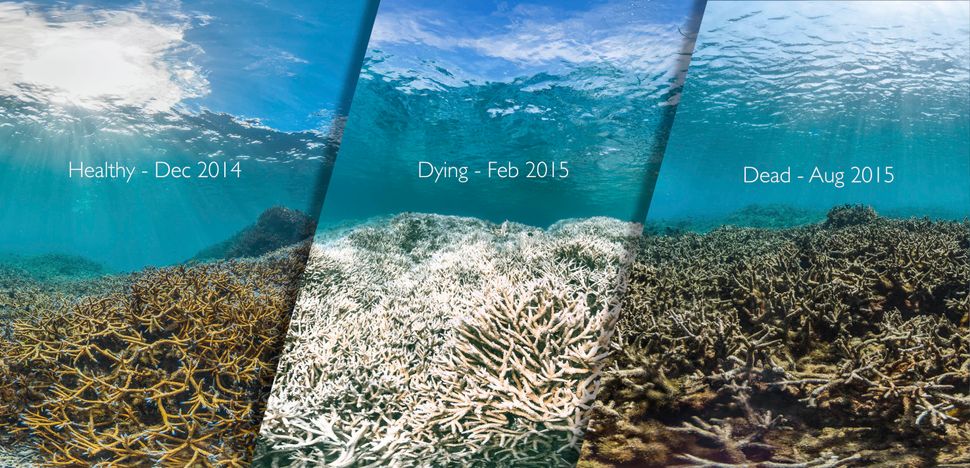
You mean hearing him speak or reading his childish rants on Twitter don't make you cringe?I voted for him because his policies were better than Hillary's, Imo. Plus, she is so unlikable, untrustworthy and makes me cringe when I hear her speak.
Rising CO2 levels, temperature and other things related to it are killing plant and animal life. You can't just say 'the climate is always changing' without trying to understand it further.
You mean hearing him speak or reading his childish rants on Twitter don't make you cringe?
You said nothing has turned out like they predicted. Wrong.[/QUOTE]How do you know "man" caused those variables? Doing what?
You said nothing has turned out like they predicted. Wrong.
You said nothing has turned out like they predicted. Wrong.[/QUOTE]How do you know "man" caused those variables? Doing what?
You said nothing has turned out like they predicted. Wrong.
Reefs died due to rising temps. We predicted this.[/QUOTE]What did we (man) do to dry up those coral reefs shown in that pic inside of one year? Who predicted that, and what did we do?
Reefs died due to rising temps. We predicted this.
Google Greenhouse Effect.[/QUOTE]How did we cause the temps to rise...by how much...doing what? Who predicted it? Who is "we"?
A few points. Rising CO2 does not cause deforestation. In fact, CO2 is required for plant and tree growth. It's their fuel. Sea levels have been rising since we emerged from the Little Ice Age. Again, the degree man is responsible is the big question. Third, warmists have claimed that warming will mean more hurricanes, more unusual weather, more droughts, etc. That has not proven to be the case. In fact, we have far fewer hurricanes than in years past.
Before we destroy fossil fuels and transfer trillions of dollars to third world countries (to keep them from using fossil fuels), let's do a lot more work on global warming and man's role. A lot more.
Good lord man, take some friendly advice. You are not a scientist. Stop commenting on global warming. You look like a complete moron. You constantly deny things that are proven facts.
What are your proven facts?
Warmer ocean temperatures contribute to higher likelihood of hurricanes.
Warmer ocean temperatures contribute to higher likelihood of hurricanes.
That's just one of many.
We've been in a hurricane drought. LOL.
http://dailycaller.com/2014/03/20/number-of-hurricanes-reaches-30-year-low/
http://www.livescience.com/50704-hurricane-drought.html
What planet do you live on?
2016 produced the most hurricane deaths since 2005. There were 15 named storms, 7 hurricanes and 3 major hurricanes.
What planet do you live on?
2016 produced the most hurricane deaths since 2005. There were 15 named storms, 7 hurricanes and 3 major hurricanes.
Do you remember time magazine had us freezing over back in the 70's? Now, we are going to boil over.
The term "Climate Change" is not a recent invention. In the scientific community, it started earlier and had more use initially than "global warming."
The changes in terminology were driven by people with different agendas. The media began using "global warming" more frequently because it is somewhat more sensational. In the 90s, it was a specific Republican strategy to use the term
"climate change" because it sounds much less ominous. This is all documented in the Frank Luntz strategy memo to the administration that was leaked.
The misinformation on this board is amazing!!


Suits the liberal narrative now, doesn't it. Sorry, I just don't think that man is the cause.That was never consensus among climate scientists
In fact, we have far fewer hurricanes than in years past.
We've been in a hurricane drought.
Good lord man, take some friendly advice. You are not a scientist. Stop commenting on global warming. You look like a complete moron. You constantly deny things that are proven facts.
Like I said:
Suits the liberal narrative now, doesn't it. Sorry, I just don't think that man is the cause.
You cite one year and claim a trend and a year where we had just 1 more hurricane than the average. The IPCC states the opposite, no trend. Talk about imitating a scientist, you take the cake.
Suits the liberal narrative now, doesn't it. Sorry, I just don't think that man is the cause.
I just showed where you were blatantly wrong on two occasions. I never claimed a trend. Last year's numbers shows we are not in a drought.
This is absolutely beautiful. Taking such fixed positions and none of you suggest that you are expert in the field. With that lack of knowledge, you are willing to bet the entire world economy that someone is actually going to be able to predict accurately what is going to happen based on a theory they have developed. Obviously I don't know jack **** about weather variation and what causes it. I do not question that there are changes, but I question that any one or any group can significantly change what is going to happen. Does anyone even know that the desired changes are appropriate in the long run?A more accurate picture:
What's in a Name? Global Warming vs. Climate Change
12.05.08
By any other name ... Whether referred to as "global warming" or "climate change," the consequences of the widescale changes currently being observed in Earth's climate system could be considerable.
The Internet is full of references to global warming. The Union of Concerned Scientists website on climate change is titled "Global Warming," just one of many examples. But we don't use global warming much on this website. We use the less appealing "climate change." Why?
To a scientist, global warming describes the average global surface temperature increase from human emissions of greenhouse gases. Its first use was in a 1975 Science article by geochemist Wallace Broecker of Columbia University's Lamont-Doherty Geological Observatory: "Climatic Change: Are We on the Brink of a Pronounced Global Warming?"1
Broecker's term was a break with tradition. Earlier studies of human impact on climate had called it "inadvertent climate modification."2 This was because while many scientists accepted that human activities could cause climate change, they did not know what the direction of change might be. Industrial emissions of tiny airborne particles called aerosols might cause cooling, while greenhouse gas emissions would cause warming. Which effect would dominate?
For most of the 1970s, nobody knew. So "inadvertent climate modification," while clunky and dull, was an accurate reflection of the state of knowledge.
The first decisive National Academy of Science study of carbon dioxide's impact on climate, published in 1979, abandoned "inadvertent climate modification." Often called the Charney Report for its chairman, Jule Charney of the Massachusetts Institute of Technology in Cambridge, declared: "if carbon dioxide continues to increase, [we find] no reason to doubt that climate changes will result and no reason to believe that these changes will be negligible."3
In place of inadvertent climate modification, Charney adopted Broecker's usage. When referring to surface temperature change, Charney used "global warming." When discussing the many other changes that would be induced by increasing carbon dioxide, Charney used "climate change."
Definitions
Global warming: the increase in Earth’s average surface temperature due to rising levels of greenhouse gases.
Climate change: a long-term change in the Earth’s climate, or of a region on Earth.
Within scientific journals, this is still how the two terms are used. Global warming refers to surface temperature increases, while climate change includes global warming and everything else that increasing greenhouse gas amounts will affect.
During the late 1980s one more term entered the lexicon, “global change.” This term encompassed many other kinds of change in addition to climate change. When it was approved in 1989, the U.S. climate research program was embedded as a theme area within the U.S. Global Change Research Program.
But global warming became the dominant popular term in June 1988, when NASA scientist James E. Hansen had testified to Congress about climate, specifically referring to global warming. He said: "global warming has reached a level such that we can ascribe with a high degree of confidence a cause and effect relationship between the greenhouse effect and the observed warming."4 Hansen's testimony was very widely reported in popular and business media, and after that popular use of the term global warming exploded. Global change never gained traction in either the scientific literature or the popular media.
But temperature change itself isn't the most severe effect of changing climate. Changes to precipitation patterns and sea level are likely to have much greater human impact than the higher temperatures alone. For this reason, scientific research on climate change encompasses far more than surface temperature change. So "global climate change" is the more scientifically accurate term. Like the Intergovernmental Panel on Climate Change, we've chosen to emphasize global climate change on this website, and not global warming.
1 Wallace Broecker, "Climatic Change: Are We on the Brink of a Pronounced Global Warming?" Science, vol. 189 (8 August 1975), 460-463.
2 For example, see: MIT, Inadvertent Climate Modification: Report of the Study of Man's Impact on Climate (Cambridge, Mass.: MIT Press, 1971).
3National Academy of Science, Carbon Dioxide and Climate, Washington, D.C., 1979, p. vii.
4U.S. Senate, Committee on Energy and Natural Resources, "Greenhouse Effect and Global Climate Change, part 2" 100th Cong., 1st sess., 23 June 1988, p. 44.
Written by Erik Conway/Global Climate Cha
Help us a little bit. What caused 2005 and 2016 to be similar? That should be very easy. And when will we have another season so busy? Can you change the future outcomes?What planet do you live on?
2016 produced the most hurricane deaths since 2005. There were 15 named storms, 7 hurricanes and 3 major hurricanes.
A more accurate picture:
What's in a Name? Global Warming vs. Climate Change
12.05.08
By any other name ... Whether referred to as "global warming" or "climate change," the consequences of the widescale changes currently being observed in Earth's climate system could be considerable.
The Internet is full of references to global warming. The Union of Concerned Scientists website on climate change is titled "Global Warming," just one of many examples. But we don't use global warming much on this website. We use the less appealing "climate change." Why?
To a scientist, global warming describes the average global surface temperature increase from human emissions of greenhouse gases. Its first use was in a 1975 Science article by geochemist Wallace Broecker of Columbia University's Lamont-Doherty Geological Observatory: "Climatic Change: Are We on the Brink of a Pronounced Global Warming?"1
Broecker's term was a break with tradition. Earlier studies of human impact on climate had called it "inadvertent climate modification."2 This was because while many scientists accepted that human activities could cause climate change, they did not know what the direction of change might be. Industrial emissions of tiny airborne particles called aerosols might cause cooling, while greenhouse gas emissions would cause warming. Which effect would dominate?
For most of the 1970s, nobody knew. So "inadvertent climate modification," while clunky and dull, was an accurate reflection of the state of knowledge.
The first decisive National Academy of Science study of carbon dioxide's impact on climate, published in 1979, abandoned "inadvertent climate modification." Often called the Charney Report for its chairman, Jule Charney of the Massachusetts Institute of Technology in Cambridge, declared: "if carbon dioxide continues to increase, [we find] no reason to doubt that climate changes will result and no reason to believe that these changes will be negligible."3
In place of inadvertent climate modification, Charney adopted Broecker's usage. When referring to surface temperature change, Charney used "global warming." When discussing the many other changes that would be induced by increasing carbon dioxide, Charney used "climate change."
Definitions
Global warming: the increase in Earth’s average surface temperature due to rising levels of greenhouse gases.
Climate change: a long-term change in the Earth’s climate, or of a region on Earth.
Within scientific journals, this is still how the two terms are used. Global warming refers to surface temperature increases, while climate change includes global warming and everything else that increasing greenhouse gas amounts will affect.
During the late 1980s one more term entered the lexicon, “global change.” This term encompassed many other kinds of change in addition to climate change. When it was approved in 1989, the U.S. climate research program was embedded as a theme area within the U.S. Global Change Research Program.
But global warming became the dominant popular term in June 1988, when NASA scientist James E. Hansen had testified to Congress about climate, specifically referring to global warming. He said: "global warming has reached a level such that we can ascribe with a high degree of confidence a cause and effect relationship between the greenhouse effect and the observed warming."4 Hansen's testimony was very widely reported in popular and business media, and after that popular use of the term global warming exploded. Global change never gained traction in either the scientific literature or the popular media.
But temperature change itself isn't the most severe effect of changing climate. Changes to precipitation patterns and sea level are likely to have much greater human impact than the higher temperatures alone. For this reason, scientific research on climate change encompasses far more than surface temperature change. So "global climate change" is the more scientifically accurate term. Like the Intergovernmental Panel on Climate Change, we've chosen to emphasize global climate change on this website, and not global warming.
1 Wallace Broecker, "Climatic Change: Are We on the Brink of a Pronounced Global Warming?" Science, vol. 189 (8 August 1975), 460-463.
2 For example, see: MIT, Inadvertent Climate Modification: Report of the Study of Man's Impact on Climate (Cambridge, Mass.: MIT Press, 1971).
3National Academy of Science, Carbon Dioxide and Climate, Washington, D.C., 1979, p. vii.
4U.S. Senate, Committee on Energy and Natural Resources, "Greenhouse Effect and Global Climate Change, part 2" 100th Cong., 1st sess., 23 June 1988, p. 44.
Written by Erik Conway/Global Climate Cha
That's the 3 page version of what I was summarizing in a couple sentences. In any case, it shows that the ongoing narrative on the board that "climate change" was a recent liberal creation was incorrect. Phrases such as:
"The warmists first coined the phrase "global warming." Why did they change to to "climate change?" I'll tell you why. It is because the earth stopped warming. And who can deny that the climate changes. "
are completely incorrect
Frank Lunz was the Republican strategist who suggested that the Bush administration start using the term climate change instead of global warming.
You Claimed it was a specific Republican strategy to use climate change directed by Frank Lunz with the implication being the Republicans created the term based on his advice. But as the article stated from the warmists, it was much broader term coin by Broeckner and therefore they decided to use it. The unstated part of that sentence is that the globe was no longer warming. So the warmest wanted to point to other things like sea levels etc.
This information came from my warmists' website.
I used two examples...one media...one Luntz. Could also pick research orgs, dems, etc.... The point is that it wasn't just a creation a few years ago that liberals invented.
 WV Sports Football
West Virginia football uniforms announced for Iowa State game
WV Sports Football
West Virginia football uniforms announced for Iowa State game
 WV Sports Football
Jack Cassidy making most of his opportunities
WV Sports Football
Jack Cassidy making most of his opportunities
 WV Sports
Game Preview: West Virginia football at Iowa State
WV Sports
Game Preview: West Virginia football at Iowa State
 WV Sports Football
You might remember these Cyclones when they were once WVU recruiting targets
WV Sports Football
You might remember these Cyclones when they were once WVU recruiting targets
 WV Sports Football
Where WVU football ranks in the national stats after Week 4
WV Sports Football
Where WVU football ranks in the national stats after Week 4