Ref admits he shouldn't have gave Cal a tech
- Thread starter kygent2
- Start date
You are using an out of date browser. It may not display this or other websites correctly.
You should upgrade or use an alternative browser.
You should upgrade or use an alternative browser.


That's like the captain of the Titanic admitting they didn't have croutons for the salads in the dining room.


Easy solution Roger, throw us a bone next time, that likely decides the outcome of the game.
We seem to average 1 glaringly bad call every 1.5 to 2 years, that likely costs us a game. Sometimes that costs us seeding (Texas A&M/LSU) and sometimes it costs us a chance for a title (Wisconsin/UNC).
We seem to average 1 glaringly bad call every 1.5 to 2 years, that likely costs us a game. Sometimes that costs us seeding (Texas A&M/LSU) and sometimes it costs us a chance for a title (Wisconsin/UNC).

...and the Wisconsin one didn't just cost a title, but also a chance at making history.Easy solution Roger, throw us a bone next time, that likely decides the outcome of the game.
We seem to average 1 glaringly bad call every 1.5 to 2 years, that likely costs us a game. Sometimes that costs us seeding (Texas A&M/LSU) and sometimes it costs us a chance for a title (Wisconsin/UNC).
It's interesting to me that Cal has only won 41% of the games worked by Ayers, according to Jon Scott's site. A UK coach, especially Cal, having a losing record w/r/t a given referee is about as rare as UK having a losing record vs a specific other school. Pretty rare.

I don’t think that’s the only time Ayers called a tech away from the play, but that’s the one which prompted me to change Ayers profile picture on my website.
Roger Ayers in UK Games
Also interesting in the video they went to the trouble of honing in on Rupp Arena when the game was clearly held in Thompson Boling Arena in Knoxville.
Roger Ayers in UK Games
Also interesting in the video they went to the trouble of honing in on Rupp Arena when the game was clearly held in Thompson Boling Arena in Knoxville.

Every 1.5 to 2 YEARS!? More like 1.5 to 2 minutes of game action.Easy solution Roger, throw us a bone next time, that likely decides the outcome of the game.
We seem to average 1 glaringly bad call every 1.5 to 2 years, that likely costs us a game. Sometimes that costs us seeding (Texas A&M/LSU) and sometimes it costs us a chance for a title (Wisconsin/UNC).
What is hidden in the message is the admission of emotion and to an extent retaliation that went into the call. This makes for bad officiating 100% of the time. Complete lack of professionalism. This is why the NCAA needs to get out of the officiating business and place it into the hands of a third party with yet another party responsible for integrity.
Every 1.5 to 2 YEARS!? More like 1.5 to 2 minutes of game action.
Certainly, we can pick out a ton of bad calls. But a lot of teams can. And some of those calls are subjective and easy to miss. It's like Offensive Holding in NFL: Every team does it, sometimes it's called, sometimes it's not.
But the calls above, are GLARINGLY bad. This wasn't a situation where one of our guys got bumped going to the hoop for a no call, or something that happens a dozen times a game. No, these are calls that became controversial and/or never should have been whistled the way they were. The LSU goaltend, the shotclock violation at Wisky were just things you don't see happen. And sure enough, they come from a controversial ref and never go our way.
I've ask this before, to no answer: When has Kentucky (under Cal) gotten one of those game-changing bad calls that helped us win? Kansas and Duke sure have gotten several.
Kudos to Ayers,maybe some of the other arrogant refs should follow suit

Kudos to Ayers,maybe some of the other arrogant refs should follow suit
Giving Ayers prop's is kinda like saying thank you to the devil for screwing you over..
GBB

The insight into the pac 10 / 12 scandal tells me all I need to know and should you too. these people are given incentives from the top to make things happen like this. Ayers probably got a vacation for calling that tech.
But oh well........ UK has so many resources for money and love of basketball that we too could play that game ...maybe one day Barnhart's successor wont give a damn about other programs feelings and will play the game behind the game like every other big time program does.
But oh well........ UK has so many resources for money and love of basketball that we too could play that game ...maybe one day Barnhart's successor wont give a damn about other programs feelings and will play the game behind the game like every other big time program does.
The only one I can think of was a Nerlens Noel score after a shot clock violation and it wasn’t reviewed. I remember thinking we finally got one after we won that game. It was against Vandy if I recall.Certainly, we can pick out a ton of bad calls. But a lot of teams can. And some of those calls are subjective and easy to miss. It's like Offensive Holding in NFL: Every team does it, sometimes it's called, sometimes it's not.
But the calls above, are GLARINGLY bad. This wasn't a situation where one of our guys got bumped going to the hoop for a no call, or something that happens a dozen times a game. No, these are calls that became controversial and/or never should have been whistled the way they were. The LSU goaltend, the shotclock violation at Wisky were just things you don't see happen. And sure enough, they come from a controversial ref and never go our way.
I've ask this before, to no answer: When has Kentucky (under Cal) gotten one of those game-changing bad calls that helped us win? Kansas and Duke sure have gotten several.
The only one I can think of was a Nerlens Noel score after a shot clock violation and it wasn’t reviewed. I remember thinking we finally got one after we won that game. It was against Vandy if I recall.
I know this issue was discussed in detail at the time. I searched and couldn't find it however. From what I remember, one issue was that Vanderbilt did not place their shot clock right next to the goal but like everything Vanderbilt does, it has to be different, so they placed it off to the side. (And IIRC, it was said that for this game one of the shot clock displays wasn't even working.) Beyond that, the shot clock that was displaying the time had no decimal places, only to the full second, which opens up a whole nother can of worms in terms of how was the clock set up. (i.e. if tenths of a second aren't set up, does going from 1->0 mean you went from 1.0 -> 0.9 seconds or from 0.1 -> 0.0 seconds?)
From what I remember, the only clock that had tenths of seconds was the main clock along the side of the arena. The following photo shows that Noel had already released the ball by 18.0 seconds on the game clock. I don't remember exactly what the end of the shot clock was supposed to have been but I believe I remember from earlier discussions of this, that this was determined to have been released in time.
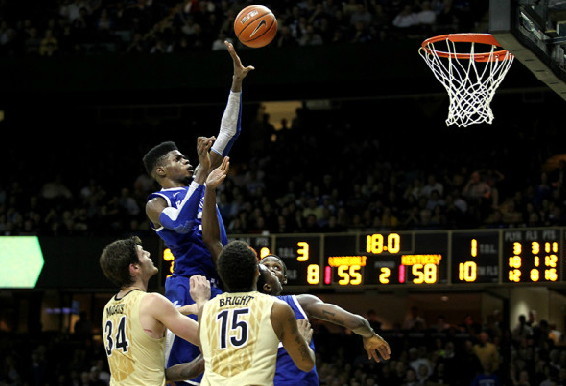
If anyone has the video and wants to revisit this, let me know. The key question is at what time on the game clock did the shot clock start and thus when was the shot clock supposed to expire?
Unfortunatley the way Vanderbilt set up their gym (and in particular their clocks), they didn't do themselves any favors. The other thing is I don't believe the referees could review the play even if had they wanted to, because the rules didn't allow for it.
IMO shot clock violations should always be reviewable (no matter when they occur during the game), shot clocks should always be in tenths of a second and as close to the goal as possible, and they should tie it in so that the light goes off on a shot clock violation, just like it does at the end of the regulation time.
Then they’re unable to control the outcome, hence why they won’t !!!What is hidden in the message is the admission of emotion and to an extent retaliation that went into the call. This makes for bad officiating 100% of the time. Complete lack of professionalism. This is why the NCAA needs to get out of the officiating business and place it into the hands of a third party with yet another party responsible for integrity.
I seem to recall these being mentioned. But I can't seem to recall Jarnell's NBA career.OT - This was the game in which Jarnell Stokes first dressed for the Vols.
Did you know he had size 18 shoes? Or that he had only practiced for 11 minutes or so before that game? Or that "he didn't even know how to stretch?" You do if you watched the game because Jimmy Dykes mentioned those facts about 70 times apiece.
Wow crazy..never would have guessed that.It's interesting to me that Cal has only won 41% of the games worked by Ayers, according to Jon Scott's site. A UK coach, especially Cal, having a losing record w/r/t a given referee is about as rare as UK having a losing record vs a specific other school. Pretty rare.
Then they’re unable to control the outcome, hence why they won’t !!!
Yeah... I wasn’t saying that for the NCAA benefit.

Least he admit it unlike roofereeGiving Ayers prop's is kinda like saying thank you to the devil for screwing you over..
GBB
^^^THIS!!!The insight into the pac 10 / 12 scandal tells me all I need to know and should you too. these people are given incentives from the top to make things happen like this. Ayers probably got a vacation for calling that tech.
But oh well........ UK has so many resources for money and love of basketball that we too could play that game ...maybe one day Barnhart's successor wont give a damn about other programs feelings and will play the game behind the game like every other big time program does.
THANK YOU for saying what I've been saying for years. No moneymaking college sport is immune to influences outside the programs. Whether it be Vegas, conference administrators, TV bigwigs and yes, AD's. Things ARE happening behind the scenes that would shock most all of us. College sports are far dirtier than the pro leagues. Easier to cheat.
I know this issue was discussed in detail at the time. I searched and couldn't find it however. From what I remember, one issue was that Vanderbilt did not place their shot clock right next to the goal but like everything Vanderbilt does, it has to be different, so they placed it off to the side. (And IIRC, it was said that for this game one of the shot clock displays wasn't even working.) Beyond that, the shot clock that was displaying the time had no decimal places, only to the full second, which opens up a whole nother can of worms in terms of how was the clock set up. (i.e. if tenths of a second aren't set up, does going from 1->0 mean you went from 1.0 -> 0.9 seconds or from 0.1 -> 0.0 seconds?)
From what I remember, the only clock that had tenths of seconds was the main clock along the side of the arena. The following photo shows that Noel had already released the ball by 18.0 seconds on the game clock. I don't remember exactly what the end of the shot clock was supposed to have been but I believe I remember from earlier discussions of this, that this was determined to have been released in time.
If anyone has the video and wants to revisit this, let me know. The key question is at what time on the game clock did the shot clock start and thus when was the shot clock supposed to expire?
Unfortunatley the way Vanderbilt set up their gym (and in particular their clocks), they didn't do themselves any favors. The other thing is I don't believe the referees could review the play even if had they wanted to, because the rules didn't allow for it.
IMO shot clock violations should always be reviewable (no matter when they occur during the game), shot clocks should always be in tenths of a second and as close to the goal as possible, and they should tie it in so that the light goes off on a shot clock violation, just like it does at the end of the regulation time.
I remember that conversation, or at least I think it was that one. Someone pointed out, and it made me feel like such an idiot, the shot clock shows the last whole number since they don't have tenths of a second. So when a player touches the ball, the clock will show, say, 5 seconds but it's actually anywhere between 4.1 and 5. It will show 1 second down to 0.1. When it it's 0, that's a true 0.0. The thing that made it click, was someone pointed out, and maybe it was the same person, that the clock appears to start late when a player 1st touches the ball, but it's actually already counting down the tenths of a second.
This may be obvious to a lot of people, but it was one of those things that escaped me my entire life up to that point (kind of like when I finally realized you can peel the package apart on those beef and cheese things, or beef sticks, instead of ripping them with your teeth).
I know this issue was discussed in detail at the time. I searched and couldn't find it however. From what I remember, one issue was that Vanderbilt did not place their shot clock right next to the goal but like everything Vanderbilt does, it has to be different, so they placed it off to the side. (And IIRC, it was said that for this game one of the shot clock displays wasn't even working.) Beyond that, the shot clock that was displaying the time had no decimal places, only to the full second, which opens up a whole nother can of worms in terms of how was the clock set up. (i.e. if tenths of a second aren't set up, does going from 1->0 mean you went from 1.0 -> 0.9 seconds or from 0.1 -> 0.0 seconds?)
From what I remember, the only clock that had tenths of seconds was the main clock along the side of the arena. The following photo shows that Noel had already released the ball by 18.0 seconds on the game clock. I don't remember exactly what the end of the shot clock was supposed to have been but I believe I remember from earlier discussions of this, that this was determined to have been released in time.
If anyone has the video and wants to revisit this, let me know. The key question is at what time on the game clock did the shot clock start and thus when was the shot clock supposed to expire?
Unfortunatley the way Vanderbilt set up their gym (and in particular their clocks), they didn't do themselves any favors. The other thing is I don't believe the referees could review the play even if had they wanted to, because the rules didn't allow for it.
IMO shot clock violations should always be reviewable (no matter when they occur during the game), shot clocks should always be in tenths of a second and as close to the goal as possible, and they should tie it in so that the light goes off on a shot clock violation, just like it does at the end of the regulation time.
Here's the video. It starts at about 58 seconds. It was most definitely a shot clock violation based on the clock (it doesn't go far enough back to show when the possession started). We also get to hear Bob Knight not even knowing what a shot clock is as a bonus.
I've ask this before, to no answer: When has Kentucky (under Cal) gotten one of those game-changing bad calls that helped us win? Kansas and Duke sure have gotten several.
I'll get blasted for saying this, but we got most of the calls in the Sweet 16 win over Louisville in 2014. And you know what? I don't feel the least bit sorry for them. Freaking Hancock spent more time trying to draw fouls than outplay anyone straight up, so he deserved to get no calls down the stretch of that game. And Harrell, karma was a *****, dude. When Poythress drove straight into Hancock, Hancock went flying and they swallowed their whistles, I was yelling "there you go, *****" at the TV screen.
I know this issue was discussed in detail at the time. I searched and couldn't find it however. From what I remember, one issue was that Vanderbilt did not place their shot clock right next to the goal but like everything Vanderbilt does, it has to be different, so they placed it off to the side. (And IIRC, it was said that for this game one of the shot clock displays wasn't even working.) Beyond that, the shot clock that was displaying the time had no decimal places, only to the full second, which opens up a whole nother can of worms in terms of how was the clock set up. (i.e. if tenths of a second aren't set up, does going from 1->0 mean you went from 1.0 -> 0.9 seconds or from 0.1 -> 0.0 seconds?)
From what I remember, the only clock that had tenths of seconds was the main clock along the side of the arena. The following photo shows that Noel had already released the ball by 18.0 seconds on the game clock. I don't remember exactly what the end of the shot clock was supposed to have been but I believe I remember from earlier discussions of this, that this was determined to have been released in time.
If anyone has the video and wants to revisit this, let me know. The key question is at what time on the game clock did the shot clock start and thus when was the shot clock supposed to expire?
Unfortunatley the way Vanderbilt set up their gym (and in particular their clocks), they didn't do themselves any favors. The other thing is I don't believe the referees could review the play even if had they wanted to, because the rules didn't allow for it.
IMO shot clock violations should always be reviewable (no matter when they occur during the game), shot clocks should always be in tenths of a second and as close to the goal as possible, and they should tie it in so that the light goes off on a shot clock violation, just like it does at the end of the regulation time.
And JP, thanks again for all of the info and work that you put into this.
I remember that conversation, or at least I think it was that one. Someone pointed out, and it made me feel like such an idiot, the shot clock shows the last whole number since they don't have tenths of a second. So when a player touches the ball, the clock will show, say, 5 seconds but it's actually anywhere between 4.1 and 5. It will show 1 second down to 0.1. When it it's 0, that's a true 0.0. The thing that made it click, was someone pointed out, and maybe it was the same person, that the clock appears to start late when a player 1st touches the ball, but it's actually already counting down the tenths of a second.
The thing about the clock is that the same can be said for when a clock is counting upwards. I.e. if you start at 0 seconds and start counting upwards, the digit doesn't change until you go from 0.9 to 1.0 seconds. (just like an analog odometer)
If it's counting downwards, then it doesn't operate the same way. For example you start at 30 seconds and it doesn't move to 29 seconds until you go from 29.1 to 29.0.
In other words if you're at 29.5 seconds with a clock that doesn't show tenths of a digit, the clock should show 29 seconds if it's counting up but show 30 seconds if it's counting down. So the clocks are not working in the same way. What I don't know is whether timers are automatically designed to switch from one mode to the other, or if there's some setting that needs to be manually set depending on whether the clock is counting up or down.
I agree that in principle when the clock counts down to 0, that it should mean there's no time remaining, however again that's assuming that's how the clock was set up to function that way.
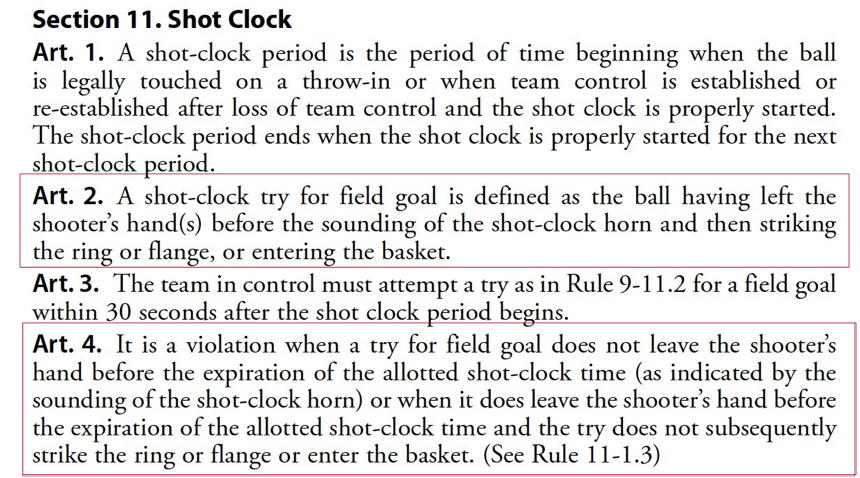
Regardless of the clock, the NCAA rule book actually throws a wrench into the whole thing because although they go into great detail about the shot clock and how it's supposed to be set up and operated, when it comes down to calling a violation, they don't seem rely on the clock, but instead on the horn, which (correct me if I'm wrong) is still manually sounded by the shot clock operator (i.e. it's not clear that the horn is tied to the clock and automatically sounds).
Article 3 below does mention the attempt needs to be made within the shot clock time (in this case 30 seconds, at the time of the Vandy game it was 35 seconds), but then Article 2 and 4 explicitly define it in relation to the horn.
In the Youtube Video, the view from the far endline clearly shows that the shot clock hit 0 when the game clock was at 18.3 seconds and Noel still had the ball. In my photo above the ball was clearly out of his hands by 18.0 seconds, so it was close.
The referees are listening for the horn, not necessarily looking at the shot clock. And as I mentioned Vanderbilt made it especially difficult because they put the clock down on the side and away from the goal and IIRC the other shot clock on the other goal wasn't even working that game, so the horn was the referee's best option.
Unfortunately, this also means that in the case of the 2015 UK-Wisconsin shot clock violation, the same argument could be made as to why the officials didn't call it (i.e. they can argue that they didn't hear the horn until after the shot clock had expired).
Last edited:
The thing about the clock is that the same can be said for when a clock is counting upwards. I.e. if you start at 0 seconds and start counting upwards, the digit doesn't change until you go from 0.9 to 1.0 seconds. (just like an analog odometer)
If it's counting downwards, then it doesn't operate the same way. For example you start at 30 seconds and it doesn't move to 29 seconds until you go from 29.1 to 29.0.
In other words if you're at 29.5 seconds with a clock that doesn't show tenths of a digit, the clock should show 29 seconds if it's counting up but show 30 seconds if it's counting down. So the clocks are not working in the same way. What I don't know is whether timers are automatically designed to switch from one mode to the other, or if there's some setting that needs to be manually set depending on whether the clock is counting up or down.
I agree that in principle when the clock counts down to 0, that it should mean there's no time remaining, however again that's assuming that's how the clock was set up to function that way.
Regardless of the clock, the NCAA rule book actually throws a wrench into the whole thing because although they go into great detail about the shot clock and how it's supposed to be set up and operated, when it comes down to calling a violation, they don't seem rely on the clock, but instead on the horn, which (correct me if I'm wrong) is still manually sounded by the shot clock operator (i.e. it's not clear that the horn is tied to the clock and automatically sounds).
Article 3 below does mention the attempt needs to be made within the shot clock time (in this case 30 seconds, at the time of the Vandy game it was 35 seconds), but then Article 2 and 4 explicitly define it in relation to the horn.
The referees are listening for the horn, not necessarily looking at the shot clock. And as I mentioned Vanderbilt made it especially difficult because they put the clock down on the side and away from the goal and IIRC the other shot clock on the other goal wasn't even working that game, so the horn was the referee's best option.
Unfortunately, this also means that in the case of the 2015 UK-Wisconsin shot clock violation, the same argument could be made as to why the officials didn't call it (i.e. they can argue that they didn't hear the horn until after the shot clock had expired).
Mind blown. I like the comparison to the clock counting up. To work the same, it would show 1 second at 0.1...
I guess by these rules, it wasn't a shot clock violation (which obviously, it wasn't called that way) if they thought it left his hand before the horn.
But this makes me wonder. Today, when they review a shot clock violation, do they listen for the horn to sound? Or just go off video of when the clock hits 0?
NCAA has zero to do with officials...IMO, its part of the problem. IF the NCAA would make officials , employee's", it would IMO make for a better product. Because then, guidelines could be set by the NCAA, and if those guidelines were not met, you could then be fired...Good example is MLB/NBA, etc, etc...Those officials are employee's. They are told how to call the games...If they do not follow protocol, they are out of a job. That doesn't exist in college. We are independent contractors, "hired" by an assigner, who then assigns us to games. We are hired by a conference....NOT the NCAA. They have nothing to do with the officiating..What is hidden in the message is the admission of emotion and to an extent retaliation that went into the call. This makes for bad officiating 100% of the time. Complete lack of professionalism. This is why the NCAA needs to get out of the officiating business and place it into the hands of a third party with yet another party responsible for integrity.
Depends...SOme shot clocks have their own "LED" lights, that differs from the gameclock ...SHot clock LED's are yellow...If that is available, you can use that...Or go by the horn. Shot clocks with tenths of a second is normally the only time we will use the clock...SO say we have a review....No LED lights, no tenths of a second...We have called the shot good. During the review, we cannot hear a horn, or its so vague, its hard to decipher...BUT the clock does say "0", before shot is out of his hands..Mot of the time, we will go with the call on the court(good basket), simply b/c zero's on the scoreboard never indicates a game is over----the horn/LED lights are used for this. So we cannot use it in this instance either...Mind blown. I like the comparison to the clock counting up. To work the same, it would show 1 second at 0.1...
I guess by these rules, it wasn't a shot clock violation (which obviously, it wasn't called that way) if they thought it left his hand before the horn.
But this makes me wonder. Today, when they review a shot clock violation, do they listen for the horn to sound? Or just go off video of when the clock hits 0?
It just varies......
Hell we still whipped their ***. This was in 2012.
2012? Lol I can't figure out why he's even bothering at this point.
Almost more satisfying to hear Laettner apologize to Aminu Timberlake 23 years after the fact.
NCAA has zero to do with officials...IMO, its part of the problem. IF the NCAA would make officials , employee's", it would IMO make for a better product. Because then, guidelines could be set by the NCAA, and if those guidelines were not met, you could then be fired...Good example is MLB/NBA, etc, etc...Those officials are employee's. They are told how to call the games...If they do not follow protocol, they are out of a job. That doesn't exist in college. We are independent contractors, "hired" by an assigner, who then assigns us to games. We are hired by a conference....NOT the NCAA. They have nothing to do with the officiating..
Bullcrap. Just because they don’t sign your check...
The NCAA is consortium of member institutions, aka universities who ultimately foot the bill. The conference’s are made up of these same member institutions. There is no completely independent audit function.
What I’m proposing is more more separation. Treating officiate like they were a loaf of bread. Independent assessment of their performance. Severe penalties for any evidence of bias or retribution. Much more intense training and simulation. Over all review for consistency between games and with games.
None of this exists.
I have worked college basketball for over 10 years....I am telling you, the NCAA has NO, NADDA, NONE, ZERO, beairng on officials....WE ARE IND. CONTRACTORS. We are hired by a conference...Not by the NCAA. Here is how it works:Bullcrap. Just because they don’t sign your check...
The NCAA is consortium of member institutions, aka universities who ultimately foot the bill. The conference’s are made up of these same member institutions. There is no completely independent audit function.
What I’m proposing is more more separation. Treating officiate like they were a loaf of bread. Independent assessment of their performance. Severe penalties for any evidence of bias or retribution. Much more intense training and simulation. Over all review for consistency between games and with games.
None of this exists.
1. Go to a camp/clinic...
2. You get approached by an assignor, tells you he liked to hire you...
3. You then pay your fee's and dues...
4. Said assignor then assigns you to games. If good enough, he may hire to work in the conference full-time. Meaning, you are now a conference official, thus making you a member of said conference.
Yes the NCAA will run a background check.....Yes the NCAA sets the rules, and how they would like these rules interpreted...
BUT NO, the NCAA does not have any authority to "fire" you, if you do not call a block the way its written in the book...
In other words, the NCAA has nothing to do with the officials....
But hey, you probably know more than I do, right...
I'll get blasted for saying this, but we got most of the calls in the Sweet 16 win over Louisville in 2014. And you know what? I don't feel the least bit sorry for them. Freaking Hancock spent more time trying to draw fouls than outplay anyone straight up, so he deserved to get no calls down the stretch of that game. And Harrell, karma was a *****, dude. When Poythress drove straight into Hancock, Hancock went flying and they swallowed their whistles, I was yelling "there you go, *****" at the TV screen.
I thought we got calls down the stretch of that game. Harrells last two fouls were a bit questionable imo. Andrew I think was pretty clearly out of bounds at one point, and the UofL center pretty clearly got fouled on a put back attempt with no call that would have put them up 9. But I wouldn’t say we got most of the calls the entire game.
Hancock was allowed to push off with impunity against the smaller James Young all game. Young wasn’t a very good defender anyways and had the added disadvantage that the officials just decided they werent calling push offs that game. Young fouling out is probably what won us the game because Hancock couldn’t do what he did to young against the bigger, stronger Poythress. Poythress pretty much ate hancocks lunch the rest of the way.
Then you have the center for UofL, Van Treese(?), that probably could have fouled out 3 times over if they called all of his fouls.
UofL got away with a ton that game too. I think that one pretty well evened out in the end just considering the Hancock bs alone netted them a massive advantage most of the game.
I have worked college basketball for over 10 years....I am telling you, the NCAA has NO, NADDA, NONE, ZERO, beairng on officials....WE ARE IND. CONTRACTORS. We are hired by a conference...Not by the NCAA. Here is how it works:
1. Go to a camp/clinic...
2. You get approached by an assignor, tells you he liked to hire you...
3. You then pay your fee's and dues...
4. Said assignor then assigns you to games. If good enough, he may hire to work in the conference full-time. Meaning, you are now a conference official, thus making you a member of said conference.
Yes the NCAA will run a background check.....Yes the NCAA sets the rules, and how they would like these rules interpreted...
BUT NO, the NCAA does not have any authority to "fire" you, if you do not call a block the way its written in the book...
In other words, the NCAA has nothing to do with the officials....
But hey, you probably know more than I do, right...
The money comes from member institutions, aka the NCAA. I get the NCAA doesn’t write your check. That said, I have had many independent contractors work for me. I didn’t pay their salary, but trust me I knew where their loyalties were.
When’s the last time you were evaluated by someone completely independent of your employer, their employer, or the holder of your employers contract, etc?
Latest
-
01
 KSR Basketball Recruiting
Visit Primer: 5-star PF CJ Rosser arrives for Big Blue Madness
KSR Basketball Recruiting
Visit Primer: 5-star PF CJ Rosser arrives for Big Blue Madness
-
02
 KSR Basketball
UK announces details for Saturday's post-Big Blue Madness Fan Fest event
KSR Basketball
UK announces details for Saturday's post-Big Blue Madness Fan Fest event
-
03
 KSR Football
KSR Explains the Strange History of the Kentucky-South Carolina Rivlary
KSR Football
KSR Explains the Strange History of the Kentucky-South Carolina Rivlary
-
04
 KSR Volleyball
Kentucky VB to participate in AVCA Match Point, an elite two-day championship in Louisville
KSR Volleyball
Kentucky VB to participate in AVCA Match Point, an elite two-day championship in Louisville
-
05
 KSR Football
SEC Availability Report: LB Tavion Wallace listed as questionable vs. South Carolina
KSR Football
SEC Availability Report: LB Tavion Wallace listed as questionable vs. South Carolina