Cincy
- Thread starter lawpoke87
- Start date
You are using an out of date browser. It may not display this or other websites correctly.
You should upgrade or use an alternative browser.
You should upgrade or use an alternative browser.

And the right refs. ACC refs won’t let them play that way, neither will PAC-12 refs. You’d probably get away with it with Big East, B1G, Big XII refs. Those conferences all tend to play pretty physically.They don't have the nonconference resume to get a 1 seed. But they've got a shot at the Final 4 with the right draw.
Temple had them down 5 points and had the ball with three minutes to go at Temple and lost to Cincy mainly due to an inadvertent technical foul for a water bottle . Cincy can be horrible at times.
They don't play many bad games. They've won every conference game by double digits except for that game at Temple. No other conference team comes close to that margin. Looking forward to their matchups with WSU.
WSU is going to be surprised by how physical Cincy is. WSU likes to play physical down low but Shamet and Frankamp will not like the way Cincy’s guards are in their face and bodying up, even 25ft from the basket. This will be the toughest thing WSU has to adjust to in the AAC as there’s not a team in the MVC close to Cincy’s level of play or physicalityTemple had them down 5 points and had the ball with three minutes to go at Temple and lost to Cincy mainly due to an inadvertent technical foul for a water bottle . Cincy can be horrible at times.
They don't play many bad games. They've won every conference game by double digits except for that game at Temple. No other conference team comes close to that margin. Looking forward to their matchups with WSU.
Cincy will lose at Houston. Everybody will lose there at Texas Southern Court.

Cinci doesn't "get away" with being physical as much as they beat the system (and refs) into submission. It's a well known that statistically fouls are called far closer to even than an unbiased called game should result in (particularly if you take away skewed data from end of game intentional fouling). And you can measure the likelihood of the next foul based on who the previous fouls were called on, what the total "count" is, and who the home team is.
This means in the aggregate there is little penalty to being a more physical team. The stats say you will not be punished as much as you should be. So if the other team fails to adjust the style of play - you have a huge advantage.
Additionally, other studies have look at "setting the tone" of the game. If you start off physical a few calls might be called early, but it isn't long before the refs get tired of calling fouls and want to let the game "flow," or the urge to keep fouls even kicks in. It's the same reason why a guy who constantly carries, travels, or sits in the lane for 25 seconds doesn't just get called over and over and over.
The NCAA tournament may seem more physical because more physical teams often make the tournament and know how to use the system to their advantage, that and refs wanting to "stay out of the way" at important moments and in big games.
Really dry (but interesting!) statistical paper on the subject:
http://home.kelley.iupui.edu/kyjander/Officiating paper - Final draft version.pdf
This means in the aggregate there is little penalty to being a more physical team. The stats say you will not be punished as much as you should be. So if the other team fails to adjust the style of play - you have a huge advantage.
Additionally, other studies have look at "setting the tone" of the game. If you start off physical a few calls might be called early, but it isn't long before the refs get tired of calling fouls and want to let the game "flow," or the urge to keep fouls even kicks in. It's the same reason why a guy who constantly carries, travels, or sits in the lane for 25 seconds doesn't just get called over and over and over.
The NCAA tournament may seem more physical because more physical teams often make the tournament and know how to use the system to their advantage, that and refs wanting to "stay out of the way" at important moments and in big games.
Really dry (but interesting!) statistical paper on the subject:
http://home.kelley.iupui.edu/kyjander/Officiating paper - Final draft version.pdf
This study examines the pattern of foul calls exhibited during 365 NCAA basketball games during the 2004-2005 season. Results of the analysis indicate that officials are more likely to call fouls on the team with the fewest fouls, making it likely that the number of fouls will tend to even out during the game. This increased probability increases as the foul differential increases. In addition, there is a significant bias toward officials calling more fouls on the visiting team, and a bias toward foul calls on the team that is leading in score. The result is that the probability of the next foul being called on the visiting team can reach as high as .70 during some game circumstances. Finally, implications of this officiating bias are explored, including the fact that basketball teams have an incentive to play more aggressively, leading to more physical play over time.

We seem to get the refs that never get tired of calling fouls.
There was a sequence yesterday where Clark grabbed a rebound and his hands were a good 18”-24” higher than anyone around him. He can really jump, he has really strong hands. He actually reminds me a bunch of Michael Ruffin in that way. He of course is a bit more versatile than Ruffin was offensively. His leaping ability reminds me of KJ because he not only can get off the ground quickly, he also gets superb elevation.Gary Clark can play a badass geetar. The fact he plays for Cinci is just icing on the cake. But yes, I too, would like to see that game
Cincy’s weakness is which Evans shows up? Which Washington? I figured Washington to be a POY candidate this year in the AAC. He looked awful yesterday. Couple of airballs, seemed lost on D at times.
Cincy plays the type of defense that they can make a deep run. Which offense shows up for them will be the question
Held UCF to 13 pts in the 1st half tonight. 13 minutes left, UCF still only has 20 points.
On Saturday, held UCONN to 21 pts in the 1st half. Ridiculous how good defensively they are. In watching more closely, they are really good in their defensive principles and fundamentals. Their footwork and defensive posture to a man are textbook. They move their feet extremely well. I pointed this out to my son so he would see how he needed to move his feet defensively (he picked up 4 fouls in the 1st half a couple weeks ago <LOL>).
When you see how well they move their feet you understand why their games seem to be so much of a grind for the opposition. There’s just no space to move
On Saturday, held UCONN to 21 pts in the 1st half. Ridiculous how good defensively they are. In watching more closely, they are really good in their defensive principles and fundamentals. Their footwork and defensive posture to a man are textbook. They move their feet extremely well. I pointed this out to my son so he would see how he needed to move his feet defensively (he picked up 4 fouls in the 1st half a couple weeks ago <LOL>).
When you see how well they move their feet you understand why their games seem to be so much of a grind for the opposition. There’s just no space to move
I’m anxious to see them go into Texas Southern and play. No one has won there yet on the road.
I’m anxious to see them go into Texas Southern and play. No one has won there yet on the road.
If that wasn't a 6pm tip, would be an interesting game to meander to.
No one else in the AAC plays defense like Cincinnati. Evans on Gray will be an interesting matchup (I'm assuming Evans will get the duty of locking Gray down). Plus Houston is garbage on the interior. I expect Cincinnati to out rebound Houston by 15+ with 15+ offensive rebounds. Cincinnati is not going to outshoot anyone, they're going to do their damage with the 2nd chance garbage points off of offensive boards.I’m anxious to see them go into Texas Southern and play. No one has won there yet on the road.
Houston (on the road) gave Cincy all they wanted a couple of weeks ago.
I expect a Cougar win in the rematch.
I expect a Cougar win in the rematch.
I’d like to see Mike Davis coach at Cincinnati. I can’t think of a school, fan base, and coach who would get along better. Maybe Hines could then become the beat writer.
Latest
-
01
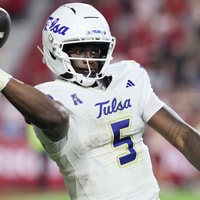 Inside Tulsa Sports Football
Tulsa offense sputters in loss at Arkansas
Inside Tulsa Sports Football
Tulsa offense sputters in loss at Arkansas
-
02
 On3 Football
College Football Injury Report: Latest Week 4 updates at Texas, Ole Miss, Florida & more
On3 Football
College Football Injury Report: Latest Week 4 updates at Texas, Ole Miss, Florida & more
-
03
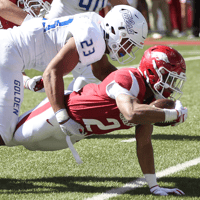 Inside Tulsa Sports Football
Tulsa at Arkansas: History, Rivalry and Bad Blood
Inside Tulsa Sports Football
Tulsa at Arkansas: History, Rivalry and Bad Blood
-
04
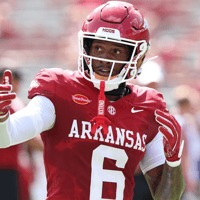 Inside Tulsa Sports Football
Tre Lamb warns Tulsa defense: 'Number six is a real problem'
Inside Tulsa Sports Football
Tre Lamb warns Tulsa defense: 'Number six is a real problem'
-
05
 Inside Tulsa Sports Basketball
Former Tulsa guard Miles Barnstable added to Spurs training camp roster
Inside Tulsa Sports Basketball
Former Tulsa guard Miles Barnstable added to Spurs training camp roster