Rex Chapman: Mac McClung walks when he dunks
- Thread starter akaukswoosh
- Start date
You are using an out of date browser. It may not display this or other websites correctly.
You should upgrade or use an alternative browser.
You should upgrade or use an alternative browser.
He’s not wrong. McClung picks up the ball and then takes three steps pretty clearly.


He’s not wrong. McClung picks up the ball and then takes three steps pretty clearly.
Optometrist..... Find one.
It looks like it the first showing but when they show it again, it doesn't look like he does. I see more walks with players posting up under the basket than breakaways.
It looks like it the first showing but when they show it again, it doesn't look like he does. I see more walks with players posting up under the basket than breakaways.
I see guys walk catching the ball on the perimeter quite often. They will change their pivot foot 3 times.
I've often complained about the refs letting players take a bunny hop after catching the ball before shooting (usually a 3 point shot) and call walking way too many times when a player tries to make a jab step of some kind of fake before taking off with the ball.

That’s a travel. He gathers with his right foot planted. Right foot becomes the pivot foot. He then steps with his left, and then with his right (moving pivot foot), before gathering again and jumping off of two feet.
ETA: I shouldn’t say he gathered again...rather that he went into his upward motion.
Also, I believe this is a legal play in the NBA because of their gather provision. It’s what James Harden does so well when he looks like he’s getting away with a walk.
AFAIK, the rule is still different in the NCAA. If anyone knows better, let me know.
ETA: I shouldn’t say he gathered again...rather that he went into his upward motion.
Also, I believe this is a legal play in the NBA because of their gather provision. It’s what James Harden does so well when he looks like he’s getting away with a walk.
AFAIK, the rule is still different in the NCAA. If anyone knows better, let me know.
Last edited:
"Gimme 3 steps, gimme 3 steps mister and you'll never see me no more".
That will never be called a walk but Refs seem to call it on EVERY head fake our kids use on a 3 pt jumpshot.
That will never be called a walk but Refs seem to call it on EVERY head fake our kids use on a 3 pt jumpshot.

Well, I think that might've been called in past eras. Palming (is it ever called anymore?) and walks on breakaways are two areas where officiating has gotten FAR more lax in recent years.
But it was not a blatantly obvious walk like Rex makes it sound. It was borderline, the type that is routinely let go nowadays.
But it was not a blatantly obvious walk like Rex makes it sound. It was borderline, the type that is routinely let go nowadays.
Last edited:

Definitely not a walk. Poor Rex. Needs attention. Maybe he needs to go back to Best Buy and steal a few more items.
Seems like he should direct his attention to how often almost every player carries and or palms the ball these days. on a breakaway like that it was borderline a walk, that's a good no call, but how often do we see players these days walking up the court putting their hand on the bottom of the ball and turning it over with their dribble, also the stutter step, put the ball on the hip hesitation fake mid dribble, that's carrying the ball plain and simple, but they've seemed to stop enforcing that rule altogether. Most of those players get credit and accolades for faking somebody out of their shorts when they actually break a rule doing it that never gets enforced anymore.
I've often complained about the refs letting players take a bunny hop after catching the ball before shooting (usually a 3 point shot) and call walking way too many times when a player tries to make a jab step of some kind of fake before taking off with the ball.
Yep. Plus the dunk set ups. Plus the evolution of the jump stop (which now includes being able to pivot after).
But somehow refs get Lazer vision when it comes to jab steps. It's just another way refs get to show off and overly influence a game.
It was a walk and pretty obvious too. Any ref worth their salt would have and should have called it.
Seems like he should direct his attention to how often almost every player carries and or palms the ball these days. on a breakaway like that it was borderline a walk, that's a good no call, but how often do we see players these days walking up the court putting their hand on the bottom of the ball and turning it over with their dribble, also the stutter step, put the ball on the hip hesitation fake mid dribble, that's carrying the ball plain and simple, but they've seemed to stop enforcing that rule altogether. Most of those players get credit and accolades for faking somebody out of their shorts when they actually break a rule doing it that never gets enforced anymore.
Seriously. They need to either get rid of the palming rule or start calling it. But it's silly to have a rule that today's officials have seemingly decided they're just never gonna call even when it's glaringly obvious.
Last edited:
Below is the traveling rule according to the NCAA rules. The one in bold never gets called anymore.
Section 72. Traveling[1]
Art. 1. A player who catches the ball with both feet on the playing court may pivot, using either foot.
Art. 2. A player who catches the ball while moving or dribbling may stop and establish a pivot foot as follows:
a. When both feet are off the playing court and the player lands:
1. Simultaneously on both feet, either may be the pivot foot;
2. On one foot followed by the other, the first foot to touch shall be the pivot foot;
3. On one foot, the player may jump off that foot and simultaneously land on both; neither foot can be the pivot foot.
b. When one foot is on the playing court:
1. That foot shall be the pivot foot when the other foot touches in a step;
2. The player may jump off that foot and simultaneously land on both; neither foot can then be the pivot foot.
Art. 3. After coming to a stop and establishing the pivot foot:
a. The pivot foot may be lifted, but not returned to the playing court, before the ball is released on a pass or try for goal;64 Rule 4 / definitions
b. The pivot foot shall not be lifted before the ball is released to start a dribble.
Art. 4. After coming to a stop when neither foot can be the pivot foot:
a. One or both feet may be lifted, but may not be returned to the playing court, before the ball is released on a pass or try for goal;
b. Neither foot shall be lifted, before the ball is released, to start a dribble.
Art. 5. It is traveling when a player falls to the playing court while holding the ball without maintaining a pivot foot.
Section 72. Traveling[1]
Art. 1. A player who catches the ball with both feet on the playing court may pivot, using either foot.
Art. 2. A player who catches the ball while moving or dribbling may stop and establish a pivot foot as follows:
a. When both feet are off the playing court and the player lands:
1. Simultaneously on both feet, either may be the pivot foot;
2. On one foot followed by the other, the first foot to touch shall be the pivot foot;
3. On one foot, the player may jump off that foot and simultaneously land on both; neither foot can be the pivot foot.
b. When one foot is on the playing court:
1. That foot shall be the pivot foot when the other foot touches in a step;
2. The player may jump off that foot and simultaneously land on both; neither foot can then be the pivot foot.
Art. 3. After coming to a stop and establishing the pivot foot:
a. The pivot foot may be lifted, but not returned to the playing court, before the ball is released on a pass or try for goal;64 Rule 4 / definitions
b. The pivot foot shall not be lifted before the ball is released to start a dribble.
Art. 4. After coming to a stop when neither foot can be the pivot foot:
a. One or both feet may be lifted, but may not be returned to the playing court, before the ball is released on a pass or try for goal;
b. Neither foot shall be lifted, before the ball is released, to start a dribble.
Art. 5. It is traveling when a player falls to the playing court while holding the ball without maintaining a pivot foot.
True.Seriously. They need to either get rid of the palming rule or start calling it. But it's silly to have a rule that today's officials have seemingly decided they're just never gonna call even when it's glaringly obvious.
Yeah seen much worse and didnt' really see one at all here.No
Seriously, some of the walks and this.
The problem with todays game that allows so many borderline walks is the line has been blurred as to when the pivot foot has been established.
In the old days when you had to dribble with your hand on top of the ball (making it almost impossible to cup it) you had to set you pivot foot the same time you picked the ball up and it was clear from there that you only got one more step to plant and jump off the other foot.
In todays game the ball is cupped and essentially carried so much a player going for a layup can take two easy steps just in the process of "picking up their dribble". The ball can rest inside the hand for a long time until they plant their lift off foot so it's hard to say definitively when they really established their pivot foot.
The whole Euro Step is an example of this.

It’s a walk for sure but not sure what the hubbub is. It’s not like he was the only person that does it. That NEVER gets called.
Now that blatant move where a guy head fakes without moving his pivot foot at all and starts dribbling literally without taking a single step, THAT needs to be called more often.
Now that blatant move where a guy head fakes without moving his pivot foot at all and starts dribbling literally without taking a single step, THAT needs to be called more often.
Yeah, I've seen way worse than that...including by Diallo a couple times last year.Well, I think that might've been called in past eras. Palming (is it ever called anymore?) and walks on breakaways are two areas where officiating has gotten FAR more lax in recent years.
But it was not a blatantly obvious walk like Rex makes it sound. It was borderline, the type that is routinely let go nowadays.
That's clearly a walk. 3rd maybe 4th step came the jump. But it's let go more often than not these days. Even worse are the strolls guys take before getting off a three these days. The missed 3 by Damion Lee (UL) that could have beat us a couple years ago, dude took like four steps before going up for shot. It's the James Harden effect.
Who will be the first LeBron fan to deny this is a travel? Rex would.
he legit took 5 steps!!

If you call that a walk then you gotta call any jumpstop/gather or eurostep a walk too. That’s tickytack and shows a little jealousy IMO. Every two foot power jumper does that. Any time Zion goes off two feet on the break he does the same exact thing. Not a walk to me.
Latest
-
01
 KSR Football
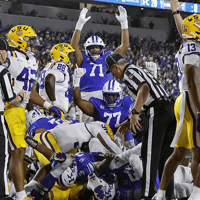
FEBU: The Kentucky Motto Driving the Wildcats to Defy Doubters
KSR Football
FEBU: The Kentucky Motto Driving the Wildcats to Defy Doubters
-
02
 KSR Football
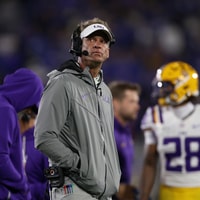
Lane Kiffin talked himself out of fourth down attempt to ice the game in loss to Kentucky
KSR Football
Lane Kiffin talked himself out of fourth down attempt to ice the game in loss to Kentucky
-
03
 KSR Football
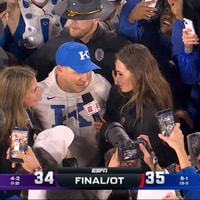
Will Stein dedicates Kentucky's win over LSU to the fans: 'This was for Big Blue Nation'
KSR Football
Will Stein dedicates Kentucky's win over LSU to the fans: 'This was for Big Blue Nation'
-
04
 KSR Football
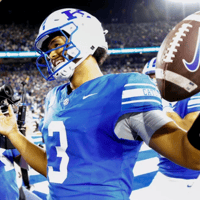
Déjà Vu? Kenny Minchey Breaks Down the Game-Winning Two-Point Play
KSR Football
Déjà Vu? Kenny Minchey Breaks Down the Game-Winning Two-Point Play
-
05
 KSR Football
Rapid Reaction: An All-Time Night as Kentucky Topples LSU in Overtime
KSR Football
Rapid Reaction: An All-Time Night as Kentucky Topples LSU in Overtime